
Closed-Loop Physical AI: Close the Gap Between Plan and Plant
Your plan is optimal once a week. Your plant runs every minute in between.
Your plan is optimal once a week.
Your plant runs every minute in between.
Imubit is the only Closed-Loop Physical AI platform built to take selected, high-value operating decisions from process modeling to autonomous control. With 100+ deployed closed-loop applications worldwide, Imubit has the industry’s largest install base. Process engineers model causality,not correlation, so they can understand what a specific operating change will cause, not simply what has moved together in the past. They then deploy validated controllers that write setpoints to live process units within configured constraints and under operator supervision.
Many industrial AI tools hand insights to someone else to act on. Imubit moves validated decisions into supervised, closed-loop execution, closing the gap between plan and plant.
See where your operation sits on the path to autonomous operations. Take the 2-Minute Readiness Index. Evaluate the opportunity using your plant data. Request an AI Assessment.
See where your operation sits on the path to autonomous operations.
Take the 2-Minute Readiness Index
What is Closed-Loop Physical AI?
Closed-Loop Physical AI is an industrial AI approach that models cause-and-effect relationships in a live physical process and turns validated models into supervised control actions for selected operating decisions. The loop connects process data, a causal model, a control decision, a setpoint, and a measured outcome. It is designed for nonlinear, constraint-limited process operations.
The plan-to-plant gap
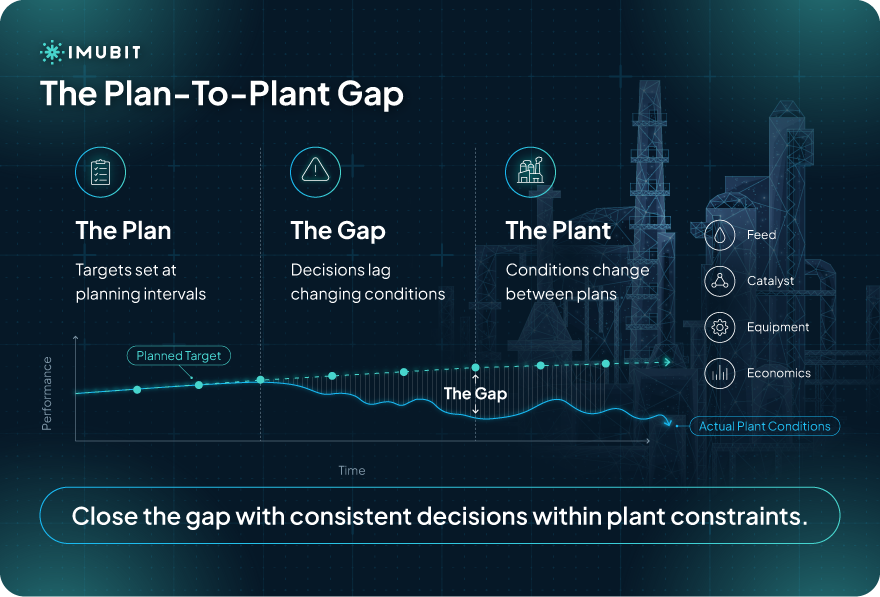
Every plant operates against plans and objectives for safety, reliability, margin, compliance, and workforce competency. In many process plants, linear programming (LP) planning models are refreshed at discrete intervals,while advanced process control (APC) helps hold units near assigned targets between planning cycles. Meanwhile,feed properties change, catalysts age, equipment performance shifts, and market economics move. The gap between what the plan assumes and what the plant is actually doing can quickly widen.
The cause is structural. Those gaps trace back to the same recurring operating decisions: how throughput, quality,reliability, and cost get balanced against the plant's real limits, made by different people on different shifts with different information. A large share of your margin is decided in exactly those moments. Today that decision-making lives in operators' heads, spreadsheets, and separate teams, so when decisions are made in isolation, their interactions stay hidden until the value is already lost.
Closing the gap requires more than identifying it. It requires executing the operating decisions that create or reducethe gap consistently and within the plant’s actual constraints.
Why correlation-based AI can't close it
Many analytics and advisory tools identify patterns in historical data. Those patterns can support prediction and recommendation, but correlation alone does not establish how a proposed control action will affect a live process under changing conditions. Closed-loop control requires a model that represents how changes to controllable variables are expected to affect outcomes across operating regimes and constraints.
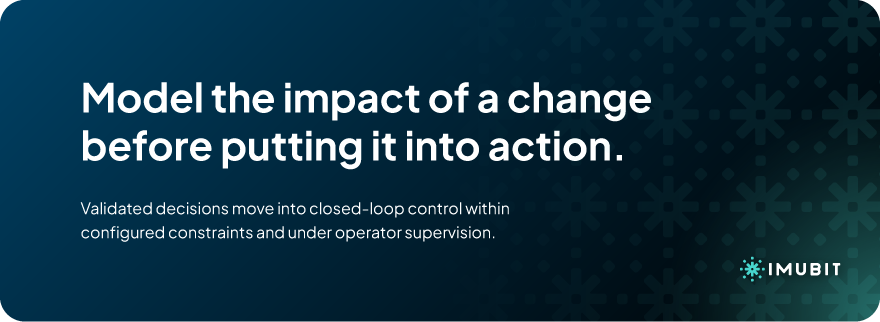
Process units often behave nonlinearly and over time. In hydrocracking, for example, catalyst age, feed properties,reaction severity, and product economics interact, so an optimum identified for one operating regime may not hold in the next. The objective is also rarely to maximize one variable in isolation. Depending on market conditions, a lower-conversion operating point that favors diesel over naphtha may be more valuable. Closed-Loop Physical AI evaluates those tradeoffs as conditions change.The plain version is this: see the result of a change before you make it. An advisory tool guesses from history. Closed-Loop Physical AI models relationships so validated decisions can progress from analysis to supervised execution.
The plain version is this: see the result of a change before you make it. An advisory tool guesses from history. Closed-Loop Physical AI models relationships so validated decisions can progress from analysis to supervised execution.
What "Physical" means in Closed-Loop Physical AI
Closed-Loop Physical AI acts on a live industrial process. Its loop connects process data, causal models, control decisions, and measured outcomes within mass and energy balances, operating constraints, and operator supervision. Here, “Physical” refers to direct interaction with process equipment and control systems, rather than a loop confined to digital workflows.
Imubit writes setpoints to the control system through deterministic controllers that operate within explicitly configured constraints and under operator supervision. The platform integrates with distributed control system (DCS)and advanced process control (APC) environments without replacing the underlying control architecture or operator authority. ARC Advisory Group describes this operating model as human-on-the-loop: the AI executes within defined limits, while the operator supervises and retains authority to intervene.
How Closed-Loop Physical AI works:
Map, Model, Control
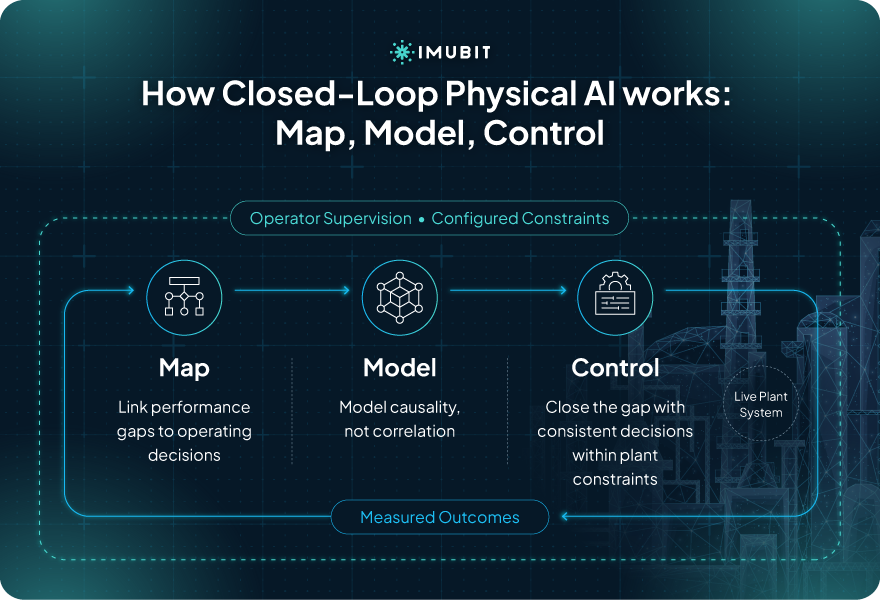

Map: Trace gaps to decisions
Imubit analyzes planning objectives alongside relevant process data and plant configuration, ranks plan-to-plant gaps by impact and recurrence, and links each gap to the recurring decisions and disturbances behind it. The result is a clear map from objectives and constraints to decisions,disturbances, and measured outcomes.

Model: Capture the causality behind each decision
Process engineers build nonlinear, dynamic AI process models from their own historical data, guided by first principles and with visibility into the learned relationships. The models capture causality, not correlation, linking decisions and disturbances to outcomes. No Python or machine-learning expertise is required. Because process engineers build, evaluate, and maintain the models, the capability compoundsinside the organization.

Control: Put key decisions in closed loop
Validated models can extend into closed-loop execution. Reinforcement learning across process regimestrains a deterministic controller to steer selected decisions toward defined objectives within explicit constraints. In production, the controller evaluates live conditions on a recurring cadence and writes setpoints to the control system under operator supervision. Gaps are measured continuously against theplan, and models can be retrained as plant conditions change.
When Closed-Loop Physical AI is a fit
Closed-Loop Physical AI is most relevant when high-value operating decisions recur frequently, involve nonlinear tradeoffs, and must adapt as conditions change. Strong candidates typically have:
A measurable gap between planning targets and actual performance
Repeated manual adjustments across shifts
Sufficient historical process data and a defined control scope
Clear objectives, constraints, and accountable engineering and operations owners
A use case where sustained execution matters more than one-time insight
Proof from production deployments
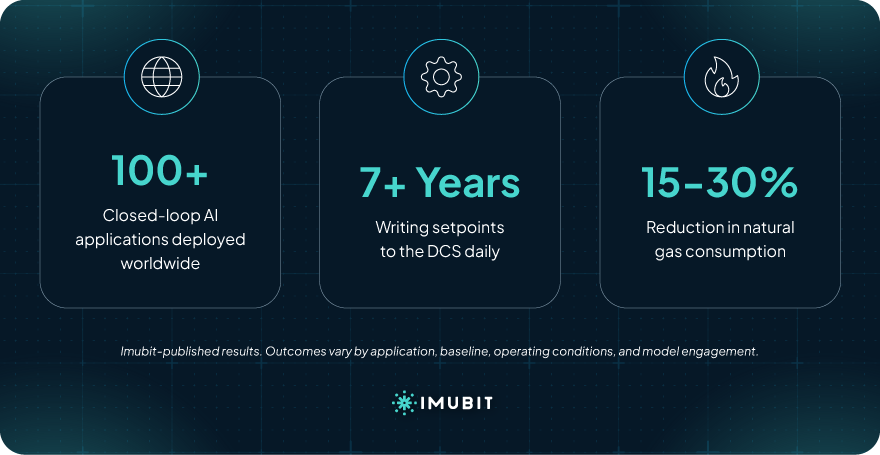
Imubit-published deployment results include the following. Outcomes vary by application, baseline, operatingconditions, and model engagement.

Deployment experience
100+ closed-loop AI applications deployed worldwide (largest install base in the industry)
7+ years writing to the DCS daily

Selected published outcomes
15 to 30% reduction in natural gas consumption
$0.25/bbl margin improvement
1 to 3% average yield improvement

Mining, minerals, and metals outcomes
13 U.S. patents
1 to 3% average improvement in metal recovery
5 to 10% savings in grinding energy
5 to 12 to 5% average increase in throughput 0% savings in grinding energy
Imubit customers include Oxbow (SmartKiln® petcoke calcination) and Preem, among others across refining,chemicals, and materials. ARC Advisory Group has separately named Imubit the leader in its Closed Loop AI Optimization category.

Close the gap
You do not have to close every gap at once. Start by seeing where your operation sits today,from reactive firefighting to running your highest-value decisions in a closed loop.
See where your operation sits on the path to autonomous operations. Evaluate the opportunity using your plant data.
Frequently asked questions about Closed-Loop Physical AI
What is Closed-Loop Physical AI?
Closed-Loop Physical AI is industrial AI that models causality, not correlation, and executes selected control actions on a live physical process within defined constraints and under operator supervision. It closes the loop from process data to decision to setpoint to measured outcome.
How is it different from agentic or LLM AI in industrials?
LLMs and software agents generally interpret information, generate content, or coordinate digital tasks. Closed-Loop Physical AI is designed to model and execute selected control actions on a live physical process within explicit operating constraints and under operator supervision. The approaches can be complementary, but they serve different functions.
What does “autonomous” mean in Closed-Loop Physical AI?
Autonomous means that validated controllers can execute selected control actions without requiring a person to make each adjustment. The scope remains bounded by configured constraints, operator supervision, and the plant’s existing control architecture.
What's the difference between causality and correlation in process control?
Correlation shows variables that moved together in historical data. Causal modeling estimates how a deliberate change to a controllable variable is expected to affect process outcomes while accounting for dynamics, disturbances, and constraints. That distinction matters when a model moves from advice to control.
Does Imubit replace my APC or control systems?
No. Imubit integrates with existing distributed control system (DCS) and advanced process control (APC) environments and can use planning objectives as inputs. It extends the current control architecture by executing selected optimization decisions in closed loop rather than replacing the underlying systems.
How is autonomous closed-loop control governed in an operational technology environment?
Governance depends on the complete control architecture, validation procedures, explicit constraints, and operator authority, not determinism alone. Imubit scopes automation to selected control actions, operates within configured limits, and preserves operator supervision and control authority.
Do my engineers need to be data scientists?
No. Imubit is designed so process engineers can build, evaluate, and retrain models using plant data without Python or machine-learning expertise.
What production experience does Imubit have?
Imubit reports 100+ deployed closed-loop applications worldwide and 7+ years of model engagement. Published customer evidence includes Oxbow’s SmartKiln® deployment and Preem’s customer statement.
Resources Slider Module: Recommended For You