
Model the cause and effect behind every decision
Imubit models how each decision moves each outcome, with first principles built in, learned from the unit's own history, in models your engineers build and own.
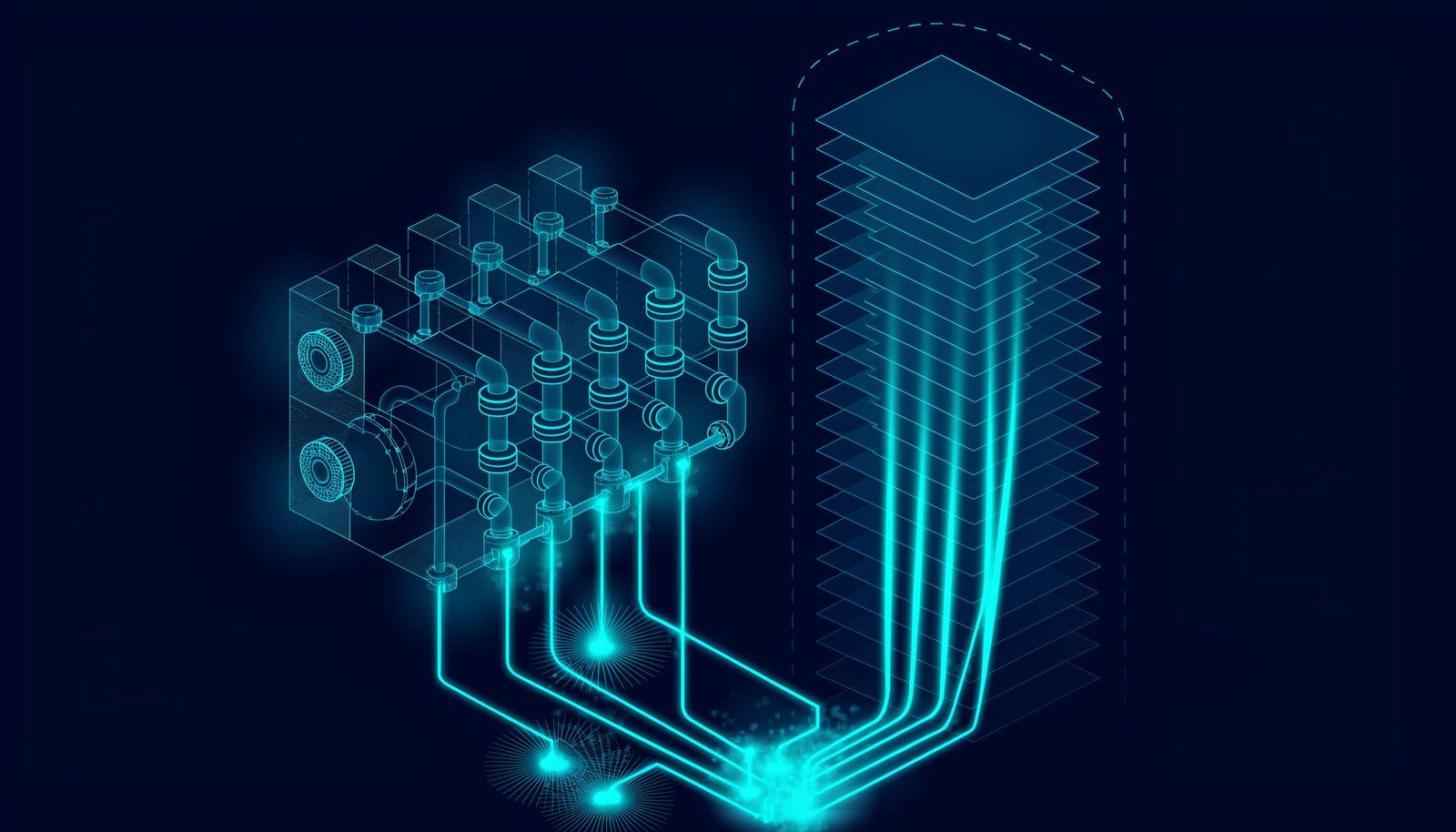
How each decision moves each outcome, against its objective and its limits.
Plant behavior is nonlinear and changes over time, and plant data has gaps.
A first-principles or kinetic model is tuned on cleaned, averaged data. It starts from an average plant, and the averaging smooths away how the unit responds minute by minute.
Imubit's learning process models use both. First principles are built in, and every relationship is visible, causal and deterministic.
A Deep Learning Predictor learns each unit's real dynamics from years of its own data, selected by your engineers.
With DLPC® Builder, process engineers build models of their own units, without Python.
Watch the introduction 1:36
Read the transcript
Model is the cause and effect behind the map. It shows how each decision moves each outcome, against its objective and its constraints. These relationships are nonlinear and dynamic. They change over time, and plant data is never complete, so data alone is not enough.
First principles matter, but on their own they fall short too. A first-principles or kinetic model is tuned on cleaned, averaged data, so it starts from an average plant, not the plant you run. And the averaging smooths away the dynamics, how the unit really responds minute by minute. Imubit's learning process models use both.
First principles are built in, and nothing sits in a black box. Every relationship is visible, causal rather than correlated, and deterministic. A Deep Learning Predictor learns each unit's real dynamics from years of its own data, selected by your engineers. And with DLPC® Builder, your process engineers build models of their own units, without Python or a machine-learning background.
Your engineers can make their own models and create their own competitive advantage.
Watch a model built, step by step 2:04
Map shows where your plant loses value. Model is how you start to close those gaps, with a model of each unit behind them. The example here is a flotation unit at a mineral concentrator. The same steps build a model of any unit in the process industries, such as an FCC in a refinery, a reactor in a chemical plant, a cement kiln or a furnace.
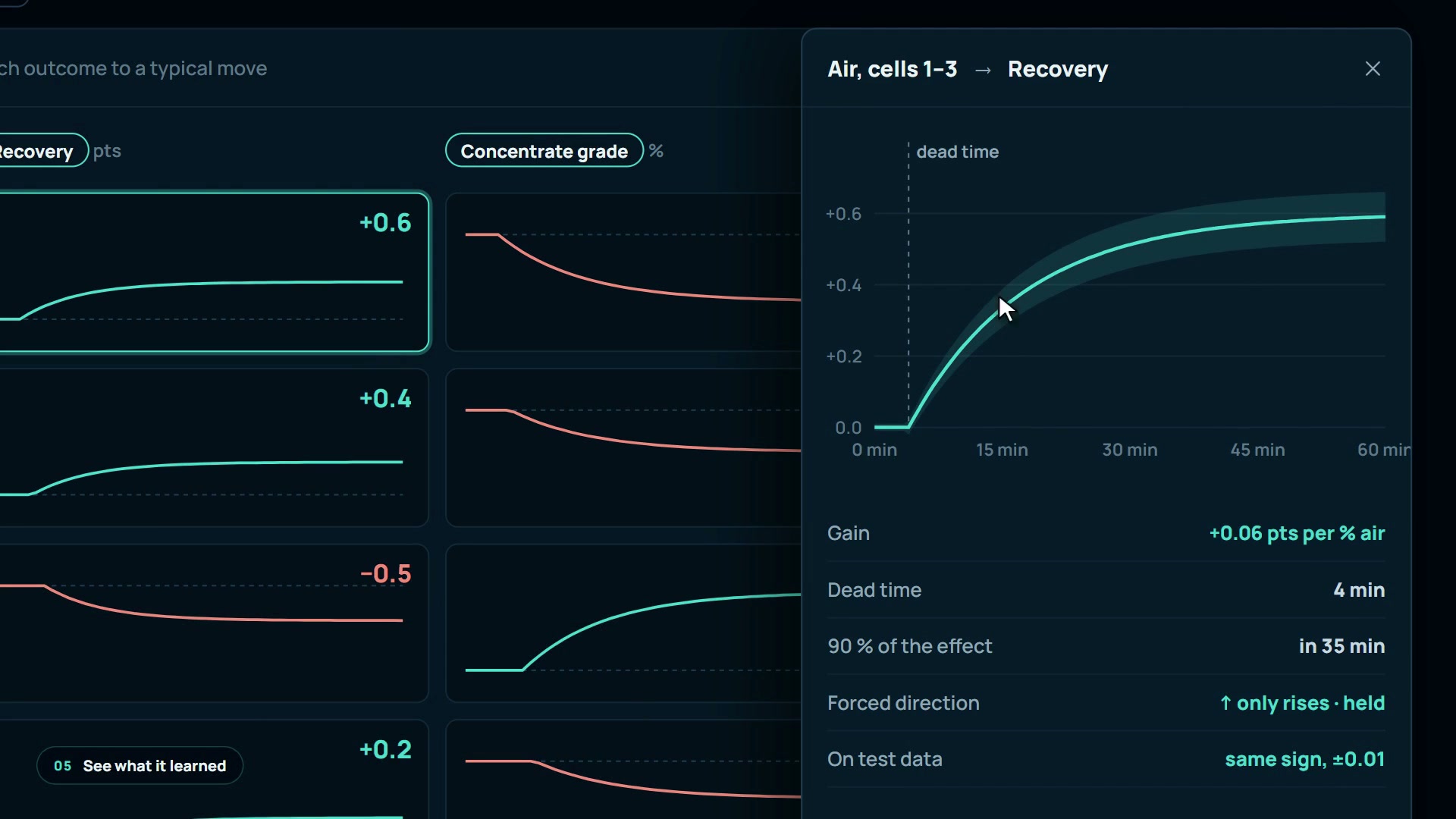
Illustrative screens on a sample concentrator, with sample data.
Read the transcript
This is how a model is built with Imubit, step by step, shown on a sample unit. Imubit's engineers build it with your team. It starts from the map. The map has already shown where the plant loses value.
From there, you choose what the model advises on, what it predicts, and what it learns around. The model learns from the plant's own history. Stops, maintenance and a stuck meter are left out. Four months are held back for testing.
Your engineers add the directions they are sure of, and the mass balance. The model learns the rest. After one review, training runs on the Imubit Platform. It is the same platform behind our closed-loop controllers.
Every relationship the model learned is in plain view, with how much each move does and how fast. Then the model is checked against months of data it never saw. Before anyone touches the plant, you can try a move. Change one setting.
Then see how each outcome would answer. Then the model advises, and operators run with the advice or not. Closed loop is a later choice, inside the envelope your engineers set, and operators can take over at any time. The model is built with your team and trained on the Imubit Platform.
Today, over 100 closed-loop controllers are deployed worldwide, with more than 300 applications deployed, from inferentials to closed loop, and over seven years of closed-loop engagement in production. Imubit. Closed-Loop Physical AI for the process industries.
What Model gives you
- Cause and effect your engineers can check
- Models that learn the unit's real dynamics, and hold where the data runs out
- Models your engineers build and own
- One model of the whole plant, joined stream to stream
Ask your plant model in plain language
Open by design, not a walled garden. Your engineers use the AI assistant they already work with to build models of their own units, ask them questions and analyze the results.
Your AI assistant
Build a model of our FCC from the last two years of data. What does five degrees more on the riser do to gasoline yield?
Building it with your Imubit model.
Gasoline yield rises at first, then flattens while coke keeps climbing. Most of the gain comes well before the regenerator limit.
Your Imubit model of the FCC
- Gathered the unit's history from your historian
- Built the model, with first principles included
- Tested it on data the model never saw
- Ran the change through the model
Your engineers review the model and certify it in the platform. It is theirs to keep and build on.
Your AI assistant
Build a model of cracking furnace 4 from its history. What do two degrees more on coil outlet temperature do to our margin?
Building it with your Imubit model.
Ethylene yield goes up, but the run between decokes gets shorter. Margin peaks partway, so the model points to a smaller step than two degrees.
Your Imubit model of furnace 4
- Gathered the unit's history from your historian
- Built the model, with first principles included
- Tested it on data the model never saw
- Ran the change through the model
Your engineers review the model and certify it in the platform. It is theirs to keep and build on.
Your AI assistant
Build a model of kiln 2 from the last 18 months. How hard can we push feed before free lime goes out of spec?
Building it with your Imubit model.
Feed can rise a little before free lime nears its limit. Past that point, each extra tonne needs much more fuel to stay in spec.
Your Imubit model of kiln 2
- Gathered the unit's history from your historian
- Built the model, with first principles included
- Tested it on data the model never saw
- Ran the change through the model
Your engineers review the model and certify it in the platform. It is theirs to keep and build on.
Your AI assistant
Build a model of the grinding circuit. What happens to throughput at our target grind if we raise mill speed?
Building it with your Imubit model.
Throughput rises with mill speed until the cyclones load up, then the grind coarsens fast. The best point sits just below that.
Your Imubit model of the grinding circuit
- Gathered the unit's history from your historian
- Built the model, with first principles included
- Tested it on data the model never saw
- Ran the change through the model
Your engineers review the model and certify it in the platform. It is theirs to keep and build on.
The language model asks. The deterministic model answers. Nothing reaches the controls without your engineers.
This connects through the Model Context Protocol (MCP), an open standard, and is part of the platform, not an add-on. Where a site does not use language models, everything works in the platform itself.
How do we know the model is right?
Each model is tested on plant data it never saw before anyone relies on it. Every relationship in it is visible, causal and deterministic, and your engineers review the model and certify it in the platform.
What data are the models trained on?
Only the data your engineers select from your own plant. Unlike a language model, nothing else goes into a model of your unit.
What happens where our data runs out?
First principles are built into every model, so it holds where the plant's history is thin, and there is no black box.
Why not use a first-principles model on its own?
First principles matter, and every Imubit model has them built in. On its own, a first-principles or kinetic model is tuned on cleaned, averaged data, so it starts from an average plant rather than the one you run, and the averaging smooths away how the unit responds minute by minute. Imubit's learning process models also learn each unit's real dynamics from years of its own data, selected by your engineers.
Does the model keep learning as the plant changes?
Yes. As new data arrives, your engineers retrain the models and certify them again, so they keep up with the plant.
Can our AI assistants use the model?
Yes. Your copilots and agents can ask the model what a change would do and get the same answer every time. It connects through the Model Context Protocol (MCP), an open standard that is part of the platform, not an add-on. Where a site does not use language models, everything works in the platform itself. The language model asks, the deterministic model answers, and nothing reaches the controls without your engineers.
Find out what your gap to plan is costing you.
One to two hours for your team to prepare and upload the data package
Results within a few working days of approval
No workshops
Send your data as it is. Gaps, outages and noisy tags are normal, and our engineers screen and clean them in the platform. If anything limits a use case, we tell you.