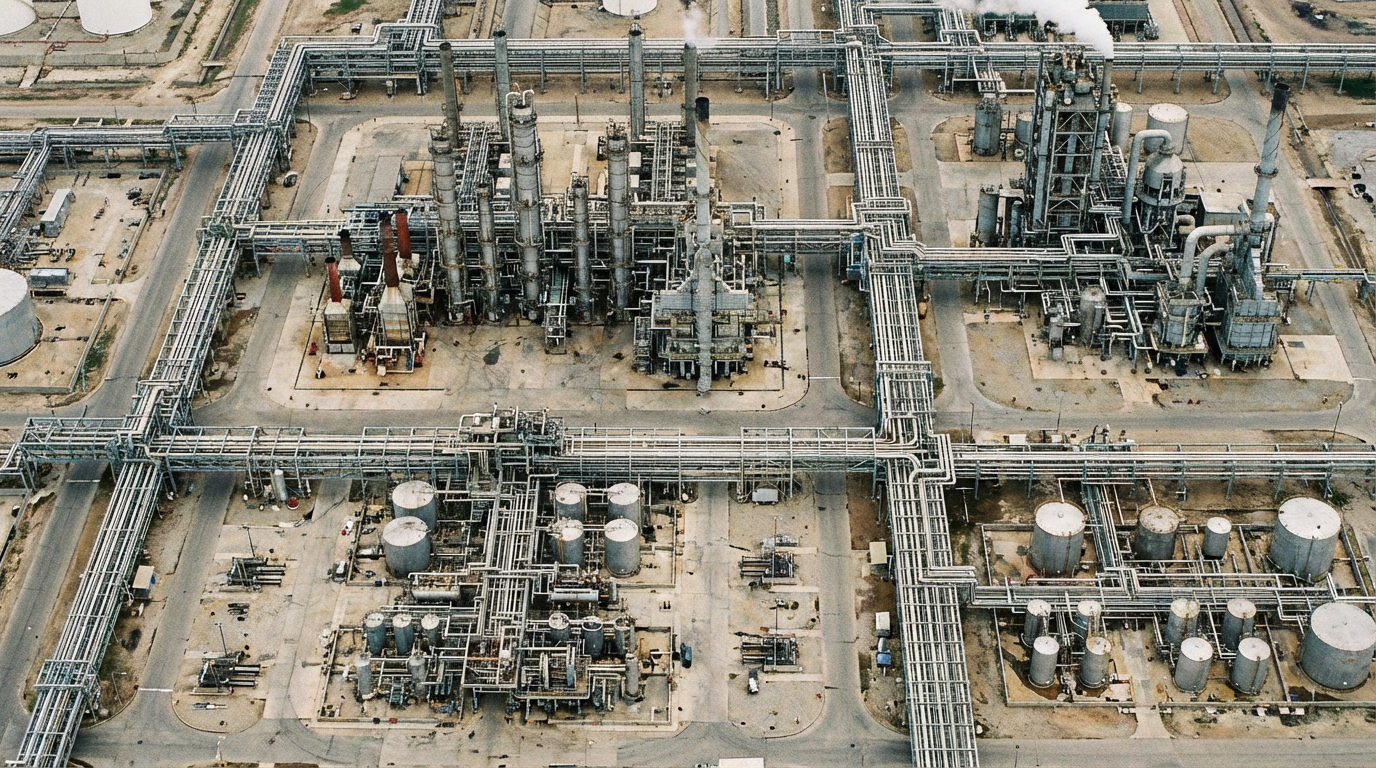
Refinery operations performance varies more between sites than equipment generations, with most of the gap showing up in execution. AI optimization closes these gaps by coordinating setpoints across interconnected units, capturing nonlinear relationships conventional control can't represent, and building operator trust through advisory mode. These approaches help plants recover roughly $0.50–$1.00/bbl in margin while tightening giveaway, lifting throughput, and steadying shift-to-shift execution.
Every refinery runs a version of the same daily problem. The crude distillation unit shifts cut points in response to a cargo change, and within hours catalytic cracking feed quality drifts, hydrotreater severity needs adjustment, hydrogen balance tightens, and the gasoline blend pool moves off-target.
These interactions keep moving through the site, and closing the value chain optimization gap can recover roughly $0.50–$1.00/bbl in margin that sits between units, between planning and execution, and between shifts. In a margin environment where downstream margins remain pressured compared with recent peaks, that per-barrel recovery separates average sites from best-quartile refinery operations performance.
Refinery operations performance varies more between sites than equipment generations, and the gap shows up in execution. Slips happen when one unit changes conditions and downstream units absorb the impact without a shared economic signal.
The sections below show how coordination closes them.
Margin leaks at the boundaries between units, where decisions made for local reasons cascade downstream without an economic signal traveling with them. A refinery is a tightly coupled system. The crude unit alone produces straight-run cuts that need secondary upgrading before reaching transportation-fuel specifications, and every conversion and treating unit downstream exists to make up that gap.
Suboptimization at any node degrades margin downstream. When a VDU experiences sudden steam surges that disrupt vapor-liquid contact, lighter distillates slip into bottom residue. That's a direct yield loss, and it constrains every unit receiving VGO feed. When operators raise FCC riser outlet temperature to increase light olefins, dry gas also increases. That can strain wet gas compressor capacity, and the octane contribution to the gasoline blend pool shifts as well.
Operators know these interactions unit by unit. The harder part is that no single controller spans the CDU-to-FCC-to-blend-header chain. Cut-point decisions made for CDU-local reasons propagate downstream without a coordinated signal to the units absorbing the consequences. Catalyst aging, exchanger fouling, and feed quality changes accumulate the same way: each is visible to the unit engineer responsible for it, but the refinery ROI impact is rarely visible in real time.
Blending sits at the end of the chain as an irreversible integration point. Conservative octane targets above specification can lock in giveaway that upstream optimization cannot recover once material reaches the blend header.
Planning models and APC leave gaps because they operate on different time horizons and different objectives than real-time cross-unit economics. Planners run offline LP models to develop average operating plans across weeks to months, and schedulers break them down using spreadsheets. Real-time operations then have to respond to conditions that neither the plan nor the schedule anticipated.
LP solutions land at constraint-set boundary intersections, but when operations shift to different product qualities or a different schedule, shadow prices are no longer valid. Console operators end up making real-time economic decisions based on stale signals, or no economic signals at all. Advanced process control (APC) keeps individual units within target operating ranges and is widely used to improve unit performance.
Conventional model predictive control (MPC) operates each unit's controller independently. It targets local specifications based on estimates and delayed feedback from adjacent units. The maintenance burden compounds the problem. Large-matrix MPC requires specialized APC engineers for ongoing model calibration, and many of those engineers have moved into other roles. Site-level skill gaps can leave controllers drifting into a degraded or inactive state without anyone detecting the performance loss.
Shift consistency adds another dimension. The same equipment, run under similar feed and ambient conditions, can produce noticeably different yield outcomes from one shift to the next. That variation reflects different operator strategies, different comfort with constraint pushing, and different responses to the same alarm patterns. Closing this oil and gas workforce gap is one of the highest-impact opportunities in day-to-day execution.
AI optimization closes cross-unit coordination gaps by deciding what setpoints each unit should target and updating those decisions as plant conditions change. APC handles setpoint execution well. Day-to-day operations still need continuous, cross-unit economic optimization that addresses refinery process challenges in real time.
Conventional APC relies on linear, empirical model approximations that work within narrow operating windows. Those approximations become limited when process gains shift with crude slate changes or catalyst aging. AI models trained on a refinery's own historical operating data can capture nonlinear relationships that linear MPC cannot represent.
A catalyst activity improvement in a treating unit, for example, can support feed rate increase, cycle length improvement, or product quality improvement, but only one at a time. A model with visibility across units can evaluate which application generates the most economic value under current refinery-wide conditions. That kind of hydrocracker yield optimization is hard to do with separate linear models for each piece of equipment.
Cross-unit recommendations only deliver value if console operators act on them, and operator trust usually builds when deployments begin in advisory mode. The AI recommends setpoint changes; operators decide whether to act. Crews compare those recommendations against unit behavior they already know, and trust builds through repeated accuracy rather than assumption.
In well-running advisory deployments, operators start to challenge the model. They run a recommendation, compare the result against the move they would have made, and learn from the cases where the model caught a cross-unit tradeoff they hadn't weighed. That back-and-forth gives planning, operations, and engineering teams a single reference for plant behavior, so console operators and planners stop working from different versions of the same plant.
Refinery performance turns on yield, giveaway, specific energy consumption, throughput, and reliability. The gap between average and best-quartile performance on those five levers is recoverable margin that compounds when units coordinate.
Giveaway reduction often offers the most immediate return. Static buffers applied independently at each unit accumulate into conservative product targets that AI optimization can tighten by adjusting setpoints to real-time blend composition rather than fixed margins. That can return value quickly without changing physical assets.
Throughput recovery and yield optimization compound that return. Closing the hidden cost of throughput often surfaces capacity that was always there but never accessed because no one had visibility into the constraint that mattered most under current conditions. Energy efficiency improvements layer on top, particularly in furnace operations and steam balance.
Cash operating expenses vary across the refining peer group based on operating discipline. The differentiators are how consistently units coordinate, how quickly economics flow to the control room, and how effectively optimization persists across shifts. Closing those gaps is mostly about the quality and timeliness of decisions made on equipment already in place. New equipment rarely accounts for the difference.
The same day-to-day data also feeds longer-cycle decisions. A model that tracks unit-level degradation in real time gives planning teams visibility into trends that LP models update only infrequently. That visibility can change how turnaround scope is defined, how heavy a crude slate the refinery commits to, and how aggressively to push unit constraints between major maintenance windows. The cumulative effect is an operation that adjusts to current conditions in real time. Shift-to-shift execution becomes a margin lever that's hard to replicate without that visibility.
For refinery leaders looking to close these gaps systematically, Imubit's Closed Loop AI Optimization solution learns from each refinery's actual operating data and writes optimal setpoints in real time across interconnected process units. Plants can start in advisory mode, where transparent recommendations let operators audit, challenge, and learn from the model before granting it direct control, then progress to closed loop optimization as confidence develops. The solution integrates with existing distributed control system (DCS) and APC infrastructure, and pairs the technology with workforce transformation services so the model becomes a shared reference for operators, engineers, and planners rather than another opaque tool on the console.
Get a Plant Assessment to discover how AI optimization can lift refinery operations performance toward best-quartile execution.
Optimizing units separately misses value because each one changes the feed, constraints, or quality targets of the next. A CDU decision that looks efficient locally can still create downstream losses in FCC performance or blending. Much of the recoverable margin sits in those system-level tradeoffs, which is why coordinating across units rather than within them tends to produce the larger return on existing refinery quality management.
Advisory mode shifts the conversation in the control room. Console operators and shift supervisors review recommended moves, accept or override them, and document the reasoning when they deviate. Over time, that record becomes a feedback loop the model learns from, and incoming shifts inherit a clearer picture of what was tried, what worked, and why. The yield variation that comes from different operator strategies narrows as crews build consensus around a shared reference for plant behavior through stronger human-AI collaboration.
Yes. Cross-unit optimization works as a layer that determines what setpoints to target while existing continuous process control continues handling execution within individual units. Plants can improve coordination without replacing their current control system structure. The added value comes from linking real-time decisions back to refinery-wide economics rather than only local targets, and from keeping that linkage current as crude slate, catalyst activity, and product specifications change.