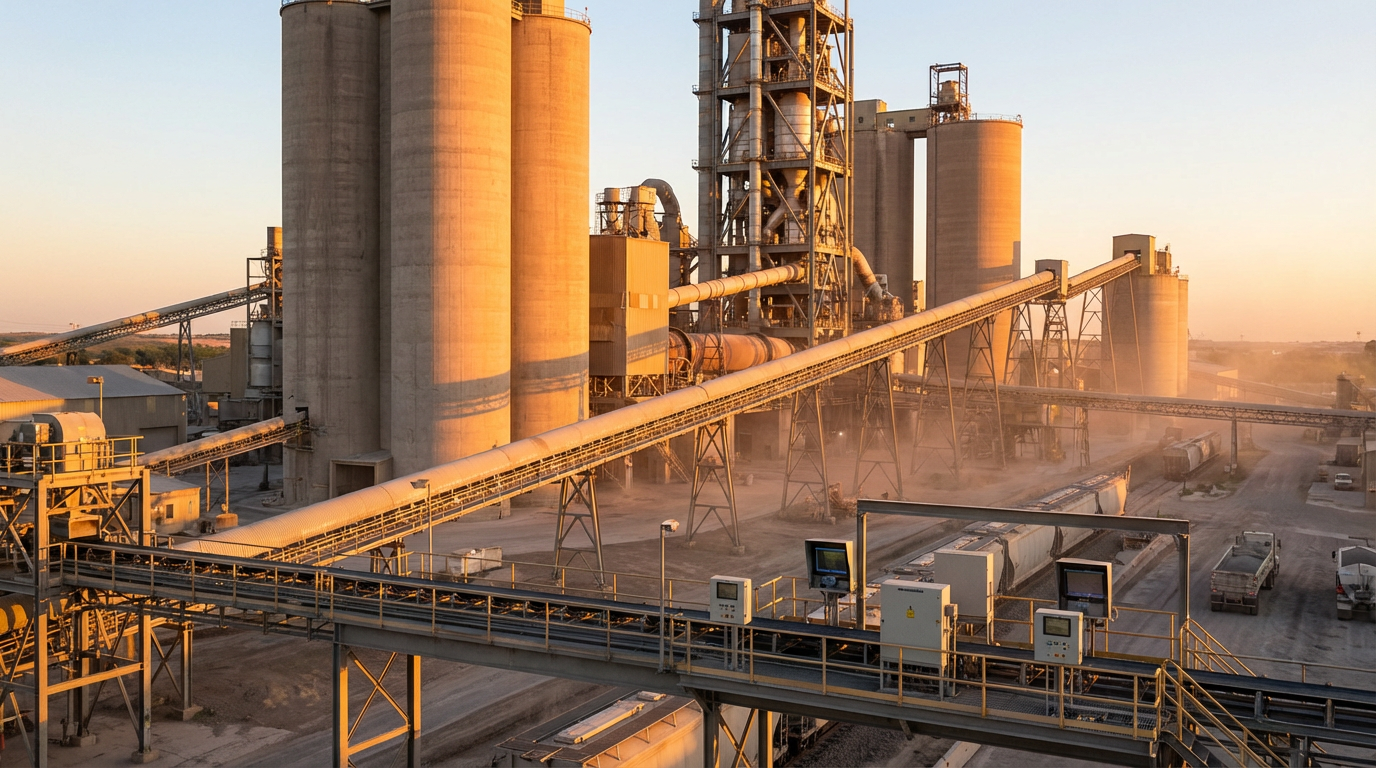
Finish mill operations balance throughput, fineness, and energy, but single-loop control and delayed lab measurements push operators to run conservatively and overgrind. AI optimization treats the mill as a coupled system, learning from plant data to predict Blaine, coordinate setpoints across feed, separator, and ventilation, and deliver value in advisory mode before any move to closed loop. The approach can improve throughput, cut energy consumption, and preserve operator knowledge as veterans retire.
The finish mill grinds clinker, gypsum, and supplementary cementitious materials into final cement product through either ball mills, vertical roller mills (VRMs), or high-pressure roller presses paired with ball mills. It's also the largest single consumer of electrical energy in most cement plants, which makes the unit a focal point for any margin or efficiency conversation.
Every finish mill shift forces the same tradeoff: tonnes per hour, fineness within spec, and specific energy consumption that doesn't erode margin. Cement plants pursuing digital transformation can target margin or cost improvements in the 10–15% range, and finish grinding is one of the units where that opportunity concentrates given grinding's share of cement plant energy use.
The control problem sits in the interaction between variables such as feed rate, separator speed, mill ventilation, water injection, and grinding aid dosage, not in any single loop or setpoint. That gap between installed capability and day-to-day performance is one of the central challenges in improving cement plant performance, particularly when existing advanced process control (APC) cannot keep up with changing mill conditions.
Finish mill throughput, fineness, and specific energy consumption move together, but most control systems still manage them one loop at a time. The biggest losses come from variable interactions across feed, separator, and ventilation, plus delayed lab feedback on Blaine and residue.
The sections below show how these constraints interact and how tighter coordination changes finish mill performance.
A closed-circuit finish mill, whether built around a ball mill or a VRM, involves dozens of interacting variables. Change separator speed to tighten fineness, and circulating load increases, mill filling shifts, and throughput drops. Change feed rate to recover throughput, and the fineness window opens back up.
Each PID loop governs one variable in isolation, with no representation of how its output moves through the rest of the circuit. High-efficiency third-generation separators sharpen the classification curve, but they don't resolve the underlying coordination problem between separator, mill, and feed. The same dynamic shows up in ball mill operations where a finishing circuit recycles oversize material through a separator.
That isolation creates a familiar operating pattern. Because controllers cannot anticipate cross-variable interactions, operators detune them to prevent oscillation.
Detuned loops mean running conservatively, away from the operating points where throughput and energy efficiency are highest. Over time, those conservative margins compound into the kind of grinding circuit bottlenecks that show up as flat tonnage despite available installed power.
Conventional advanced process control and model predictive control partially address this by coordinating a handful of variables through linear process models. Those models are identified during commissioning and degrade as plant conditions change. When clinker grindability shifts, or additive moisture varies with weather, the static model no longer reflects the process.
Re-identification campaigns restore performance temporarily. In between, operators often revert to manual control and the efficiency improvements disappear. No AI system replaces the pattern recognition that comes from decades at the board, but continuous coordination across all variables is beyond what humans or existing advanced control systems can manage.
The quality variables that matter most in finish grinding, Blaine fineness and residue on 45 microns, can't be measured continuously in most plant configurations. A typical lab cycle pulls samples once or twice per shift, with results returning 30 to 60 minutes later.
By the time the number arrives, mill conditions have moved on, residence time has shifted product through several elevators and silo layers, and the operator who triggered the test may already be on handover. That delay leaves the circuit running without immediate confirmation of quality outcomes.
Operators respond to that delay predictably. They set conservative process targets to keep product within specification under worst-case conditions. Systematic overgrinding follows, pushing cement finer than target to create margin against uncertainty. Extra fineness consumes more energy and reduces tonnes per hour at constant installed power.
The consequences can compound when product that meets formal specification still misses internal quality targets and gets routed to fringe silos or reprocessed. Reprocessing uses capacity that could otherwise handle fresh feed.
The measurement gap also obscures a subtler quality risk. Two cements with identical Blaine values can have different particle size distributions and different strength outcomes. Plants that control exclusively to Blaine carry a quality risk that may not surface until later strength results arrive.
Blaine fineness optimization using process-signal-based prediction closes that gap by giving operators a continuous read on fineness instead of a delayed lab value.
AI optimization approaches the finish mill as a single coupled system rather than a collection of independent loops. The model learns from historical plant data how feed rate, separator speed, mill ventilation, water injection, and grinding aid dosage interact under varying conditions. It uses process signals to predict Blaine and adjusts setpoints to hold throughput, fineness, and specific energy together.
The quality of that learning depends heavily on the historian record, which makes data readiness for AI one of the earlier deployment conversations to have.
That coordination can improve mill productivity and hold operating points the underlying PID or APC layers cannot reach alone. Plants with less mature control infrastructure often capture larger improvements than operations that already have stronger optimization in place. That includes sites running mostly tuned PID with limited cross-loop coordination, or those with APC models that haven't been re-identified in years.
In both cases, the AI sits above the existing control system rather than replacing it. The model also adapts as conditions change, so a shift in clinker grindability or a switch in supplementary cementitious material doesn't require manual re-tuning to keep recommendations valid.
Advisory mode delivers standalone value well before closed loop becomes the question. The AI recommends setpoint changes, and operators decide whether to apply them. That alone gives crews a continuous read on tradeoffs they previously had to estimate, narrows the gap between best and worst shifts, and surfaces operating points that conservative tuning has been hiding for years.
The trust foundation that comes from this kind of AI augmentation in cement makes any later move toward closed loop feel earned rather than imposed.
The practical effect of tighter coordination compounds over time across throughput, consistency, and knowledge retention. When the model predicts Blaine from process signals instead of waiting for lab results, the safety buffer can shrink. Grinding closer to target reduces overgrinding and creates room for more throughput at the same installed power, which is one of the more direct paths to improving grinding efficiency without capital investment.
Consistency also removes hidden losses. Less shift-to-shift variation means fewer batches routed to fringe silos for reprocessing, less re-milling consuming mill capacity, and more predictable product for downstream concrete producers formulating mix designs against incoming cement properties.
The energy footprint of overgrinding shows up in specific energy consumption (kWh per tonne cement). Trimming even a few kWh across the production envelope translates into meaningful annual savings on a unit that runs continuously. Those quality and energy benefits compound into the kind of cement energy efficiency AI outcomes that are difficult to reach with static control alone.
Knowledge retention also gets more durable as experienced operators retire. Veteran finish mill operators carry years of tacit knowledge about proxy signals such as mill power signatures, elevator current patterns, and separator load behavior.
AI models trained on historical data preserve the relationships between those process states and the actions associated with good outcomes, even if they don't capture every instinct behind the original decision. Cement operators implementing this approach, including the deployment described in the Ash Grove cement optimization program, have used the model itself as a training environment for incoming operators before they take real-time setpoint authority.
For process industry leaders seeking to close the gap between their finish mill's installed capability and actual performance, Imubit's Closed Loop AI Optimization solution learns from plant-specific historical data, predicts quality parameters from process signals, and writes optimal setpoints in real time through the existing distributed control system (DCS).
Plants can start in advisory mode, capture value through decision support and consistency, move into supervised operation within operator-defined boundaries, and progress toward closed loop operation as confidence builds.
The technology treats throughput, fineness, and energy as one coordinated plant-level optimization problem rather than three separate tunings, while the model also serves as a training environment where incoming operators build pattern recognition before they take real-time setpoint authority.
Get a Complimentary Plant AIO Assessment.
Yes. Cross-shift variation often comes from each crew balancing throughput, fineness, and energy differently as circuit conditions change. An AI optimization layer gives operators a consistent view of how process variables are interacting in the current state, so recommendations reflect the same operating relationships every shift. That consistency still matters in advisory mode, where operators make the final call, and is one of the more visible early markers of improved cement plant operational efficiency.
Because staying inside specification doesn't always mean the circuit is operating efficiently or that downstream quality risk is low. Plants can remain within the Blaine window while still overgrinding, losing throughput, or producing cement with different behavior tied to particle distribution rather than Blaine alone. Broader process variables still shape throughput, energy use, and quality consistency even when the lab result looks acceptable, which is why AI grinding technology focuses on the full operating envelope rather than a single quality target.
Transitions between cement grades, including OPC, blended cements with slag or fly ash, and sulfate-resistant grades, involve different Blaine targets, residue specs, and grindability characteristics for each grade. AI built on plant-specific historian data can recognize the operating signature of each grade and adjust setpoints to reach target faster, reducing the off-spec window and the volume routed to fringe silos during the change. Coordinating the transition across feed, separator, and ventilation in a single move shortens the unproductive period typical of conservative manual transitions. That kind of coordinated change is one of the more practical grinding optimization in cement outcomes.