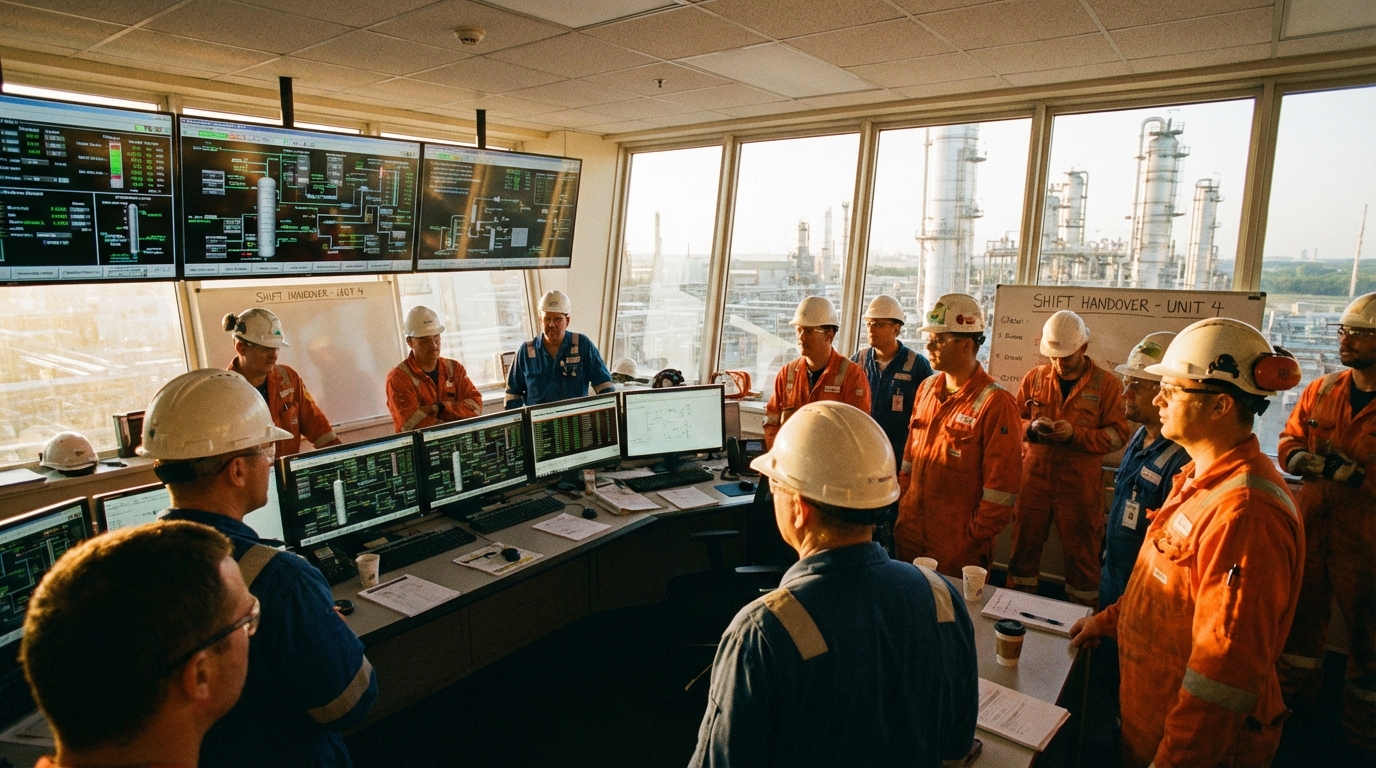
Every shift handover in an oil and gas control room represents a transfer of knowledge that no operating manual can fully capture. The subtle patterns in column behavior, the equipment quirks that experienced operators instinctively account for, the judgment calls that keep units running smoothly: this expertise takes years to develop. And it’s walking out the door at a rate the industry can’t ignore. According to McKinsey’s talent analysis, more than a fourth of U.S. oil and gas employees are nearing retirement age, with up to 400,000 energy sector workers projected to retire over the next decade.
This isn’t a distant workforce development exercise. It’s an operational constraint affecting production consistency, safety margins, and the ability to optimize complex processes today. AI-driven workforce management offers a path forward, but only when it’s designed to amplify operator expertise rather than attempt to replace it.
TL;DR: How AI Addresses Workforce Management Constraints in Oil and Gas
AI optimization gives oil and gas operations a way to preserve institutional expertise and reduce shift-to-shift variability before experienced operators retire.
How AI Preserves Institutional Knowledge
- AI models trained on plant data capture observable operator decision patterns before that knowledge walks out the door
- Simulation-based training built from real unit data accelerates new hire time-to-competence
- Consistent decision support narrows the performance gap between veteran and junior crews
Why Workforce-First Implementation Succeeds
- Only 16% of companies achieve AI-related targets; the gap is mostly about people, not technology
- Involving operators as contributors to AI development builds both model accuracy and adoption
- Advisory mode creates early wins that build the foundation for advancing toward greater autonomy
Here’s how these strategies work in practice across oil and gas operations.
How Does the Workforce Constraint Show Up in Operations?
The oil and gas workforce constraint isn’t just a hiring problem. It manifests in specific, measurable operational gaps that compound over time.
When experienced operators retire, the operators who replace them make the same moves with less contextual understanding of why. Conservative operating strategies become the norm because newer operators lack the confidence to push toward optimal envelopes. The gap shows up in measurable ways: wider variation in yield between shifts, inconsistent responses to feed quality changes, and reluctance to operate near constraint boundaries where the best economics live.
The constraint extends beyond the control room to advanced process control (APC) systems. These tools balance multiple control loops simultaneously, yet McKinsey’s research notes that APC usage erodes over time at many sites, with less than 10% of implemented APCs remaining active and maintained in some cases. When the engineers who built and tuned those systems move on, institutional knowledge of how to maintain them leaves too. Without structured practices to bridge those gaps, controls drift and sophisticated systems get bypassed in favor of manual adjustments.
Meanwhile, functions that should coordinate, including maintenance, operations, planning, and engineering, often make decisions without visibility into each other’s constraints. Maintenance defers work that operations needs done. Planning sets linear-program (LP) targets based on annual models that don’t reflect current equipment condition or catalyst state. Engineering proposes capital projects without fully understanding how current operating strategies already compensate for the bottleneck they’re trying to solve. Each group optimizes for what it can measure, not what matters to the organization.
A single shared model of plant behavior can change this dynamic. When all functions reference the same data-first view of how the plant actually runs, planning teams can update their linear-program vectors more frequently, maintenance can see how deferring work affects unit economics, and engineering can ground debottlenecking proposals in current operating reality. Plants applying AI to improve coordination and optimization have reported 10–15% production increases and 4–5% EBITA improvements. Those numbers hint at how much value these silos leave on the table.
How Can AI Preserve Institutional Knowledge Before It Walks Out?
AI models trained on years of plant data can capture how experienced operators respond to specific conditions: how crude slate changes affect downstream unit behavior, when to anticipate equipment constraints before alarms trigger, which operating envelopes deliver the best economics under different market conditions. Once embedded in the model, these observable decision patterns remain accessible regardless of workforce changes. The model won’t capture every instinct behind a thirty-year veteran’s judgment call, but it preserves the observable relationships between process states and the actions that produced good outcomes.
Beyond capturing operator knowledge, the same model can track process degradation over time. It reveals how catalyst deactivation, exchanger fouling, or feed quality shifts evolve across months. These insights inform maintenance timing and capital decisions using actual operating data instead of tribal knowledge about when equipment “usually” starts underperforming.
Simulation-based training accelerates new hire time-to-competence by recreating operational scenarios in dynamic digital environments built from actual plant data. Rather than relying on generic training modules, new operators practice on scenarios that reflect their specific unit’s behavior, equipment quirks, and operating constraints. A new console operator can practice responding to a sudden crude quality shift or an unexpected fractionator pressure excursion in the simulator before encountering it on a live unit.
Together, these narrow the consistency gap between shifts. When every crew has access to the same operating recommendations and the same decision support tools, the performance spread between veteran and junior operators tightens. AI doesn’t eliminate the value of experience; it makes experience-driven insights available on every shift, not just the ones staffed by the most senior crews. Organizations still need people who can interpret context, exercise judgment during novel situations, and contribute new knowledge as processes evolve. The AI model handles the complexity that even experienced operators struggle with; the operators handle the judgment that models can’t replicate.
What Does Effective Human-AI Collaboration Look Like in a Control Room?
The approach that works in oil and gas operations builds trust incrementally instead of demanding it upfront. In advisory mode, the AI model functions as an informed colleague: it processes the same plant data operators see, but across more variables simultaneously, and offers recommendations while operators make all execution decisions. Operators can run what-if scenarios to test trade-offs between throughput and energy efficiency before making moves, or compare the model’s suggestion against their own read of the unit. Over time, this builds confidence in the system’s understanding of their specific operation.
What makes advisory mode particularly valuable for workforce effectiveness is how it changes the relationship between experienced and newer operators. Rather than depending solely on informal mentorship during overlapping shifts, teams gain a shared reference point grounded in data. Senior operators contribute their expertise to the model; junior operators learn from that expertise through daily interaction with AI recommendations. The knowledge transfer happens continuously, not just during the narrow windows when veteran operators are available.
As confidence grows, organizations can move toward supervised automation, where AI executes routine adjustments under continuous operator monitoring. In a refining context, this might mean AI managing column temperature profiles and reflux ratios during steady-state operation while operators retain control during feed switches, startup sequences, or weather-related upsets. Operators define the boundaries: stepping back to advisory mode during unfamiliar conditions and allowing higher autonomy during stable operations. The transition is operator-driven, not management-mandated. Transparency in AI reasoning matters throughout this progression, because operators in safety-critical environments rightly need to understand why the system recommends a particular action before trusting it with control authority.
Why Does Workforce-First Implementation Succeed Where Technology-First Fails?
According to the BCG-WEF AI survey of nearly 1,800 manufacturing executives, only 16% of companies achieve their AI-related targets. The gap between ambition and results stems less from technical limitations than from how organizations approach their people.
The implementations that succeed involve operators from the beginning, not as reviewers of a finished system but as contributors to its development. When senior operators see their own decision logic reflected in the model, something shifts: the system becomes theirs, not something imposed on them. This also serves a workforce management purpose beyond adoption. The structured conversations required to capture operator decision-making patterns become a knowledge-preservation exercise. Expertise that might otherwise retire with the individuals who developed it gets documented and embedded in a tool the entire team can access. When the model reaches twenty or thirty people at a site instead of two or three, the knowledge it contains compounds.
Implementations that fail typically share a common pattern. Organizations treat AI as a technology project, skip workforce readiness, and deploy systems that operators don’t trust, can’t understand, or weren’t consulted about. In safety-critical process environments, where errors can result in incidents or significant financial losses, skepticism toward opaque systems is professionally appropriate. That skepticism isn’t resistance to change; it’s sound engineering judgment that the implementation approach needs to respect. Research on digital transformation confirms the pattern: workforce readiness and trust-building are major determinants of value creation, often outweighing the marginal returns from algorithmic sophistication alone.
Connecting Workforce Empowerment to Operational Excellence
For oil and gas operations leaders seeking to strengthen their workforce while addressing coordination and knowledge retention constraints, Imubit’s Closed Loop AI Optimization solution offers a proven path forward. The technology learns from actual plant data and operator expertise, writing optimal setpoints in real time while maintaining full operator visibility and control. Plants can start in advisory mode, where operators evaluate AI recommendations and build confidence through demonstrated performance, then progress toward closed loop optimization as trust develops across the organization.
Get a Plant Assessment to discover how AI optimization can help your workforce operate more effectively while preserving the expertise your experienced operators have built over decades.
Frequently Asked Questions
How long does it typically take to see workforce management improvements from AI optimization?
Plants implementing AI-driven optimization typically observe measurable improvements in shift consistency within the first few months of deployment. Initial results often come from providing all crews with the same decision support, which narrows the performance spread between shifts. Deeper knowledge transfer benefits develop as the system learns plant-specific behavior over subsequent operating cycles.
Can AI optimization integrate with existing control infrastructure?
AI optimization integrates with current distributed control systems (DCS) rather than replacing them. The technology operates as an optimization layer above existing infrastructure, and the same AI model can serve as a training environment where new operators practice decision-making with scenarios built from real plant data. Operators maintain override authority throughout.
How does cross-functional coordination improve when teams share a single AI model?
When maintenance, operations, planning, and engineering reference the same model of plant behavior, they gain visibility into how their decisions affect other functions. Maintenance can see how deferring work impacts operating margins. Planning can set targets grounded in current equipment condition. This shared understanding reduces the finger-pointing that slows response time and leaves value on the table.