Hydrocracking yield optimization is a daily tension between pushing conversion for middle distillate margin and protecting catalyst life. As the run progresses, catalyst aging, feed quality shifts, and recycle composition drift narrow the operating window—and those interactions tighten faster than traditional control models can track. Configuration choices around recycle service, HPNA management, and UCO bleed set the economic envelope, while WABT connects every yield lever to reactor condition. AI optimization trained on actual unit history helps coordinate these nonlinear trade-offs, giving operations, planning, and maintenance a shared current model of what the unit can actually deliver.
Every refining operations leader managing a hydrocracker faces the same daily tension: push conversion harder to capture middle distillate margin, or ease back to protect catalyst life. In refinery operations, that trade-off is economic long before it becomes visible in product yields.
Operational efficiency has become a defining sector priority as margins tighten and costs rise. For units where conversion directly sets middle distillate volume and product slate flexibility, hydrocracking yield optimization is where that economic pressure shows up shift by shift.
Every yield lever interacts with catalyst life, hydrogen balance, and equipment limits, and those interactions tighten as the run progresses.
Hydrocracking yield depends on how severity, recycle quality, and reactor condition move together. As catalyst activity declines, the operating window narrows.
Those interactions explain why hydrocracker yield control gets harder through the run, and why AI-assisted coordination is gaining traction.
Configuration sets the unit's economic envelope. Once-through operation usually leaves more unconverted oil available for other uses, while recycle service pushes conversion higher but also increases exposure to ammonia, H₂S, and HPNA buildup in the reaction system. Teams weighing those trade-offs often consider distillation yield optimization across the refinery, not just single-reactor conversion.
Those choices matter most through the middle and back half of the run. In sour recycle service, passivation of acidic sites can force higher WABT to hold conversion. Higher WABT then raises hydrogen demand and speeds deactivation.
That trade-off sits at the center of yield control because conversion targets only matter if the unit can sustain them within normal hydrogen and utility limits. And because hydrogen availability often sets a hard ceiling on severity, any WABT increase later in the cycle draws directly against whatever hydrogen budget remains.
Those same constraints ripple through crude oil refining economics across the complex, not just inside the hydrocracker.
In a two-stage sweet arrangement, better selectivity can delay that trade-off, but only if fractionation, quench performance, and separator operation stay tight. Configuration differences show up most clearly in HPNA management.
Recycle operation can also concentrate heavy aromatics in the loop, which hurts catalyst performance and product quality. Operators can bleed UCO to control that buildup, but the yield penalty is immediate. The right answer depends on crack spreads, hydrogen availability, and how much run length remains in the catalyst cycle.
And because those variables shift week to week, the optimal bleed rate and recycle ratio rarely stay constant for long.
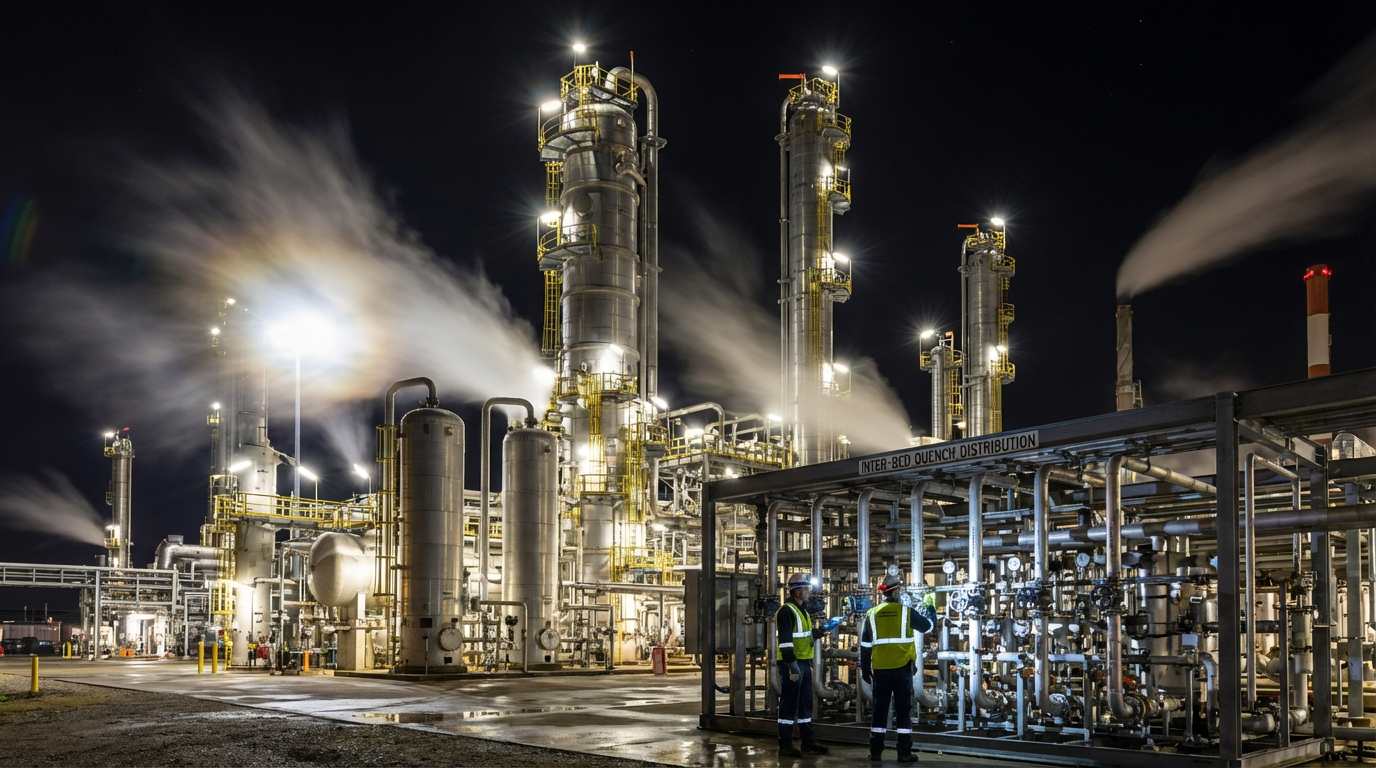
Reactor design sets the precision available to the board operator. Hydrocracking reactions are strongly exothermic, so inter-bed quench is the practical tool for keeping bed temperatures inside a usable operating window. When distributors foul or lose effectiveness, temperature control gets less even across the bed and severity stops being uniform.
The same industrial process control constraint shows up across refining units wherever temperature uniformity drives product quality.
That loss of uniformity carries a direct cost. Local hot spots coke catalyst faster, while underused zones contribute less conversion than their share of reactor volume should deliver. The unit may still look stable at the aggregate level, but the effective operating window narrows because the most stressed locations reach their limit first.
WABT connects every other yield lever to that physical reality. Raising WABT can recover conversion after catalyst aging or feed deterioration, but the same move also raises hydrogen consumption, gas make, and aromatic condensation risk. Higher nitrogen reduces cracking activity, while heavier and less stable feeds increase the burden on both pretreating and fractionation.
Even the UCO cut-point affects severity because it changes recycle composition and the quality of material returning to the reactor loop. Units processing heavier or more variable slates see this interaction most acutely, which is why heavy oil processing operations tend to run tighter WABT margins through the back half of the cycle.
The separator and main fractionator often decide how much of that burden returns to the reactor. Slight drift in separation efficiency can leave more dissolved light ends, contaminants, or heavier material in the recycle path than operators intended. A cut-point adjustment that looks minor in the tower can still change recycle quality enough to raise hydrogen demand, lower selectivity, and force another WABT increase a few hours later.
The difficulty compounds because those feedback loops operate at different timescales: a cut-point change may take hours to register in reactor performance, while the WABT response to maintain conversion shows up in minutes.
Those interactions extend into the unit's thermal network, where heat exchanger optimization determines how much preheat the reactor section actually receives.
Traditional advanced process control (APC) works well when process relationships stay close to the model used to tune it. Hydrocrackers rarely stay in that condition for long. Catalyst aging changes those relationships continuously, and feed quality shifts do the same. A model that was well tuned early in the cycle can become less reliable as severity rises, pretreat performance changes, or recycle composition drifts.
That drift is one reason many teams find APC performance declining as the cycle matures. For a unit processing multiple crude blends in sour recycle service, that mismatch can develop within weeks of a tuning update.
The planning gap adds another layer. LP targets often assume a catalyst state and constraint set that no longer match the plant. Operations compensates for actual limits. Maintenance may defer exchanger work that operations already sees as a severity constraint, and engineering may evaluate capital projects without full visibility into the temporary workarounds the unit is already using.
Each function ends up optimizing within its own information, not against the same current picture of unit behavior. A shared, current model built from the unit's own operating data narrows that gap by giving every function the same picture of actual constraints and trade-offs.
The same principle applies to plant operations broadly, but it matters most for units like hydrocrackers where the constraint picture changes faster than quarterly planning cycles can track.
No APC model replaces the pattern recognition that comes from decades at the board. But hydrocrackers develop interacting constraints that move faster than fixed models can track, especially as the cycle progresses. Exchanger fouling cuts preheat, fired duty rises, reactor severity shifts, and hydrogen demand moves toward compressor limits.
Those links are manageable one at a time, but coordinating them together in real time is harder than any single control loop accounts for. The practical consequence is conservatism: operators leave conversion on the table to protect against constraints they can see individually but can't evaluate together in the time available.
AI optimization becomes useful when unit behavior is moving faster than retuning cycles can keep up. That's especially true when teams need more consistent decisions across shifts and feed conditions. Plants often start in advisory mode, where a model trained on the unit's own operating history recommends setpoint changes and operators decide whether the recommendation fits current conditions.
That arrangement builds trust gradually: operators get decision support, what-if analysis on severity moves, and recommendations that hold steady across shift changes. It's human AI collaboration applied to daily hydrocracker operations. Advisory mode also gives planning teams a way to test scenarios against actual current constraints rather than the LP assumptions that may no longer reflect the unit.
In hydrocracking, the model shows more than severity recommendations. It surfaces the trade-off between conversion, gas make, hydrogen draw, and remaining operating room on WABT. Experienced operators can compare those recommendations against patterns they already know, while newer operators can see why one shift held conversion and another backed off.
Over time, the plant captures a steadier operating strategy instead of relying on whichever instincts happen to be on the board that day. The operational payoff from AI in processing plants comes from coordinating nonlinear trade-offs that conventional control approaches handle one at a time.
Some plants remain in advisory mode because it improves scenario evaluation and cross-functional alignment without changing control authority. Others progress to supervised or validated automation, where recommendations are checked against operating boundaries and team expectations before wider deployment. The progression matters because every stage produces better-informed yield decisions.
Advisory mode alone narrows the gap between planned and actual conversion by giving operations a current model to test LP assumptions against. Those improvements compound across successive catalyst cycles as the model captures which operating strategies delivered the best refinery ROI outcomes under specific feed and constraint conditions.
For refining operations leaders seeking tighter hydrocracker yield control without forcing a unit outside its safe operating window, Imubit's Closed Loop AI Optimization solution learns from plant data and writes optimal setpoints in real time within existing control system boundaries. Plants can start in advisory mode, progress through supervised deployment as confidence builds, and move toward closed loop operation only when the model proves itself on the unit.
Get a Plant Assessment to discover how AI optimization can tighten hydrocracking yield and extend catalyst run length.
The earliest signs are usually higher WABT to hold conversion, less quench flexibility, rising hydrogen consumption, and stronger yield sensitivity to normal feed shifts. Operators may also notice that separator or fractionation disturbances carry a larger economic penalty than they did earlier in the cycle. Tracking those patterns through hydrocracker yield improvement strategies makes it easier to respond before margin erodes further.
Separator and fractionation drift affects selectivity by changing recycle quality even when average reactor temperatures still look acceptable. A slightly heavier recycle stream, weaker separation, or cut-point movement can return harder material to the reactor loop. The result is higher hydrogen demand, more gas make, and lower sustainable conversion. Reviewing those interactions within refinery quality management frameworks often reveals yield losses that aren't visible from reactor data alone.
A shared current model gives planning, maintenance, and operations the same view of actual unit behavior. Planning can revise targets when catalyst activity or hydrogen limits shift, maintenance can prioritize exchanger or quench issues that already constrain severity, and operations can explain why temporary workarounds are losing effectiveness. That alignment supports steadier hydrocracker optimization decisions across the full run.