Lab-based clinker testing can't keep pace with moving kiln conditions, pushing plants toward conservative burn margins that raise fuel costs without improving quality. This article explains why free lime creates cost on both sides of the target, how feedback delay drives over-burning, and how soft sensors trained on actual DCS data give operators a continuous free lime estimate instead of intermittent lab snapshots. Advisory mode builds trust by letting teams compare predictions with observed results before progressing toward closed loop kiln control.
Free lime control rarely breaks down because operators don't understand the kiln. The bigger constraint is time. Lab-based clinker testing can't keep pace with moving process conditions. The IEA reports that thermal energy intensity across the global cement sector has remained flat at about 3.6 GJ per tonne of clinker, which reflects untapped kiln efficiency.
Between samples, the burning zone drifts, fuel consumption changes, and operators work from the last lab result rather than the current process state. That delay pushes plants toward conservative margins that raise cement manufacturing costs and leaves off-spec clinker undetected until the next sample.
Delayed lab feedback is the main constraint on free lime control. Plants protect quality with extra heat margin and operate farther from target than they intend.
The sections below explain why that lag matters and how real-time prediction closes it.
Free lime matters because both sides of the target carry a cost. When fCaO rises too high, clinker leaves the kiln with more unreacted calcium oxide. High free lime can cause volume expansion during hydration, which compromises soundness and strength development in the finished product. In practice, that pushes quality risk forward into the product and can mean rework, blending adjustments, or lost batches downstream.
Plants often respond by running hotter, but hotter operation has its own price. The acceptable range typically falls between about 0.6% and 2.0% free lime, with 1.0–1.5% often preferred as a window that balances clinker quality with fuel economy.
With energy representing a substantial share of cement production costs, even small temperature shifts matter. Over-burning by 20–30°C across a full campaign adds up in wasted fuel without producing meaningfully better clinker.
The operating window also keeps moving. Chemistry changes in the raw mix, thermal shifts in the burning zone, variation through the pyroprocessing circuit, and fuel blend changes can all push free lime higher or lower during normal operation. When plants increase their share of alternative fuels, the variability often increases further because calorific value, moisture content, and ash chemistry fluctuate more than they do with a stable coal or petcoke supply.
Free lime is a live indicator of how chemistry, heat, and combustion are lining up inside the rotary kiln at any given moment.
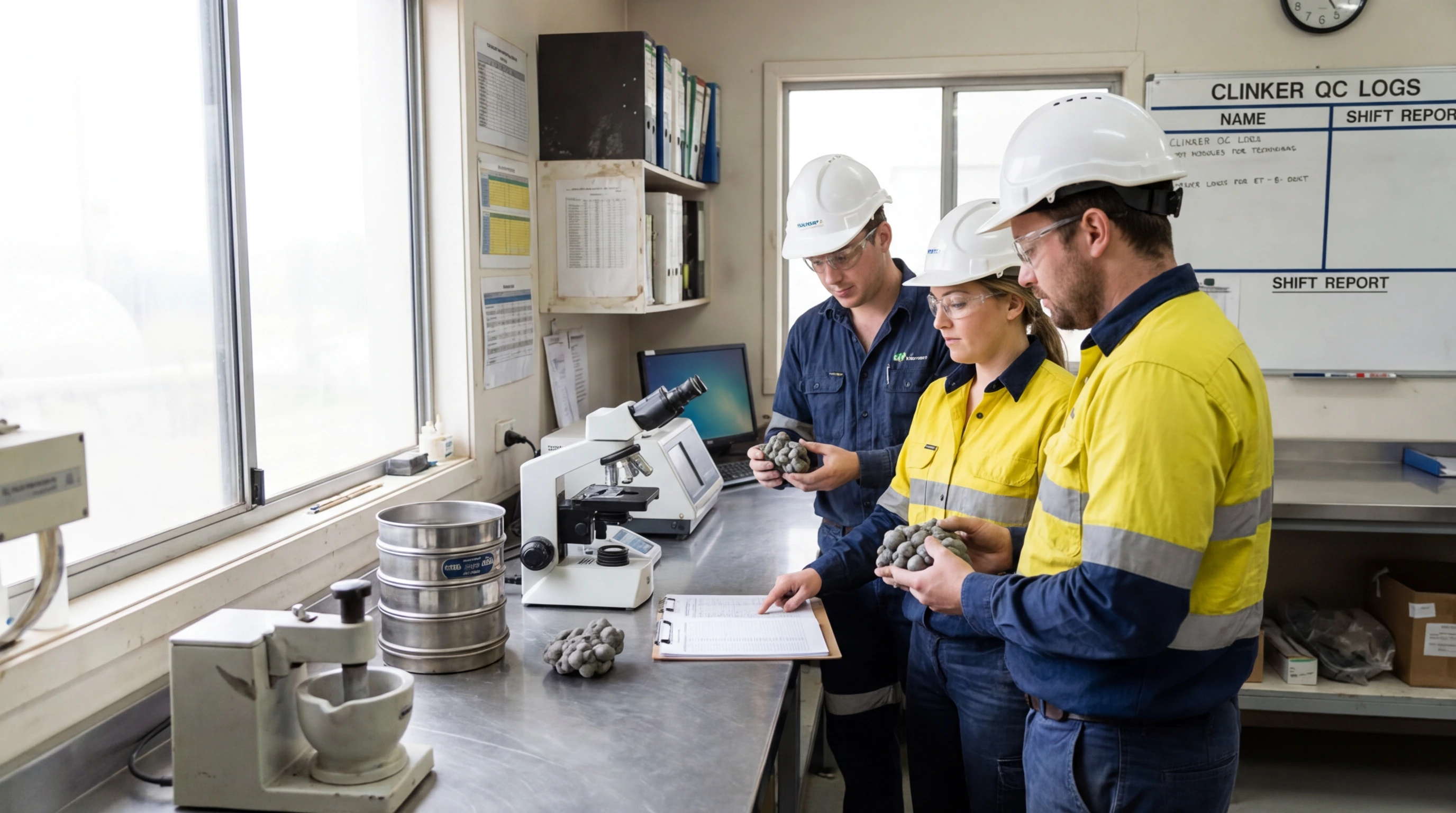
The core control problem is feedback delay. By the time a clinker sample is collected, transported to the lab, prepared, and tested, the material may reflect kiln conditions from 30 minutes to several hours earlier. Operators then adjust fuel rate, feed rate, or burning zone conditions based on a result that describes where the process was rather than where it is now.
That delay changes behavior in the control room. Teams hold extra safety margin because they have no fast way to confirm whether free lime is trending high or low between samples. The margin protects quality, but it also makes hotter-than-needed operation more likely, and it can mask the early stages of a drift that becomes harder to correct later.
Over a full campaign, the accumulated cost of conservative over-burning is rarely tracked explicitly, but it shows up in fuel bills, refractory wear, and sometimes in clinker that's harder than it needs to be for the target strength class.
Conventional measurement methods add further limits. Wet chemistry results can vary with analyst judgment at the titration endpoint. XRF reports total calcium rather than free lime phase information, so it can't distinguish between reacted and unreacted CaO. XRD identifies mineralogical phases more directly, but sample preparation demands and peak overlap can limit practical turnaround. Even when plants increase testing frequency, each sample still has to be collected, cooled, ground, and interpreted before anyone can act on it.
The result is a control loop that runs on intermittent snapshots rather than continuous feedback. In stable, steady-state conditions, that's manageable. But when raw mix, fuel blend, or thermal conditions shift, the gap between what the operator sees and what the kiln is actually doing widens. Decisions made in that gap often default to conservative kiln process optimization strategies that protect quality at the expense of energy and throughput.
A soft sensor for free lime prediction estimates fCaO from process variables already flowing through the distributed control system. Burning zone temperature, kiln drive current, feed rate, fuel flow, kiln speed, preheater exit temperatures, and gas composition carry much of the same information operators already use to judge kiln condition.
A model trained on historical plant data uses those signals to estimate free lime every few minutes instead of every few hours.
That shorter cycle changes control in a practical way. Rather than reacting to a lab result that's already behind the process, operators can see an estimate that tracks the current state. Plants that have deployed this kind of prediction have reported improved cement operational efficiency, with lower fuel use and more consistent clinker quality.
For the control room, the benefit is concrete: operators can work closer to target instead of carrying as much protection against a long feedback delay.
Advisory mode is usually where trust starts. The model shows predicted free lime alongside existing measurements, and operators still make the decision. Over time, experienced operators compare the estimate with lab results and with what they observe in the kiln. They learn where the model tracks well and where it lags. Newer operators, meanwhile, gain a reference point for how process signals connect to clinker quality, something that previously took years of shift experience to develop.
That caution is part of the value. No model captures every instinct behind a thirty-year board operator's call during unstable conditions. But a model can preserve the patterns connecting process conditions to the moves that kept the kiln in range. Those patterns come from the plant's own operating data rather than idealized assumptions.
Because it maps free lime against multiple inputs simultaneously, operators can isolate whether a shift traces to raw meal chemistry, a fuel blend change, or a preheater issue faster than interpreting each trend in sequence.
A soft sensor also needs ongoing calibration to stay accurate. As lab data continues to come in, the model recalibrates so its estimate stays tied to current plant conditions rather than frozen in an older operating period. Raw material shifts, new fuel blends, and post-maintenance changes all alter kiln behavior, and the model adjusts alongside them.
The value of a continuous free lime estimate extends well beyond the control room. When operations, maintenance, quality, and process engineering work from the same prediction, they stop arguing from different versions of kiln reality. A maintenance deferral, a fuel change, or a burn target adjustment becomes easier to evaluate because each group can see the same process response in the same timeframe.
Maintenance teams, for instance, can correlate a creeping free lime trend with equipment degradation they're already tracking, rather than discovering the connection only after a quality event.
That shared view also reduces friction between functions. Quality teams and board operators see the same real-time prediction rather than working from separate snapshots, whether a delayed lab result or a kiln temperature trend. When a process engineer recommends adjusting the raw mix to account for a limestone quality change, the team can see how that adjustment affects predicted free lime before committing.
The conversation shifts from "trust me, the kiln is fine" to a shared, data-grounded picture of cement plant performance.
Cross-shift consistency improves as well. Different crews naturally develop different operating styles, and free lime results can reflect those differences. When every shift works from the same predictive estimate, the variation between crews narrows because the reference point is the same regardless of who's on the board.
That consistency compounds over time, especially for plants managing energy intensity reduction targets where shift-to-shift variation in fuel use and kiln stability adds up across a full year.
For cement operations leaders seeking tighter free lime control without giving away fuel, AI optimization offers a path from reactive lab-based control to continuous kiln management. Plants can begin in advisory mode, use the model to support shared decisions across teams, and progress toward closed loop optimization as trust builds.
Imubit's Closed Loop AI Optimization solution learns from actual plant data and writes optimal setpoints in real time. With 90+ applications across process industries, the approach has demonstrated measurable improvements in consistency, energy efficiency, and throughput.
Get a Plant Assessment to discover how AI optimization can tighten free lime control while reducing fuel cost.
Free lime prediction uses a broader set of process signals than a single gas relationship. A kiln gas proxy can track burning zone conditions when chemistry and fuel are stable, but it often needs recalibration after material or fuel changes. A soft sensor draws on multiple DCS variables operators already monitor, which supports cement kiln optimization across a wider operating range.
Most of the required signals already exist in the DCS. Typical inputs include kiln drive current, thermal readings, preheater temperatures, fuel flow, and gas analyzer data. The model trains on historical plant data to align those signals with lab results, then updates the estimate much faster than a lab cycle. Plants with reliable fineness control and consistent sampling practices tend to see faster calibration.
Yes, because fuel changes are one of the main reasons static relationships break down. Free lime can move with thermal shifts, chemistry changes, and fuel variability, so a model trained across those transitions can better relate changing conditions to clinker quality. That matters especially for plants increasing their share of alternative fuels, where operating conditions are less stable and a prediction model preserves a usable control signal.