Clinker coolers lose fuel efficiency and throughput through weak heat recovery, uneven air distribution, and bed depth instability that conventional single-loop controls can't coordinate. This article explains how those losses compound through the pyroprocessing system, why cascading upsets lock in conservative feed rate cuts, and how multivariable control learns from plant operating data to manage interacting cooler and kiln variables together. AI optimization can improve heat recovery, reduce fuel costs, and lift capacity utilization by sustaining coordination that manual control achieves only intermittently.
Margin pressure in cement usually shows up first in fuel costs, throughput losses, and equipment wear. Global average thermal energy intensity for clinker production sits around 3.6 GJ/t clinker, with IEA roadmaps projecting gradual reductions through better cement fuel efficiency and process integration.
Much of the remaining gap traces back to the grate cooler, where air distribution problems, bed depth instability, and conservative control strategies quietly erode margins every shift. The hardest part is coordination: multiple cooler zones move at once, and isolated control loops often can't keep up.
Clinker cooler optimization directly affects fuel efficiency, kiln capacity, and clinker quality. The biggest losses come from weak heat recovery, uneven air distribution, and unstable bed depth when multiple zones shift at once.
The rest of the article covers how these losses develop, when the cooler constrains throughput, and what multivariable control changes.
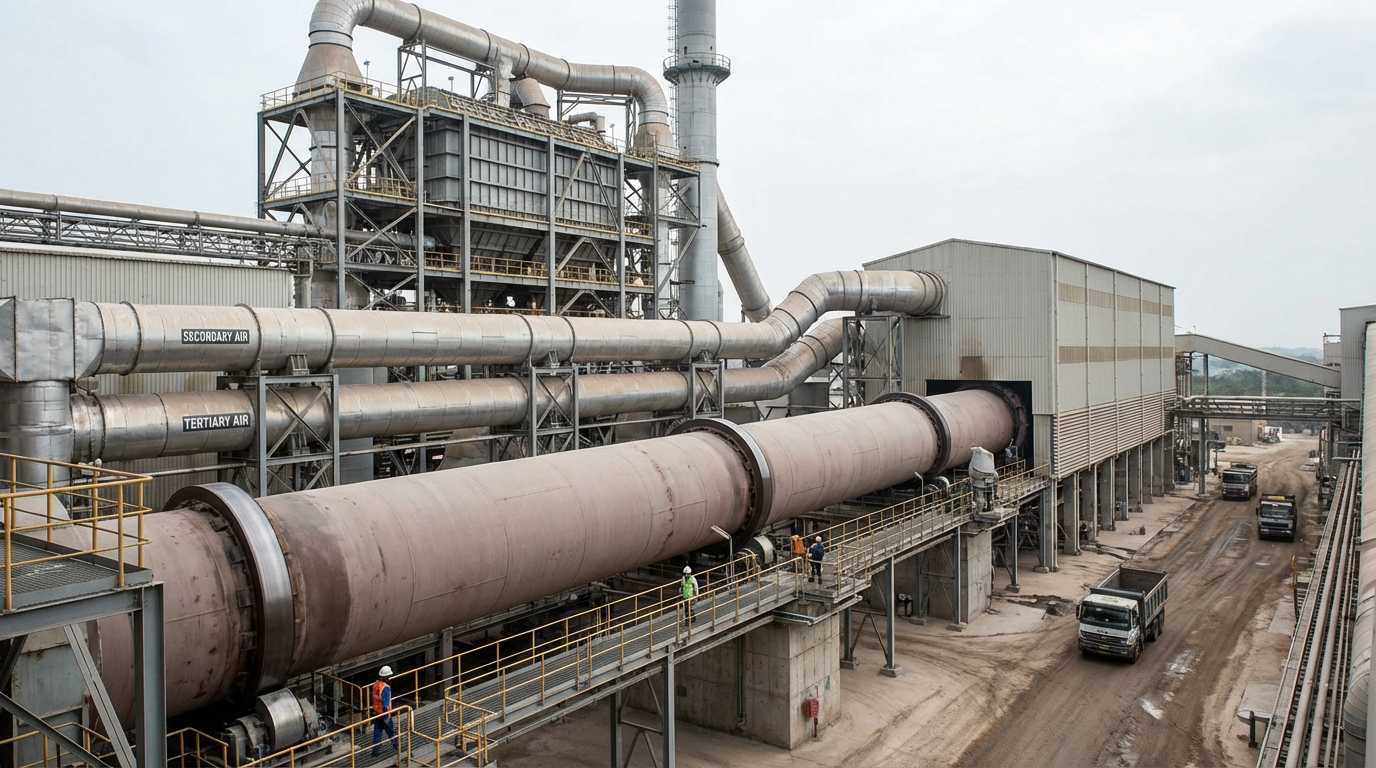
Clinker leaves the rotary kiln at roughly 1,400–1,500°C. The grate cooler's job is to extract as much of that thermal energy as possible and return it to the pyroprocessing system. Heat flows back through two high-value pathways: secondary air drawn into the kiln as combustion air, and tertiary air routed to the precalciner for raw meal decarbonation. Whatever heat remains exits as cooler vent air, typically at 200–350°C.
Higher secondary air temperatures mean higher flame temperatures and lower fuel demand. Recuperation efficiency, the ratio of heat returned via secondary and tertiary air to total heat entering with clinker, is the primary KPI for cooler optimization. Plants with weak recuperation carry that fuel penalty on every tonne produced.
The effect goes beyond fuel. Lower secondary air temperatures force operators to compensate with higher primary air ratios, which brings more ambient-temperature air through the burner. That additional cold air mass must be heated to flame temperature. Across the full pyroprocessing loop, that penalty compounds into measurably higher energy intensity.
Inconsistent secondary air temperature also makes combustion harder to stabilize. Flame shape and heat flux distribution in the burning zone depend on predictable air conditions, and fluctuations from the cooler force continuous burner adjustments that reduce process stability.
Plants tracking kiln-level specific heat consumption without connecting it to cooler recuperation often miss the source of the loss. A 50°C drop in secondary air temperature might not trigger an alarm, but across a full shift it adds measurable fuel cost. The cooler and kiln aren't separate optimization problems. They're one thermal system, and treating them in isolation leaves energy on the table every shift.
Uniform air distribution through the clinker bed is the single most important factor in cooler thermal performance. In practice, achieving it is difficult because the bed is never uniform across the full cooler width.
The main problem is particle size segregation. Large-diameter kilns discharge fine clinker on the load side and coarse clinker on the opposite side. Fine clinker creates higher airflow resistance, so cooling air follows the path of least resistance and channels through the coarse side while the fine side remains inadequately cooled.
That imbalance produces red river conditions: fine clinker fluidizes, moves faster than the grate, and reaches the discharge end still glowing red-hot. The damage isn't limited to lost heat recovery. Red-hot material contacts cooler walls, grate plates, and side seals in zones where those temperatures should never occur.
Components fail, and unplanned shutdowns follow. Those shutdowns hit cement plant performance harder than most operators realize, because the kiln restart cycle burns additional fuel to re-establish thermal equilibrium.
Total air volume creates another constraint. Too much air reduces secondary air temperature and promotes fluidization of fines. Too little air raises clinker discharge temperature and leaves more heat in the product.
Operators managing air distribution manually face a familiar trade-off: maintaining bed depth thick enough for proper airflow across the highest-resistance zones while protecting grate plates from overheating. Thin beds protect equipment but sacrifice heat recovery.
Undergrate pressure readings, the most common indicator of bed conditions, only tell part of the story. A single pressure value can mask wide variation across the cooler width, and operators making fan or grate speed adjustments based on that reading may correct one zone while worsening another.
Conventional process control systems can't resolve these interacting trade-offs because multiple zones need to move together.
The cooler occupies a unique position in the kiln line. It's both a product-handling unit and the primary energy source for combustion air. When cooler performance degrades, operators usually face the same choice: reduce kiln feed rate to maintain clinkering temperature, or accept under-burned clinker that compromises clinker quality downstream.
Feed rate reduction is almost always the response, but those lost tonnes don't come back.
The failure modes compound quickly, and they rarely stay isolated. Snowman formation at the cooler inlet restricts clinker flow and creates uneven bed depth. Uneven bed depth then triggers air channeling and red river conditions downstream. Coating fragments breaking from the kiln outlet can surge into the cooler and overload the bed.
Each event forces reactive intervention.
What makes the cooler a throughput constraint rather than just an efficiency problem is the cascading nature of these events. A single air distribution upset can trigger a feed rate cut, which changes kiln thermal conditions, which alters clinker characteristics entering the cooler, which affects air distribution again.
Manual recovery from that cycle takes time, and the conservative settings operators adopt during recovery often persist for hours or shifts beyond the original upset.
A feed rate cut intended as a temporary response becomes the default, and the window for meeting kiln process optimization targets narrows with each event. The kiln may be capable of higher feed rates, but the cooler's instability holds the system back.
That pattern directly limits capacity utilization across the full kiln line. Lost tonnes from conservative cooler settings accumulate shift over shift. Annual production erodes well below what the equipment can handle.
The core limitation of conventional cooler control is architectural. PID controllers often manage grate speed from undergrate pressure in a single loop, while fan speeds run constant. Advanced process control on cooler and kiln operations can coordinate more variables, but isolated loops still struggle when the cooler shifts across multiple zones at once.
Multivariable control approaches address that problem by managing bed depth, fan air distribution across zones, and grate speed as a coordinated system rather than as separate loops. Those variables interact continuously with secondary air temperature and kiln draft, and adjusting one in isolation often moves the others in the wrong direction.
Instead of reacting to one measurement at a time, the system learns from years of operating history, specifically how experienced operators handled specific combinations of clinker chemistry, kiln conditions, and cooler loading. The coordination matters most during feed rate transitions, when clinker characteristics can change faster than single-loop controllers can track.
Because the model trains on actual operating data from the plant's own historian, it reflects how that specific cooler behaves with its particular grate configuration, fan layout, and clinker characteristics.
No such system replaces the pattern recognition that comes from decades at the board, but it can sustain coordination that even strong operators achieve only intermittently. Plants that have deployed advanced process control on kiln and cooler systems have documented 3–8% energy savings, with payback periods that can range from three to eight months.
For most operations, building confidence in that coordination comes before committing to closed loop.
Advisory mode lets operators compare the model's recommended setpoint controls against what they would do themselves. That comparison matters most when the cooler moves through unstable conditions that are hard to coordinate manually.
Rather than working from a single pressure reading or one zone's temperature, operators and the model share the same view of how the cooler and kiln are interacting in real time.
That shared view also changes how teams diagnose cooler problems. Instead of debating whether high discharge temperatures came from fan settings or upstream kiln conditions, operations and process engineering can reference the same model of cooler-kiln interaction. When a shift hands over during an upset, the incoming team has the same context the outgoing team was working from, rather than starting from scratch with a handful of trend charts.
Newer operators build cooler intuition faster because they can see how process variables relate to specific cooler behaviors, rather than learning only from upsets. That kind of accelerated learning matters as experienced kiln operators retire and newer team members take on more responsibility at the board.
Plants can start with this kind of visibility and progress toward closed loop control at whatever pace builds confidence.
For cement operations leaders seeking to close the gap between current and achievable cooler performance, Imubit's Closed Loop AI Optimization solution learns directly from plant data. It writes optimal setpoints in real time across cooler and kiln variables. Plants can start in advisory mode, where operators compare recommendations against their own decisions, and progress toward closed loop control as trust builds.
Get a Plant Assessment to discover how AI optimization can improve heat recovery, reduce fuel costs, and remove throughput constraints across cooler and kiln operations.
Cooler efficiency affects fuel consumption through secondary and tertiary air temperature. When recuperation falls, the kiln receives cooler combustion air and must burn more fuel to maintain clinkering conditions. Lower secondary air temperature can also push operators toward higher primary air ratios, adding more ambient-temperature air that must be heated at the burner. Tracking energy efficiency across the full pyroprocessing loop connects cooler behavior to fuel cost.
Coordinated control can reduce red river frequency by improving how fan distribution, grate speed, and bed depth respond to changing conditions. Control alone doesn't remove the physical cause of particle segregation, but multivariable responses can reduce the operating conditions that make red river events more likely, particularly during feed rate changes and shifts in clinker in cement characteristics from upstream kiln upsets.
Secondary air temperature and clinker discharge temperature are the most useful shift-level indicators because they show heat recovery effectiveness and cooling completeness. Tracking those values alongside kiln specific heat consumption connects cooler behavior to fuel cost directly. Fan power per tonne of clinker adds another useful signal, showing whether total air volume is being used efficiently relative to cement plant performance targets.