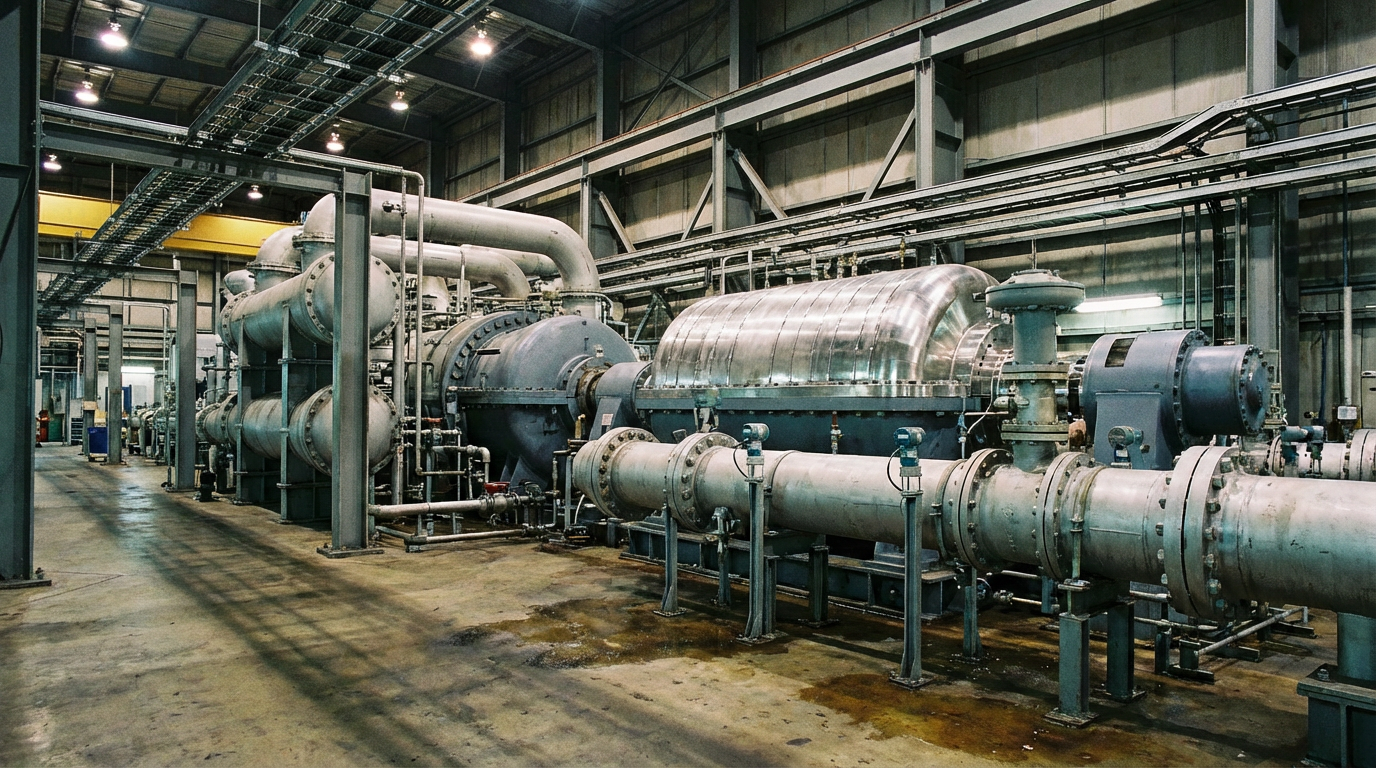
Centrifugal compressors often become expensive long before they become unstable. Recycle valves open wider, discharge temperatures creep up, and power costs rise—all without triggering alarms. The biggest efficiency gaps come from design assumptions drifting apart from actual plant conditions: fixed anti-surge settings that don't follow real gas properties, off-design loading, and static control models that lose accuracy with fouling and seasonal changes. AI optimization trained on real operating data can track these shifts continuously, recover energy across parallel trains, and align maintenance, planning, and operations around what each machine can actually deliver.
A centrifugal compressor usually gets expensive before it gets unstable. Recycle opens a little wider, discharge temperature creeps up, and the machine keeps running while power use quietly rises. In industrial processing plants, energy is one of the largest controllable operating costs, and operators applying AI in processing plants have reported 10–15% production increases alongside measurable margin recovery.
The biggest efficiency gaps usually come from design intent and process monitoring drifting apart over time, not from the equipment itself.
Compressor efficiency degrades when design assumptions, operating maps, and control settings drift from actual plant conditions. Most recoverable margin hides in plain sight.
Here's where those losses originate and what it takes to recover them.
A compressor's efficiency envelope starts with its hardware: impeller type, diffuser configuration, staging, and intercooling. Those choices define the practical trade-offs between head, operating range, and energy consumption. A vaneless diffuser, for example, supports a wider stable range but recovers pressure less efficiently at any given point; a vaned diffuser can deliver higher peak efficiency but narrows the window where that peak holds as conditions shift from design.
These trade-offs sharpen as gas composition, throughput, and inlet conditions move further from the original specification. Internal leakage paths in multi-section configurations can quietly erode performance over time, and those losses rarely appear as a single alarm, so periodic equipment performance review still matters.
But the design choice that costs the most over time is usually margin itself. A compressor sized for a future throughput case that never arrives may spend years operating left of its best-efficiency region. The machine still meets demand, but it does so with more recycle and more absorbed power than expected.
That kind of mismatch can persist for years because the compressor never trips or alarms; it simply costs more to run than it should. Recognizing where design margin has become operating penalty is the first step toward recovering it.
Most compressor efficiency losses accumulate in the operating region between surge and choke, well away from either boundary. The surge line marks where the compressor can no longer sustain forward flow and reverses, while choke marks where additional flow produces a sharp drop in developed head.
The control line sits to the right of surge to preserve margin, but the true surge boundary moves with inlet temperature, molecular weight, pressure, and fouling. A fixed surge control strategy may then become either too conservative or too risky.
A compressor doesn't need to hit either extreme to become expensive. It only needs to drift far enough from its best-efficiency region that power rises faster than useful compression work. When operators can see suction pressure, corrected flow, head, and recycle position together, the map becomes a decision tool instead of a commissioning artifact.
Fouling often appears first as a pattern rather than a trip point. Head falls at a given speed, discharge temperature creeps up, and recycle opens more often under loads that used to stay stable. Those signals are easy to miss in isolation, but together they show that the map the plant is using no longer matches the machine it's running.
Recycle economics are easy to underestimate because the compressor can look stable while wasting power. If a recycle valve stays open to protect margin under a condition that no longer exists, the machine keeps compressing gas that returns to suction.
Power draw stays high, but the process sees little added throughput. Industry accounts for roughly one-third of end-use energy in the United States, so persistent recycle losses compound quickly across a site with multiple compression stages.
Over-designed compressors often spend long periods in recycle. Better map visibility, combined with control strategy review, lets plants separate true protection needs from inherited conservatism.
The control layer often leaves the most recoverable efficiency on the table. Traditional decoupled PID loops handle one interaction at a time, so operators compensate with detuning, manual intervention, or wider anti-surge margins. Each workaround protects the machine, but it also leaves power savings uncaptured.
More advanced strategies, including advanced process control (APC), can coordinate variables better than independent loops in some applications. But stronger control still depends on how well its models represent the compressor's actual behavior under changing conditions. When the unit sees shifting gas properties, seasonal temperature swings, or gradual fouling, static models lose accuracy.
The resulting gap between model assumptions and real behavior grows wider with each season, and production efficiency erodes along with it.
AI optimization closes that gap by learning from plant data under real operating conditions. Instead of relying on a commissioning-era model that hasn't kept pace with the unit, the AI tracks how the compressor actually behaves as conditions move. Operations then have a better basis for balancing efficiency, throughput, surge margin, and equipment reliability at the same time.
That difference becomes practical when the plant has to choose between competing goals. A small move in suction throttling, speed, guide vane position, or recycle behavior may reduce power under one gas composition but narrow margin under another. Static logic usually protects the most conservative case.
A model that updates from observed behavior can evaluate those trade-offs under current conditions, drawing on the same plant operating data that engineers already trust.
Validation still matters. Engineers compare suggested setpoint moves with historical trends, machine limits, and recent operating actions before deciding whether the logic is seeing the unit clearly. When those relationships hold up across changing feed conditions and seasonal shifts, the model earns its place in the operating workflow.
The value of better compressor models compounds when plants run parallel trains. Load distribution across those trains affects both energy use and reliability, but most plants default to equal loading because it feels stable, even when one train is carrying hidden degradation. A slightly fouled machine may still meet its assigned load, yet do so at a higher power cost and with less surge margin.
Shifting even a small percentage of load from a degraded train to a healthier one can recover meaningful energy savings without adding risk to either machine. Adaptive control can manage that distribution based on real-time efficiency behavior and equipment condition, rather than following a fixed split that no longer matches the machines.
Compressor efficiency is rarely an operations-only topic. Maintenance, planning, engineering, and front-line operations often work from different assumptions about what the machine can deliver. The disconnect shows up in deferred seal work, throughput targets based on outdated curves, or load-sharing decisions that reflect habit more than current equipment condition.
A shared model of compressor behavior changes that conversation.
Maintenance can see how leakage or fouling is affecting efficiency before the next turnaround. Planning sets targets that reflect current capability instead of design-point assumptions. Engineering judges whether a control change or rerate addresses the real bottleneck. That kind of plantwide coordination gives different teams the same working understanding of the machine.
The implementations that build lasting trust usually begin in advisory mode. The AI optimization technology recommends setpoint changes, and operators decide whether to act on them. Experienced operators can compare recommendations against their own pattern recognition, while newer operators can see why a recommendation was accepted, delayed, or rejected.
That combination of coordinated decision support and human judgment gives advisory mode its standalone operating value, regardless of whether a plant later progresses toward closed loop.
For process industry leaders seeking to recover compressor efficiency margin, Imubit's Closed Loop AI Optimization solution learns from plant data and writes optimal setpoints in real time across compression systems.
Plants can begin in advisory mode, build confidence by comparing AI recommendations with experienced operator judgment, and then progress toward closed loop optimization on their own timeline. The platform integrates with existing distributed control system (DCS) and advanced process control (APC) infrastructure. Safety certification and prior control investment stay intact.
Get a Plant Assessment to discover how AI optimization can reduce compressor energy costs and recover hidden efficiency margin.
Traditional anti-surge systems focus on machine protection, not minimum power use. Most depend on fixed relationships set during design or commissioning, so margins often stay wider than necessary as gas composition, fouling, and ambient conditions change. That usually increases recycle and wasted energy. A more adaptive approach to surge margin can reduce that penalty while preserving protection.
Off-design operation affects plant margins by using more power, limiting throughput, and hiding losses inside normal production. A compressor can remain mechanically stable while operating far from its higher-efficiency region, especially when it spends long periods recycling or carrying load that doesn't match current conditions. Better visibility into efficiency metrics makes the gap easier to quantify and supports better control decisions.
Optimizing load across parallel compressor trains requires current visibility into each machine's efficiency, surge margin, and degradation state. Equal loading is common but rarely optimal, especially when one train is carrying hidden fouling or seal wear. Shifting load toward healthier machines based on real-time performance data can reduce total power draw while maintaining the same throughput. AI optimization can evaluate those trade-offs continuously, drawing on plant operating history to balance energy cost, reliability, and protection margin.