Batch reactors running the same recipe often deliver different results because design constraints, fixed controller tuning, and operator variability compound across every cycle. This article explains how heat transfer sizing and agitation set the tightest achievable control envelope, why fixed tuning drifts as composition and viscosity shift through the batch, and how reference-based analysis paired with advisory optimization recovers the margin gap between best and average performance across hundreds of annual batches.
Every batch reactor operator knows the frustration: two batches run the same recipe, same feedstock lot, same shift, and deliver different results. The gap between best and average performance represents recoverable margin most plants leave on the table. Advanced process modeling and data-driven batch optimization can reduce deviations across batch-processing industries, but the starting point is understanding where inconsistency originates and how it accumulates.
For operations running hundreds of batches annually, even a minute saved per cycle adds up across the year. The constraint is rarely a single broken loop or a bad recipe. Batch reactor control problems emerge from design decisions interacting with tuning limitations and operator variability, and the mismatch compounds every cycle.
As experienced operators retire, the institutional knowledge that compensates for gaps in chemical manufacturing optimization leaves with them. Recovering that margin means connecting equipment constraints, control strategy, and data-driven decision-making.
Batch reactor performance slips when equipment limits and control mismatch compound across the cycle. Small improvements matter because they repeat every batch.
The sections below connect those constraints to throughput, quality, and batch economics.
Batch reactor design decisions made during engineering set the operating envelope that the control system must work within for years. Heat transfer jacket selection, agitation configuration, and vessel geometry all affect how tightly temperature and composition can be managed during reaction. Those same choices also influence how quickly the reactor can return to productive service between batches.
Heat transfer sizing creates one of the clearest design-to-operations constraints. Agitation itself adds to the reactor's thermal load during high-agitation phases. When jacket cooling capacity doesn't account for that contribution, the cooling system becomes overstressed as viscosity increases during polymer processing and other exothermic reactions.
Operators then compensate by reducing agitation speed or extending cycle time to avoid temperature excursions, both of which cut into throughput.
Vessel geometry adds another layer. Aspect ratio and baffle design affect mixing uniformity, which in turn affects how evenly heat distributes through the batch. A tall, narrow vessel with standard baffles may develop dead zones at higher viscosities. Those dead zones produce localized temperature differences that the jacket can't correct from outside the wall.
These constraints exist before the control system even enters the picture.
Batch reactors present a control problem that fixed-tuning approaches can't solve well across the full cycle. Composition, viscosity, heat generation rate, and mass transfer coefficients all shift as the reaction progresses. A controller tuned for the beginning of the batch becomes less well matched by the middle and poorly matched by the end.
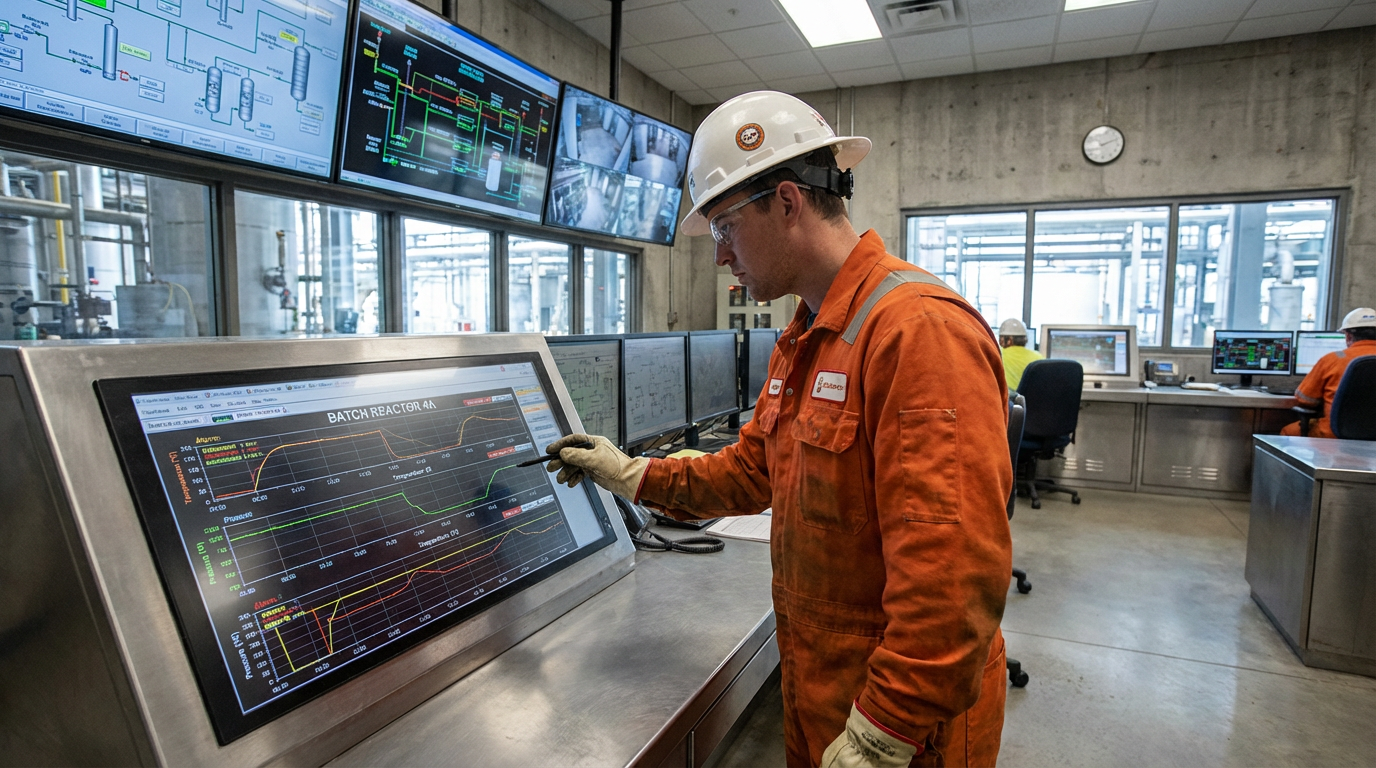
Temperature control shows that mismatch clearly. Steam heating responds quickly, while cooling water responds more slowly, and those modes have different process gains. A single tuning set rarely reconciles both conditions well, so the jacket can swing between steam and chilled water while reactor temperature overshoots recipe limits.
Cascade arrangements work when the inner loop is well characterized, but batch conditions change fast enough that even cascaded controllers struggle to track the evolving process dynamics.
Operators often respond by taking manual control. It keeps the process within bounds, but it also creates the shift-to-shift variability visible in batch records and pulls experienced staff away from other work such as quality sampling.
For exothermic reactions, operators commonly stay below theoretically optimal conditions to preserve chemical process safety margins. The gap between safe-conservative and optimally aggressive represents real capacity left on the table, and its size varies by who's on shift.
Measurement quality matters just as much. When readings sit inside an instrument's noise band, the control system can't tell whether it's seeing a real upset or random variation. Upgrading key sensors can improve batch-to-batch consistency before any advanced optimization layer is added.
Often, improving a handful of critical measurements delivers more value than adding software on top of unreliable signals.
Closing the gap between best and average batch performance starts with knowing what "good" looks like under comparable conditions. Batch economics often look modest when viewed one cycle at a time, but across hundreds of batches, the numbers compound quickly. In PVC production, for example, a minute saved per cycle can translate to significant annual capacity improvements in batch recycling time alone.
That's why reference-based analysis matters. By mapping performance and quality parameters to first pass yield benchmarks, operations teams can identify when a batch begins to drift and intervene before it produces off-spec material.
A stable reference for what good looks like also preserves hard-won operational expertise across shift changes and personnel turnover. When experienced operators retire, those reference patterns retain the observable relationships between process states and outcomes, even if they can't capture every instinct behind a veteran's judgment call.
Transitions between products multiply the same economics. Cleaning requirements vary by product sequence, and one batch's outcome affects the timing of the next. When teams optimize transitions using actual conditions rather than worst-case assumptions, they can recover batch cycle time that static recipes and conservative schedules leave stranded.
Feed variability makes the problem worse. Feedstock purity, moisture content, and catalyst activity differ from batch to batch, but static recipes execute the same timing and setpoints regardless. They ignore whether the catalyst is fresh or near end-of-life, whether the feedstock arrived from a different supplier, and whether the previous batch was excellent or off-spec.
Applying chemical reactor AI to learn from historical batch outcomes changes that pattern. Instead of starting every cycle from the same assumptions, the recipe becomes a starting point that adjusts to the conditions each batch actually faces. Off-spec risk drops without requiring operators to manually re-tune for every incoming lot.
For operations teams evaluating how AI optimization applies to batch reactors, the integration model matters as much as the algorithms. These systems typically sit above the existing distributed control system (DCS) and advanced process control (APC) layers. They read historical operating data and write setpoint adjustments through the current control hierarchy. Plants can add a learning layer without replacing infrastructure they've spent years calibrating.
The trust-building path usually starts in advisory mode. The system recommends adjustments based on what it has learned from historical batch performance, and operators decide whether to act. Experienced operators can compare the recommendation with plant reality: does the model account for feed variability, or for a fouled heat exchanger that the data may not fully capture?
For newer staff, advisory recommendations offer a decision-making process grounded in many past batches, not a single mentor's availability.
Advisory mode also reduces cross-shift variability. The model gives all crews a shared reference for how similar situations were handled before: a consistent baseline they can accept, modify, or override based on current conditions. That consistency builds across hundreds of batches annually. And because the model learns from outcomes, the recommendations improve as the plant accumulates more operational history.
A shared model changes cross-functional coordination as well. Operations, planning, maintenance, and quality teams can reference the same process behavior instead of relying on competing interpretations of what happened during a batch. When maintenance schedules a jacket cleaning, the model can show how fouling has affected recent performance.
When planning evaluates a product sequence change, the model can estimate transition impacts based on actual plant history. Knowledge transfer built on shared process data becomes more valuable as workforce turnover accelerates.
For operations leaders seeking to close the gap between average and best batch performance, Imubit's Closed Loop AI Optimization solution offers a path that starts with actual plant data. The system learns from historical and real-time operating history, builds an adaptive model tailored to each plant's batch reactor behavior, and writes optimal setpoints in real time through existing control infrastructure.
Plants can begin in advisory mode, where operators evaluate recommendations against their own experience, and progress toward closed loop operation as confidence builds.
Reliable batch analysis starts with measurement quality. When instrument readings sit inside the noise band, the control system can't separate a real process shift from random variation, and batch-to-batch comparisons become less useful. Teams should assess whether critical measurements produce signals that accurately reflect process state. Upgrading a handful of key sensors often has a bigger impact than layering optimization software over unreliable data, and builds chemical data readiness for more advanced applications later.
Yes. The optimization layer sits above the existing distributed control system and advanced process control layers rather than replacing them. It reads historical and real-time data, then recommends or writes updated setpoints through the current control hierarchy. Teams can begin with advisory recommendations, comparing them against actual plant behavior, and progress toward closed loop control as trust builds. No DCS replacement or major infrastructure change is required.
A useful reference captures what good performance looks like across a range of comparable conditions, not just a single perfect run. Teams map quality results, timing, and process parameters to create batch profiles that account for feed composition, ambient conditions, and equipment state. This gives operations, maintenance, and quality groups a common basis for comparison. Consistent reference profiles also support plant operator training by showing newer staff how experienced operators handled similar situations.