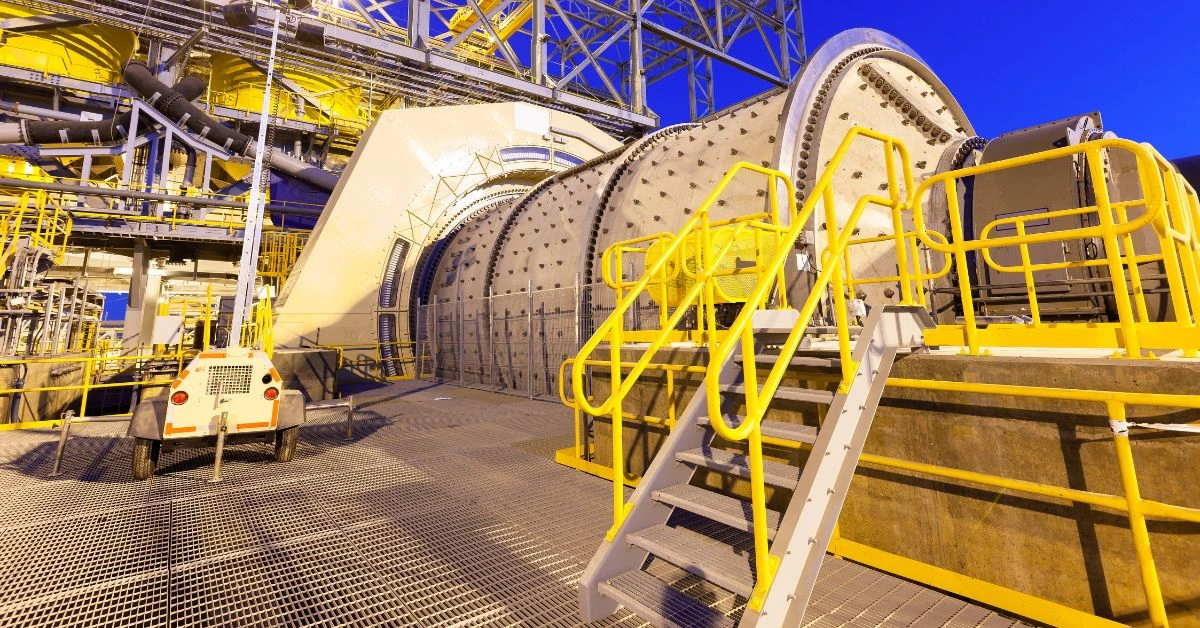
Ball mills form the critical core of mining and cement operations, consuming up to 40% of energy budgets while dictating production ceilings. These grinding vessels create precisely sized particles essential for downstream processing, making them strategic leverage points for plant-wide performance.
Traditional mill management approaches leave substantial value untapped. With rising energy costs and declining ore grades, suboptimal grinding creates significant hidden losses. The complex interplay of variables exceeds human capacity to optimize in real-time.
AI optimization transforms mills from constraints into strategic assets by continuously adapting to changing conditions. This maintains ideal particle distribution while maximizing throughput and minimizing energy consumption, creating a compounding effect that stabilizes downstream processes and drives competitive advantage across the entire production chain.
Why Ball Mills Determine Plant-Wide Performance
Understanding the pivotal role of ball mills in plant operations is essential for enhancing performance. At the heart of the process, the particle-size distribution (PSD) directly influences flotation recovery, kiln fuel efficiency, and production ceilings. When PSD is optimized, you achieve better flotation kinetics, leading to improved recovery rates and more consistent plant output.
The particle-size distribution leaving your mill sets the tone for every downstream unit. A few microns of drift can slash flotation recovery or force a kiln to burn extra fuel. Because the mill’s power draw often dwarfs every other motor on site, any inefficiency ripples through the process flow.
Several hidden constraints originate here. Variable ore hardness makes the mill oscillate between over- and under-grinding, creating recovery swings downstream. Operators often set conservative limits to avoid these issues, inadvertently restricting throughput. Quality giveaways increase costs when the grind is finer than necessary, wasting media, liners, and electricity.
Turning the mill into a performance lever starts with disciplined tracking. Plants can audit PSD targets based on downstream requirements, not historical habits, while aligning grinding KPIs with plant constraints such as thickener capacity or kiln residence time.
Establishing live dashboards that correlate mill signals with downstream recovery provides the visibility needed to remove bottlenecks. When your mill consistently delivers the right grind at the right rate, the whole operation runs closer to its true ceiling.
The Hidden Costs of Traditional Mill Control
Rule-based PID loops and occasional manual tweaks were built for steadier conditions than modern plants face today. When feed hardness shifts or moisture jumps, the mill drifts outside its “safe” zone, and operators often hedge toward conservative set-points. The penalty is steep: grinding circuits already rank among the most power-hungry assets, and each percentage point of inefficiency translates directly into higher energy bills.
Invisible losses pile up in multiple ways. An erratic particle-size distribution drags down downstream recovery, forcing compensation with higher reagent use or longer residence times. Vibration spikes and load swings accelerate liner fatigue, while suboptimal slurry density increases grinding media turnover. Chronic over-grinding wastes power and generates excess fines, creating additional operational inefficiencies.
The common thread is control rigidity. Data arrives in minutes, not seconds, so corrective moves chase the problem instead of preventing it. Operators juggle alarms, paperwork, and competing production goals, leaving little room for continual optimization. Meanwhile, static physics models overlook the nonlinear links between ore variability, water addition, and power draw.
To keep pace with modern throughput targets and sustainability pressures, mills need adaptive, self-learning control that responds to changing conditions in real-time, something traditional approaches simply weren’t designed to deliver.
How AI Models Learn Your Mill’s Unique Behavior
AI models learn mill behavior through years of sensor data, including power draw, feed rate, and particle-size distribution. By analyzing these signals, the model uncovers non-linear patterns that routine sampling misses and identifies optimal control moves. This data-first approach outperforms traditional rule-based strategies for grinding circuit optimization.
Once trained, the model functions like a digital twin, continuously updating predictions as conditions change. Unlike static physics models, this data-driven system adapts automatically to changing ore properties, liner wear, and instrumentation drift, eliminating manual retuning requirements.
Successful implementation requires reliable sensors, verified lab samples, and quality historical data that includes typical operational variability. A robust control network enables real-time data sharing for effective AI deployment.
To maintain data integrity and operator trust, implementation teams must clean data streams, monitor sensor drift, and balance model complexity. Crucially, metallurgical expertise must guide the AI to ensure recommendations remain grounded in operational reality rather than purely mathematical solutions.
Real-Time Adjustments That Cascade Through Operations
AI-driven real-time adjustments are transforming how plants achieve optimal performance by issuing continuous, high-frequency updates that fine-tune operations based on changing conditions. These systems adjust feed rates according to ore characteristics, optimize water addition to maintain ideal slurry density, and recommend precise ball charge adjustments to maintain grinding efficiency. Each modification contributes to stabilized grind sizes and enhanced downstream separation processes.
The broader impact of these micro-adjustments extends throughout plant operations. Stabilized grind sizes lead to better separation and flotation performance downstream, while reduced over-grinding results in lower energy consumption and decreased media wear. Consistently precise mill discharge improves flotation kinetics, leading to enhanced recovery rates, and optimized power draw supports increased throughput within existing constraints.
Effective monitoring proves essential to capture these benefits. Tracking power spikes and sump level swings through live dashboards reveals how adjustments propagate through downstream processes. Such proactive monitoring and real-time control underscore AI’s powerful role in enhancing throughput, quality, and efficiency across milling operations.
These capabilities illustrate AI’s transformative potential, allowing plants to operate closer to optimal conditions and achieve significant gains in operational efficiency while maintaining the precision required for consistent performance.
Building Confidence Through Measured Implementation
Turning an algorithm into a daily, low-risk value starts well before the first set-point change. Begin by letting the model learn from historical signals, then replay its decisions against past events. Virtual testing in controlled environments can pinpoint optimal ball charge without touching the mill, potentially cutting energy use in simulations by measurable percentages.
Once the offline benchmark confirms merit, shift into advisory mode. Plants following best practices first expose operators to AI recommendations while they retain full control of separator speed and feed rates. Dashboards reveal why each move is suggested, using explainable AI techniques that help identify key operational variables affecting energy consumption.
After operators trust the logic, activate the model during stable operating windows and let it update water addition or feed rate in real-time. Gradual, time-boxed activation helps capture early wins while keeping variance within safe limits.
Effective change management centers on transparency and control. Override buttons remain on every loop, and short training sessions focus on interpreting AI reasoning rather than coding. Cross-functional reviews keep maintenance and metallurgy aligned with the new control cadence.
Several common pitfalls require early attention: rushed commissioning demands clear validation criteria before going live, while alarm overload necessitates rationalizing alerts so new signals don’t overwhelm existing ones. Operator disengagement can be prevented by including crews from day one to build ownership, and setting achievable success metrics prevents overpromising while maintaining clear communication about progress.
Measuring Success Beyond Energy Savings
Cutting power use is just the beginning for AI-guided grinding operations. To capture full plant-wide value, implement a balanced scorecard that tracks how mill adjustments affect downstream processes. The most significant gains often come from throughput improvements, particle size consistency, and reduced equipment wear rather than energy savings alone.
A comprehensive KPI framework should include:
- Throughput is measured in metric tonnes processed
- Recovery or yield improvement percentages
- Grinding media consumption rates
- Equipment life extension metrics
- Particle size distribution variance
- Downstream process stability indicators
These metrics reinforce each other, as better particle size control reduces over-grinding, lowers media consumption, and stabilizes recovery processes. Even a small throughput increase can deliver multi-million-dollar annual revenue while extending maintenance cycles.
Verify these improvements through disciplined monitoring using statistical process control, comparative analysis, equipment inspections, and cross-functional reviews. This creates clear visibility from every set-point adjustment to measurable financial and operational benefits across your plant.
How Imubit’s Closed-Loop AI Optimization Transforms Mill Operations
Grinding variability drains energy, limits throughput, and sends instability rippling across every downstream unit. The Imubit Industrial AI Platform turns that constraint into an advantage. Its Closed Loop AI Optimization solution learns a mill’s unique signatures, then writes precise setpoints back to the control system in real time, steadily tightening particle-size distribution, power draw, and feed balance.
Think of it as an Optimizing Brain™ for your plant: a data-first modeling approach captures historical baselines, a deep reinforcement learning (RL) controller adapts on the fly, and dedicated value-sustainment services keep improvement curves rising long after commissioning. Plants that start in advisory mode can move toward full closed-loop confidence as results accumulate, unlocking steady improvements in energy intensity, throughput, and liner life.
Explore a low-risk proof-of-value workshop to see site-specific potential quantified before major investment. As the models keep learning, measurable ROI continues to grow, turning everyday variability into lasting competitive strength.