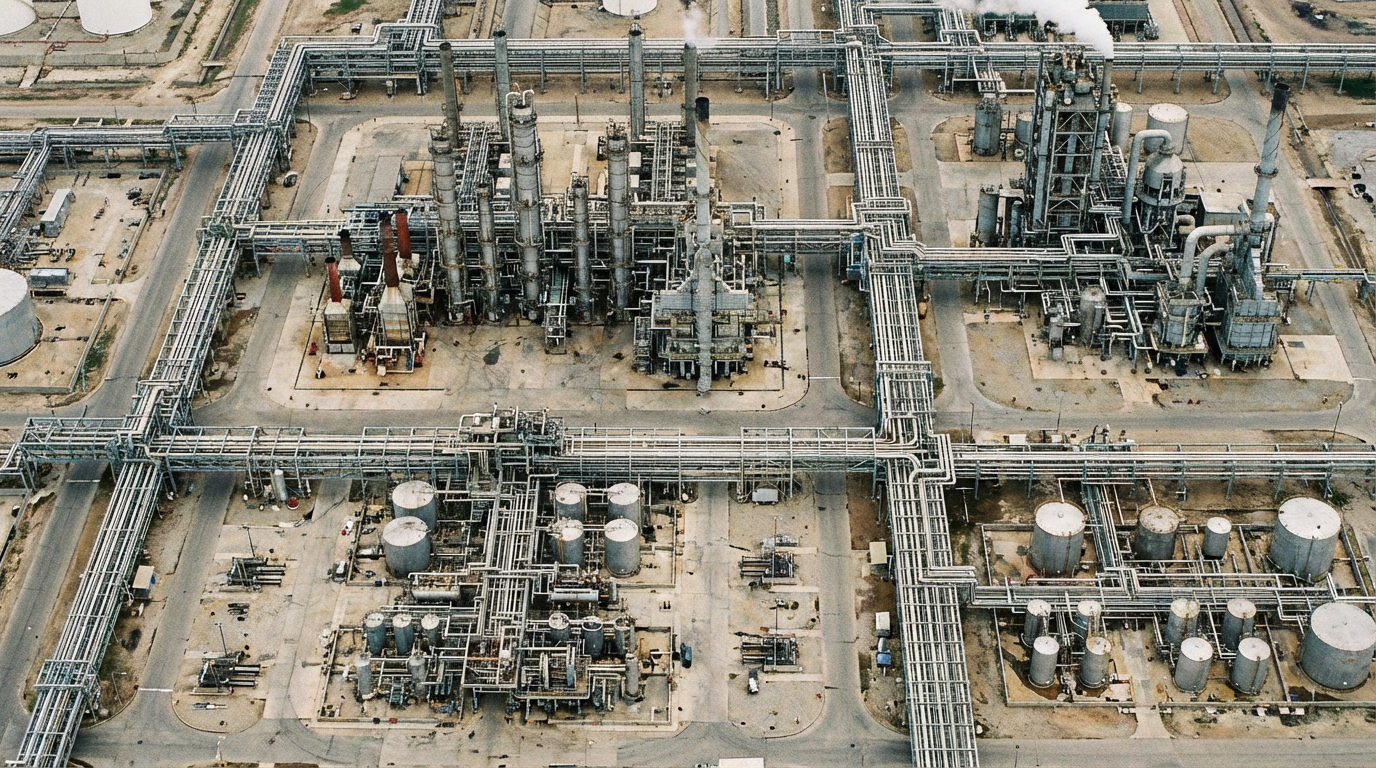
Vacuum gas oil feeds some of the refinery's highest-value conversion pathways, but no two VGO streams behave alike. Differences in sulfur, nitrogen, metals, and aromaticity change catalyst response, hydrogen demand, and product quality across FCC and hydrocracking routes. Single-unit optimization often misses the real economics because a local yield improvement can tighten fractionation, hydrogen balance, or blending constraints elsewhere. AI optimization connects feed quality, unit response, and plantwide economics using actual operating history, helping refiners make VGO routing and severity decisions against the active site bottleneck rather than stale planning assumptions.
Vacuum gas oil is the heavy intermediate fraction recovered from the vacuum distillation unit, typically boiling between 370°C and 565°C. It feeds some of the refinery's highest-value conversion pathways, including the FCC and hydrocracker, but it doesn't behave the same way twice.
With shifting product balances adding pressure to downstream margins, even a modest VGO quality change can alter catalyst stress, hydrogen demand, and product value faster than the rate target suggests. VGO is one of the barrels that most often exposes the gap between plan and operation in refinery operations.
VGO composition determines which processing route creates value and which constraint binds first.
The sections below walk through those trade-offs across processing pathways.
VGO sits at the center of refinery conversion economics because it can feed several high-value pathways, yet no two streams behave alike. Straight-run VGO, coker gas oil, and imported or blended streams can differ sharply in sulfur, nitrogen, metals, aromaticity, and endpoint.
Those differences affect catalyst response, hydrogen demand, coke tendency, and final product quality. What looks interchangeable in a planning model often behaves very differently in the unit.
The first screen is usually contaminant and stability risk. Sulfur, nitrogen, nickel, vanadium, and Conradson carbon can each narrow the practical operating envelope. In FCC service, those properties can increase dry gas and coke while reducing the flexibility to hold conversion. In hydrocracking or hydrotreating, the same properties can raise hydrogen consumption, catalyst deactivation pressure, and cycle risk.
Related limits often show up first in catalytic cracking optimization or hydrotreater performance, not in the feed tank itself.
Boiling range and density matter just as much. A heavier VGO cut may still carry strong value, but it often brings lower conversion ease and greater product quality sensitivity. Paraffinic and naphthenic VGOs typically process differently from highly aromatic streams, so the most profitable route depends on more than volume. The Deloitte downstream outlook notes how operators are leaning harder on operating discipline and feed flexibility as earnings pressure persists.
Assay averages can also mask the real problem. A monthly average sulfur or density number may look manageable while day-to-day variability keeps operators backing away from severity. Feed characterization needs to connect with process variability and not stop at a lab summary.
The barrel that hurts margin is often the one that stays within broad spec but arrives at the wrong moment, with the wrong contaminant mix, against the wrong unit constraint.
Pretreatment decisions start here as well. If a stream needs deeper hydrotreating before it can move safely into FCC or hydrocracking, the refinery has to weigh more than sulfur removal: hydrogen balance, reactor temperature margin, catalyst life, and whether the pretreatment step simply moves the constraint upstream.
The most useful view connects feed quality with current crude oil processing capacity and available conversion headroom.
The best VGO route depends on which unit can convert the barrel into the highest-value products without shifting a bigger problem downstream. FCC often offers strong flexibility and high conversion of suitable VGO into gasoline-range material and light olefins, but that value can fall quickly when feed quality drives coke, slurry, or wet gas compressor limits.
Hydrocracking can upgrade more difficult VGO into diesel and jet-range material with tighter quality control, yet that route depends on hydrogen availability, catalyst condition, and fractionation capacity.
Those trade-offs are rarely static. A VGO blend that looks attractive in the LP may lose value in real operation if hydrogen purity slips, reactor temperature margins narrow, or product tanks are already tight. But a lower-severity route that appears conservative can protect enough catalyst life, compressor headroom, or product spec margin to create better economics over the full operating window.
Planning value and operating value often diverge, which is why hydrocracker optimization decisions benefit from a broader site perspective.
Pretreatment changes the picture further. More hydrotreating can make a difficult VGO stream easier to convert downstream, but the added cost goes well beyond reactor duty. It can also consume hydrogen, shorten catalyst cycles, and shift where the bottleneck sits. A hydrotreater that improves downstream conversion may still reduce site value if hydrogen is already the refinery's active limit or if the extra severity narrows run length ahead of a turnaround.
Product destination matters too. The same VGO barrel can carry different value when diesel cracks are strong, when jet recovery matters, or when gasoline blending is already long. A routing decision that makes sense in one market can look weak a month later. Many refineries tie VGO decisions to refinery ROI improvement targets and blending limits rather than unit yield tables alone.
A refinery may see a short-term yield uplift by pushing a heavier VGO blend to FCC while hydrocracker hydrogen is tight. If that move raises coke enough to pinch regenerator temperature margin or wet gas handling, the apparent improvement disappears. The better decision can be a lower local conversion target that preserves flexibility for the rest of the site.
Treating VGO as a fixed-value intermediate usually misses that interaction.
Single-unit optimization often misses the real VGO decision because the economic effect shows up somewhere else. A conversion unit may push for more local throughput or severity because local yields improve. Downstream, the same move can tighten fractionation, raise gas handling load, increase hydrogen demand, or narrow product specification margin enough to erase the benefit.
That blind spot becomes more expensive when feed quality drifts. Controller performance depends on assumptions about feed behavior, catalyst condition, exchanger cleanliness, and unit dynamics.
When VGO quality changes, those assumptions age quickly. Teams then compensate with conservative moves, wider operating buffers, and more manual coordination between units. In many plants, the result is hidden margin loss rather than an obvious trip or rate cut. A plantwide process control view can expose those gaps.
Planning and operations often see different versions of the same barrel. Planning may assume a stable assay and produce a clean economic ranking for FCC versus hydrocracking. The board sees compressor loading near the edge, a fouled exchanger train, less reactor temperature margin than expected, or a blending pool already close to spec.
Both views can be reasonable, but they aren't equally useful in the moment.
AI optimization can connect feed quality, unit response, and plantwide economics beyond what traditional unit-level control was designed to coordinate. The model won't capture every instinct behind a thirty-year board operator's judgment call. But it can learn the observable relationships between VGO properties, equipment behavior, and the operating choices that repeatedly protected margin, because those patterns come from actual operating history rather than idealized process models.
VGO allocation decisions are rarely simple setpoint changes, so operators still decide whether conditions support each recommendation.
That broader coordination usually starts in advisory mode. The recommendation may be to shift VGO between FCC and hydrocracking, change hydrotreater severity, or hold rate to protect a more valuable downstream target. Operators stay in control while they test whether the recommendation matches current catalyst condition, product quality trends, and equipment response.
Over time, supervised use can extend that coordination, and closed loop operation becomes a later step rather than a prerequisite for value. When that model draws on heavy oil processing realities and live plant data, planning, maintenance, and engineering teams end up working from the same constraint set.
Exchanger deferrals, capital proposals, and yield assumptions all reflect current operating reality instead of diverging from it.
VGO coordination affects more than feed routing. Better VGO decisions can reduce avoidable severity swings, make hydrogen use more deliberate, and keep the refinery away from short-lived local improvements that create downstream losses. They can also improve conversations during shift handovers because the recommendation is tied to the active constraints rather than habit or a stale planning assumption.
That kind of refinery AI augmentation makes VGO economics visible across the operations team, including engineers who haven't spent decades managing feed quality. It also supports operator training by giving those engineers a structured view of how feed allocation decisions connect to site economics.
For refinery leaders seeking better VGO decisions with existing assets, Imubit's Closed Loop AI Optimization solution learns from plant data across interconnected units and writes optimal setpoints in real time through the existing distributed control system (DCS).
Refineries can begin in advisory mode, gain value there, progress through supervised operation as trust builds, and then move toward closed loop operation at their own pace as the system proves it can manage feed allocation, conversion severity, and refinery-wide trade-offs under changing feed and market conditions.
A VGO routing change stops improving margin when it relieves one limit but creates another that costs more. Moving more VGO to one unit can improve local yields, then run into hydrogen, gas handling, fractionation, or blending constraints. Refiners judge routing against the active site bottleneck, not a single unit target. Connecting VGO decisions to surge margin optimization and downstream loading gives a clearer picture of where the real limit sits.
Sulfur, nitrogen, metals, density, aromaticity, and Conradson carbon usually matter most because they shape catalyst stress, hydrogen demand, coke make, and product quality risk. The same assay can carry different value depending on current unit limits and downstream demand. Feed selection works best when assay data is read alongside conversion capacity and the targets set for hydrocracker yield optimization.
Operators validate VGO recommendations by checking them against known unit limits, recent catalyst response, product quality trends, and current equipment condition before changing targets. If the recommendation matches observed reactor behavior and downstream loading, trust builds faster. When it doesn't, the gap still helps because it points to missing assumptions or data issues. That review process is a practical form of knowledge transfer across shifts and experience levels.