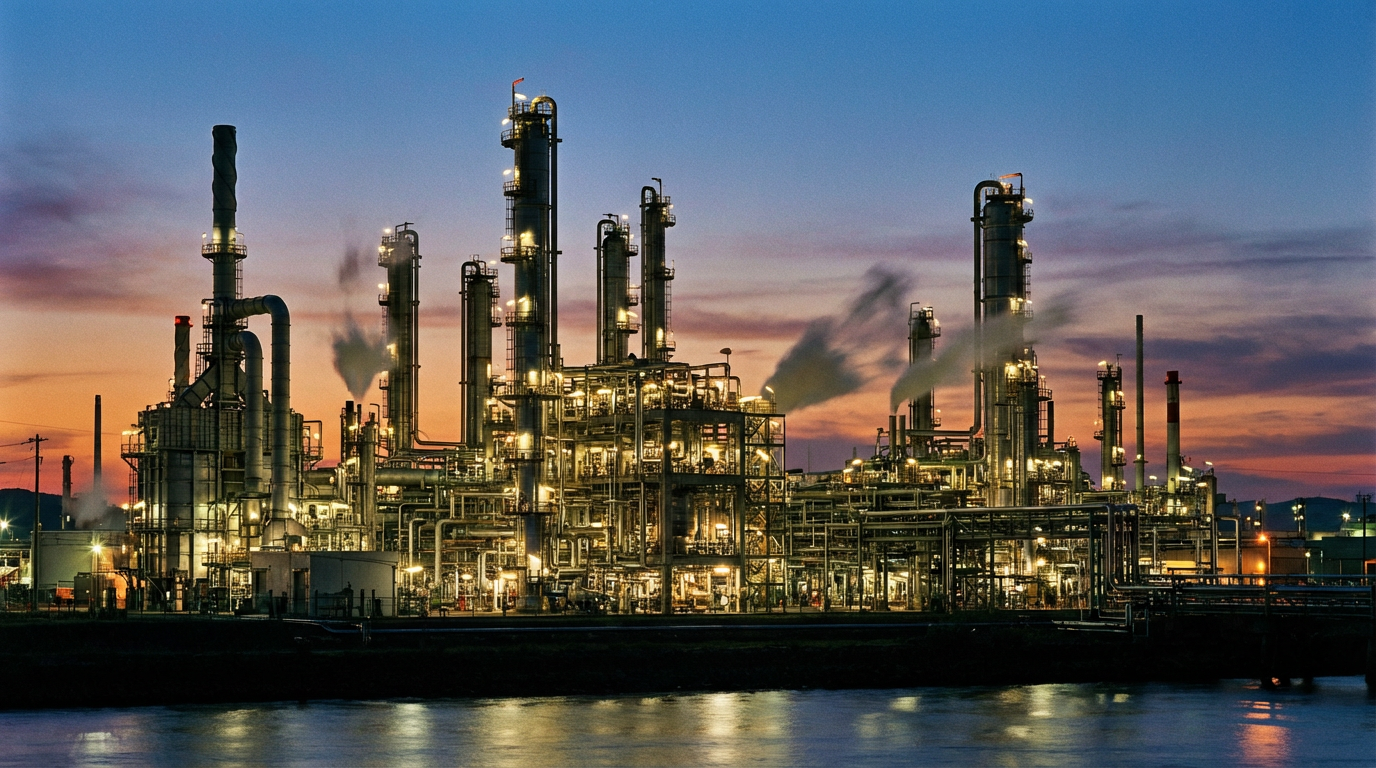
Vacuum columns can stay within formal constraints and still give away margin shift after shift when fixed control targets can't follow drifting feed, fouling, and ambient conditions. This article explains how pressure, column internals, and ejector performance interact to shape separation economics, why conventional control hierarchies leave recoverable value in the bottoms stream, and how AI optimization trained on actual plant data learns where true constraint boundaries sit under current conditions to coordinate the interacting variables that manual approaches and linear models miss.
A vacuum column can stay inside formal constraints and still give away margin shift after shift. Even a small rise in overhead pressure pushes operating temperature higher and can leave recoverable material in the bottom stream. That makes vacuum distillation optimization inside existing units more valuable than most capital projects.
Separation processes dominate energy consumption in refining and chemical processing, with industry overall accounting for nearly 40% of global energy demand, and distillation drives the bulk of that separation energy. Each shift, operators balance vacuum level, temperature, steam rates, and internal losses as feed composition changes, and the margin between optimal and acceptable in a vacuum distillation unit (VDU) compounds across every hour of plant operations.
The problem is rarely a single variable drifting out of bounds. More often, the operating window moves while fixed targets stay where they were. Many vacuum columns still operate well inside their constraint boundaries because the interacting variables exceed what conventional controls can coordinate in real time.
Margin slips away because the operating window moves faster than fixed targets can follow.
Here's how these constraints interact in day-to-day operation.
Vacuum distillation economics start with a basic relationship: lower external pressure reduces the temperature at which compounds boil. In high-temperature separation service, that matters because temperatures above the thermal limit can convert valuable material into lower-value byproducts and coke. Even a modest reduction in overhead pressure can improve product recovery by pulling more valuable material out of the bottom stream, and at typical throughput, that yield shift changes annual profit optimization economics.
A small pressure penalty at the top of the column often shows up later as lost recovery at the bottom.
The optimal overhead pressure changes with feed rate, molecular weight, steam injection rate, and current product economics. Operators work inside that moving target every shift, adjusting where they can. But in a unit where the vacuum system, column internals, and feed furnace all interact, the best pressure target at 6 a.m. may not be the best target at noon.
The gap between the current best pressure setpoint and the one the controller is holding often goes unrecognized until a yield calculation reveals what was left behind.
Higher temperature can convert more heavy material into valuable product. Push too far, though, and vapor velocity rises until heavy material contaminates the product. At that point, the margin reverses. The operating envelope between "not hot enough" and "too hot" is narrow in vacuum service, and it shifts with every change in feed quality or vacuum system performance.
Operational efficiency in a VDU depends on knowing where that envelope sits right now, not where it was last calibrated.
Column internals determine how much of the vacuum system's benefit actually reaches the separation zone. Every increment of pressure drop across internals works against the vacuum system and raises the temperature at the column base. That's why structured packing is widely used in vacuum service: it delivers lower pressure drop than trays for equivalent separation duty. But that energy efficiency advantage comes with trade-offs.
Fouling tendency depends on the service and the internal design, and open designs such as grid packing are often preferred in heavily fouling applications where structured packing would lose capacity between cleanings.
Vacuum generation equipment adds another constraint. Steam ejectors are designed for efficiency at a single inlet pressure. In multistage ejector systems, condensers remove motive steam and condensable vapors between stages, while downstream stages handle remaining non-condensables at progressively higher pressure levels.
Condenser fouling is a common failure path, and performance degradation in these systems tends to be gradual enough that operators may not notice the narrowing operating envelope until a process upset exposes it.
When condenser or ejector performance deteriorates, the effect reaches the separation itself. Operators lose room to trade pressure, steam, and temperature against one another. In deep-cut vacuum service, where the column is designed to recover the maximum possible gas oil from residue, this narrowing can directly reduce the most valuable product stream.
Pressure measurement can also distort decisions. In vacuum service, transmitter diaphragm damage during startup can create persistent measurement errors. A bad reading can make a healthy operating move look unsafe, or make a constrained unit appear to have room it no longer has. Either way, the operating team ends up optimizing against a picture that doesn't match the column.
Reliable pressure instrumentation depends on sound data historian practices as much as on the control logic that acts on those signals.
Conventional control hierarchies were designed around steady-state assumptions, and they deliver real value in that context. Regulatory PID control provides stability, model predictive control handles interacting variables, and real-time optimization (RTO) periodically computes optimal setpoints within the plantwide process control framework.
Each layer adds value. But the optimization layer was built to find the best operating point when constraint boundaries hold still, and in vacuum service, they rarely do.
RTO uses steady-state models and algorithms that find solutions at constraint boundary intersections. The approach works well when the boundaries are current. In practice, though, boundaries drift as feed composition changes, exchangers foul, and ambient conditions shift. In vacuum service, where condenser performance and ejector efficiency degrade between turnarounds, the constraint picture can change meaningfully within weeks.
The gap is less a flaw in the RTO than a mismatch between how fast the plant changes and how often the model gets updated.
Operations teams compensate by building conservatism into limits: holding overhead pressure targets higher than current vacuum system performance could support, maintaining flash zone temperatures below the thermal limit by more margin than current feed composition requires, or keeping stripping steam rates elevated when conditions don't demand it.
Those choices are understandable when the true constraint picture is unclear, but every increment of unnecessary conservatism compounds energy cost and leaves valuable material in the residue stream. For many vacuum columns, the core problem is coordination.
Too many interacting variables move at once for manual coordination or linear models to follow, and the economic best point can shift faster than the production optimization team can recalculate by hand.
AI optimization learns from years of actual operational history, laboratory results, and process model outputs instead of relying on idealized physics to predict how a shift in one variable affects the rest of the system. The distinction matters in vacuum service, where the important trade-offs are rarely linear, rarely constant for long, and rarely captured well by steady-state assumptions.
Constraint management is where the difference becomes practical. LP-based systems treat constraints as fixed limits, typically set during commissioning or a turnaround and updated infrequently. AI optimization trained on actual plant data can learn how those boundaries behave under current conditions, including the nonlinear interactions between variables that linear models can't capture.
The model doesn't replace operator judgment. It gives operators and engineers a current view of how much room the process has. Setpoint optimization based on learned constraint boundaries can recover margin that fixed-target strategies leave on the table.
Implementation usually starts in advisory mode. The model recommends setpoint adjustments, and operators evaluate those recommendations against their own experience. In that role, advisory mode has standalone value. Teams can use the recommendations for what-if analysis when throughput, quality, energy, and equipment limits pull in different directions.
The same operating view reveals where the column is losing flexibility over time as exchangers foul or feed quality shifts.
Some plants progress from advisory recommendations to supervised implementation and later to direct AI adoption as confidence builds. Others continue capturing value in advisory mode under operator oversight. When the model suggests a move that an experienced operator wouldn't have considered, the conversation that follows often exposes an opportunity neither side would have found alone.
These conversations build trust over time. Operator judgment still matters: conditions outside historical training data or equipment states the model hasn't encountered still require experienced operators to recognize and respond.
When maintenance, operations, planning, and engineering work from the same current picture of column behavior, turnaround decisions and constraint-management conversations improve. That shared view closes the gap between outdated yield assumptions and actual operating boundaries.
It moves the organization closer to self-optimizing plant performance.
For operations leaders seeking to close the gap between where their vacuum distillation units operate and where they could operate, Imubit's Closed Loop AI Optimization solution learns from actual plant data and writes optimal setpoints directly to the distributed control system (DCS) in real time.
Plants can start in advisory mode, progress through supervised use as confidence builds, and move toward closed loop optimization when the organization is ready. The technology integrates with existing DCS and APC infrastructure, building on the control foundation already in place rather than replacing it.
Get a Plant Assessment to discover how AI optimization can recover margin from your vacuum distillation operations by identifying setpoint improvements across interacting variables.
Startup conditions can damage vacuum transmitter diaphragms, and that damage creates persistent measurement errors during normal operation. Even a small error can distort how operators judge operating room, affecting temperature targets, steam rates, and constraint limits simultaneously. Sound AI risk mitigation in vacuum operations requires accurate measurement before it reaches the control logic that acts on those signals.
Advisory mode means the model recommends setpoint adjustments while operators decide whether to act. In practice, that gives teams the ability to test what-if moves when throughput, quality, energy, and equipment limits pull in different directions. It also improves cross-shift consistency by providing the same operating strategy view before any move is made. Some operations capture measurable yield and energy improvements in advisory mode without progressing further.
A shared optimization view gives maintenance, planning, operations, and engineering the same current picture of the column. Maintenance can see where fouling is tightening constraints, planning can compare targets with actual capability, and operations can explain why conservative moves are protecting yield. That coordination improves turnaround planning and leads to more realistic production efficiency targets across functions.