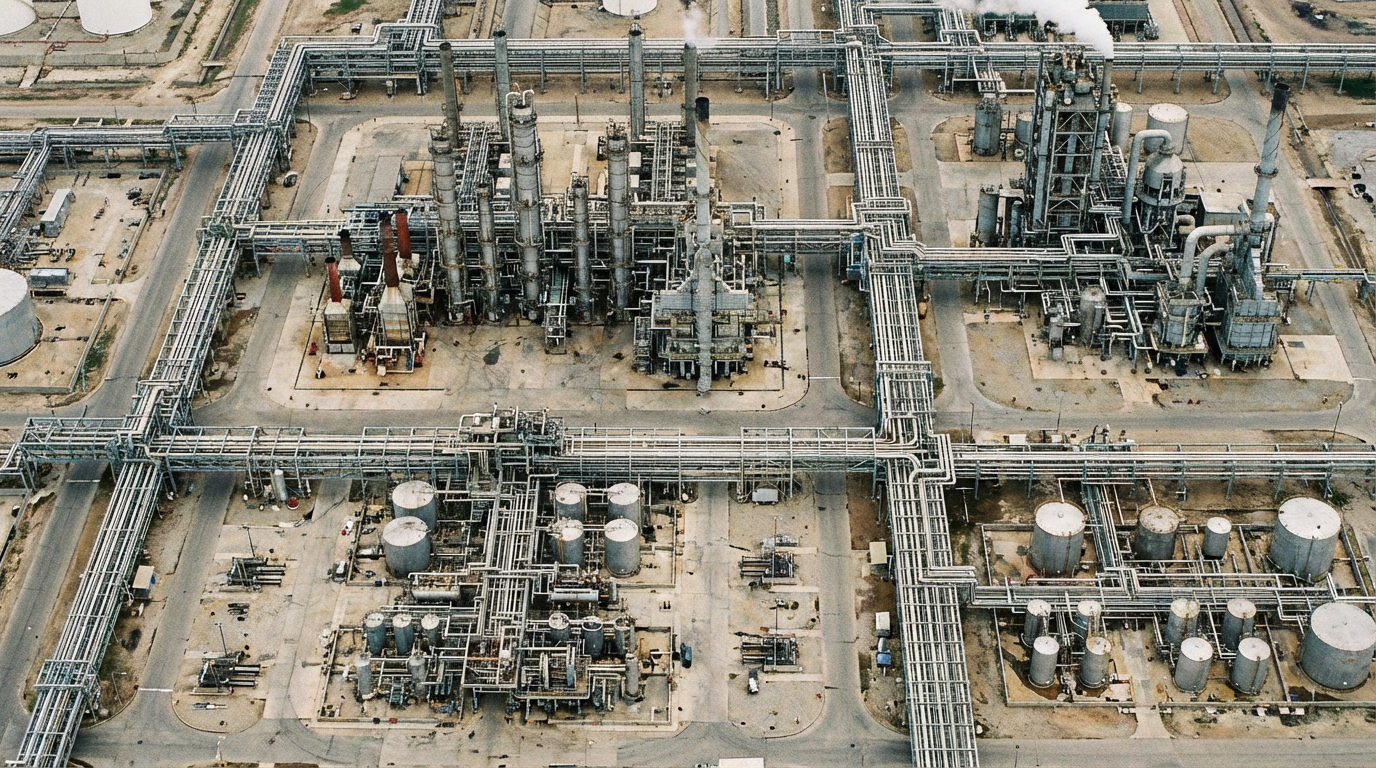
Every process plant has a DCS keeping operations stable and most have invested in APC, yet fewer than 10% of installed APCs are activated or optimized. The gap between installed value and realized value comes from how each automation layer's authority ends: DCS loops act independently, APC models drift as conditions change, and RTO updates too slowly to track real-time shifts. AI optimization adds an adaptive layer above existing infrastructure that learns nonlinear relationships from plant data, stays aligned to current behavior, and coordinates variables across the gaps where margin hides between stable operation and optimal operation.
Every process plant has a distributed control system (DCS) keeping operations stable. Most have invested in advanced process control (APC). Yet the gap between what these systems could deliver and what they actually deliver remains enormous. In some energy and materials sectors, fewer than 10% of installed APCs are activated or optimized.
That means the control technology most plants have already paid for, part of broader digital transformation efforts, is generating a fraction of its potential value.
Understanding why requires looking at what each plant automation layer actually does, where its authority ends, and what falls through the gaps. The answer has more to do with how decisions get made at different timescales in a running plant than with the technology itself.
Process plants operate through distinct automation layers, each handling decisions at different speeds. Where each layer's authority ends explains why installed technology often underdelivers.
The sections below map each layer and where AI optimization closes the gaps.
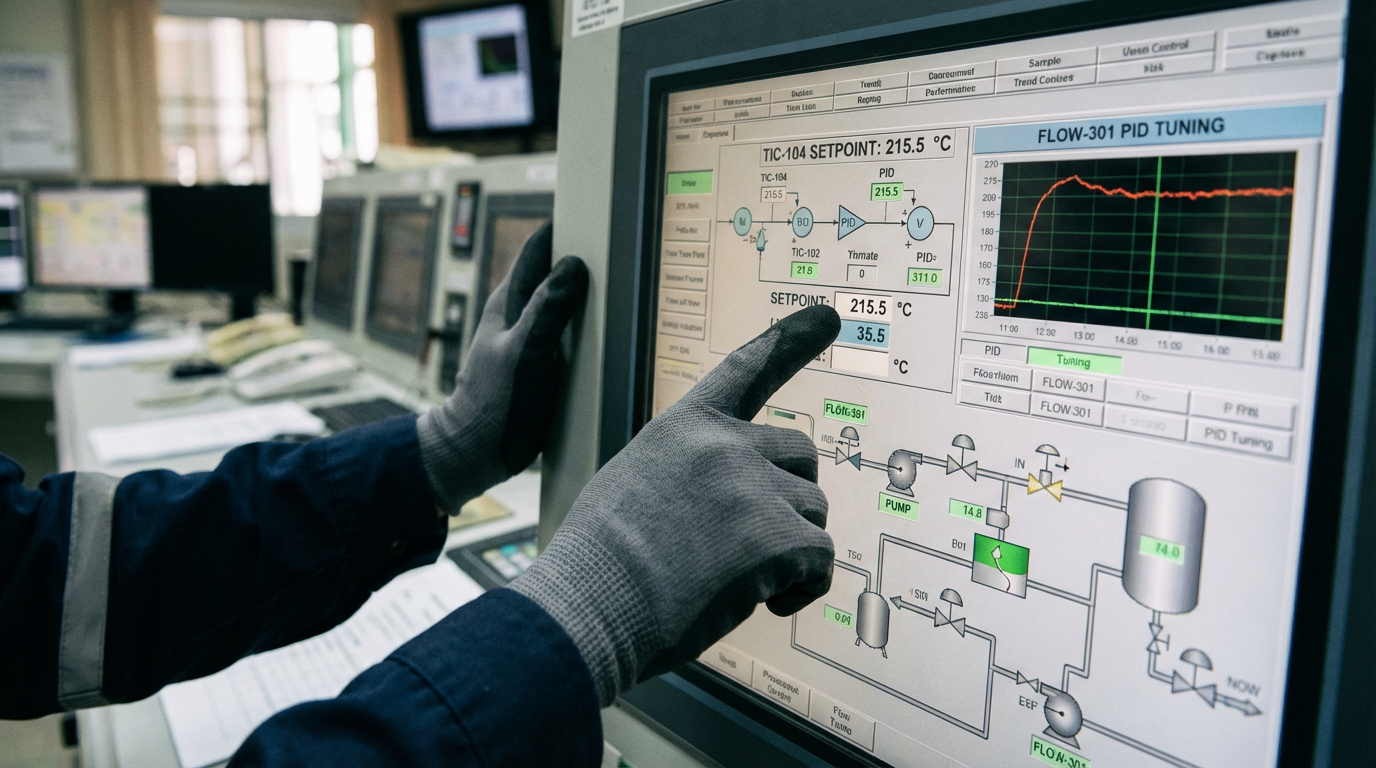
The DCS sits at the core of every process plant. Operating at the second-to-second timescale, it executes PID control loops that hold temperature, pressure, flow, and level at their setpoints. It provides the operator interface, alarm management, and continuous data collection that make everything else possible.
Where it falls short is equally important. Each PID loop operates independently. A temperature controller on a column knows nothing about the pressure controller on the same column, let alone what is happening upstream or downstream.
In practice, this shows up as "tug-of-war" between loops: pressure, temperature, and level controllers each do their job while the unit as a whole drifts away from its economic optimum. Operators often act as the coordinator, deciding which loops get priority during a disturbance.
Modern DCS configurations can include cascade, ratio, feedforward, and override strategies. Those tools help, but they still encode local logic. They rarely represent plant-wide trade-offs such as throughput versus energy, quality versus recovery, or short-term stability versus long-term fouling.
The DCS operates reactively, responding after a disturbance moves a variable off setpoint. That reactive architecture means process units must run with wider safety margins. Throughput and yield stay below what the equipment could physically deliver. And the biggest economic decisions sit "above" the DCS by design: the control system can hold a setpoint precisely, but it doesn't decide which setpoint is economically best right now.
When feed properties shift, ambient conditions change, or a downstream constraint tightens, the control system holds the line. People decide whether to push, back off, or trade quality for rate. None of this makes the DCS inadequate at its job.
Stable operation and optimal operation are simply not the same thing, and the distance between them is where margin hides.
Advanced process control (APC), typically implemented as model predictive control, adds a critical capability the DCS lacks: multivariable coordination. Instead of managing loops independently, APC simultaneously adjusts dozens of interacting variables to push the process closer to its most profitable operating point.
At the control-room level, APC works like a disciplined "move planner." Every control interval, it predicts how the unit will respond to potential moves, then selects moves that respect constraints. That matters because the best operating point in a process plant is usually right at the edge of equipment limits, quality limits, emissions limits, and downstream bottlenecks.
The business value is real when the application stays healthy. Well-maintained APC can deliver throughput improvements, tighter constraint management, and more consistent quality. The problem is sustaining that value.
APC relies on mathematical models built during commissioning through step-testing. As feed quality shifts, equipment fouls, and catalyst activity changes, the models drift from reality. Sustaining performance requires periodic retuning, and without consistent maintenance, the majority of APC applications degrade or get sidelined within a few years.
APC performance can also be limited by real plant conditions that have nothing to do with the controller math. Sticky valves, analyzer drift, instrument noise, and changing operator procedures all degrade prediction quality. The controller may still be "running," but operators stop trusting it when recommendations push into conditions that feel unstable.
APC also typically covers a single process unit or a handful of related units. Coordinating optimization across an entire facility, where upstream decisions cascade into downstream constraints, falls outside its scope.
Real-time optimization (RTO) sits above APC in the automation hierarchy. RTO systems use rigorous process simulations to calculate economically optimal targets, then pass those targets down to APC for execution. In theory, RTO bridges the gap between business economics and process control.
In practice, the bridge has structural limits. Traditional RTO typically updates on an hourly cycle or slower. Between those updates, the process may move through several operating regimes that the last optimization run didn't anticipate.
RTO also depends on APC to execute its targets faithfully, so degraded APC directly limits RTO effectiveness. And because RTO models require the same kind of maintenance as APC models, the same resource constraints that starve APC of attention often affect RTO as well.
Above RTO, planning sets targets based on commissioning-era assumptions and weekly or daily scheduling horizons. Operations compensates with conservative setpoints, and maintenance defers work that operations urgently needs.
Each function optimizes for its own priorities through siloed operating strategies, and the organization leaves margin unrealized.
Quality feedback shows how this plays out in practice. Many plants rely on lab samples or slow analyzers, so the true quality constraint arrives after the process has already moved. Operators compensate with giveaway to avoid off-spec product, and APC respects a constraint it cannot "see" in time.
Meanwhile, a partially fouled exchanger or a drifting analyzer quietly tightens constraints without triggering an alarm. Operations adapts by widening operating margins rather than coordinating with planning and maintenance to address the root cause.
No AI system replaces the pattern recognition that comes from decades at the board. But the coordination gaps between automation layers, and between the teams that manage them, represent recoverable value that no amount of individual expertise can fully address alone.
AI-powered process control doesn't replace DCS or APC. It adds an adaptive layer above them that learns from plant historian data and stays aligned to current plant behavior as conditions change. Where APC relies on linear models that approximate a narrow operating range, AI optimization captures the nonlinear relationships that actually govern how a unit behaves across different feed rates, ambient conditions, and constraint regimes.
In practical terms, this matters when the "same" move produces different results depending on where the unit is operating. A change that is safe and profitable at one throughput can become unstable near a constraint. Static linear models struggle there, which is exactly where plants want to operate.
The financial case strengthens when this layer stays active. After one industrial goods company embedded AI across its operations, BCG documented a 2 percentage-point EBITDA increase within two years.
Integration typically uses software gateways into existing DCS infrastructure, so existing loops, field devices, and safety systems stay in place.
The implementations that earn operator trust start in advisory mode. The system recommends setpoints, and operators decide whether to act. Over days and weeks, the conversation shifts from "Should this be trusted?" to "When does it perform well, and when should I override it?" That's a healthier foundation for adoption than forcing closed loop control on day one.
Advisory mode also changes how knowledge spreads across a team. Senior operators can sanity-check recommendations with decades of context, while newer staff see consistent optimization strategies across shifts. When those recommendations are logged alongside outcomes, the plant builds a record of what actually works, grounded in its own operating data rather than tribal knowledge.
As confidence grows, some plants move toward closed loop operation where the system writes setpoints directly. That step typically depends on clear guardrails, including well-defined constraints, rate-of-change limits, and a straightforward path to manual takeover. Closed loop is a destination. Advisory mode can deliver value while the organization builds the operating discipline to sustain it.
For operations leaders looking to close the gap between installed automation and realized value, Imubit's AI platform for Closed Loop AI Optimization learns from actual plant data and writes optimal setpoints in real time through existing DCS infrastructure. Plants can start in advisory mode, building operator confidence with AI recommendations before progressing toward closed loop control at a pace that fits the organization's readiness.
Get a Plant Assessment to discover how AI optimization can recover unrealized value from every layer of your existing automation stack.
Yes. AI optimization operates as an overlay above existing infrastructure, so it does not require APC to be fully functional. Plants with underperforming APC often see the most immediate benefit because the distance between current operation and optimal operation is widest. The AI model learns directly from plant historian data rather than depending on maintained step-test models.
Engineers designed each layer for a different purpose. DCS maintains stability, APC pushes constraints, RTO calculates economic targets, and planning sets weekly schedules. As equipment fouls, feed quality shifts, and operator workarounds accumulate, the assumptions baked into each layer diverge from reality. Each function optimizes locally while the plant as a whole drifts from its economic potential. An AI adoption strategy that addresses this disconnect can reconnect intent to execution across the hierarchy.
Traditional RTO uses rigorous process simulations to calculate optimal targets, typically updating hourly. AI optimization learns dynamic, nonlinear relationships directly from operational data and adapts continuously as conditions change. RTO also depends on APC to execute its targets, so underperforming APC limits RTO effectiveness. Smart manufacturing with AI can write setpoints directly to the control system. That closes the execution gap that often prevents RTO targets from being realized.