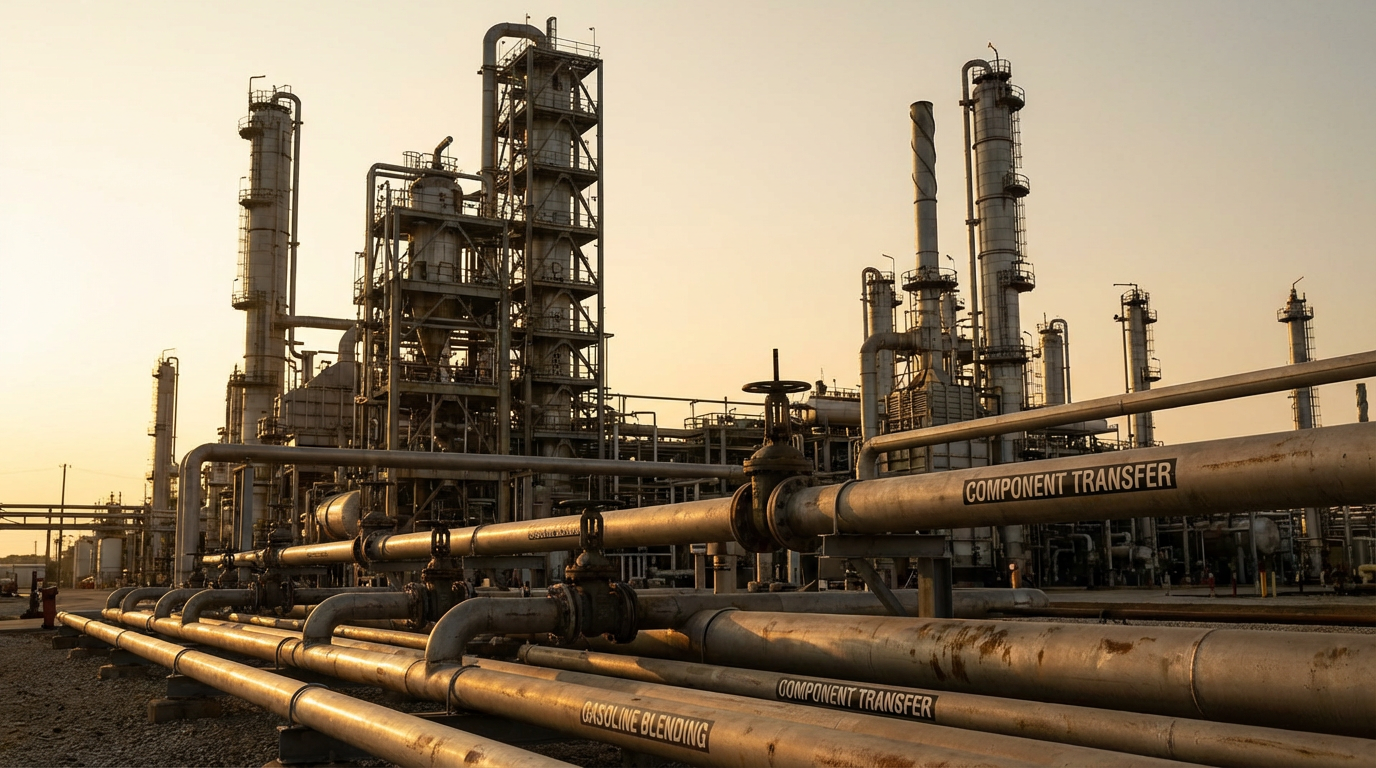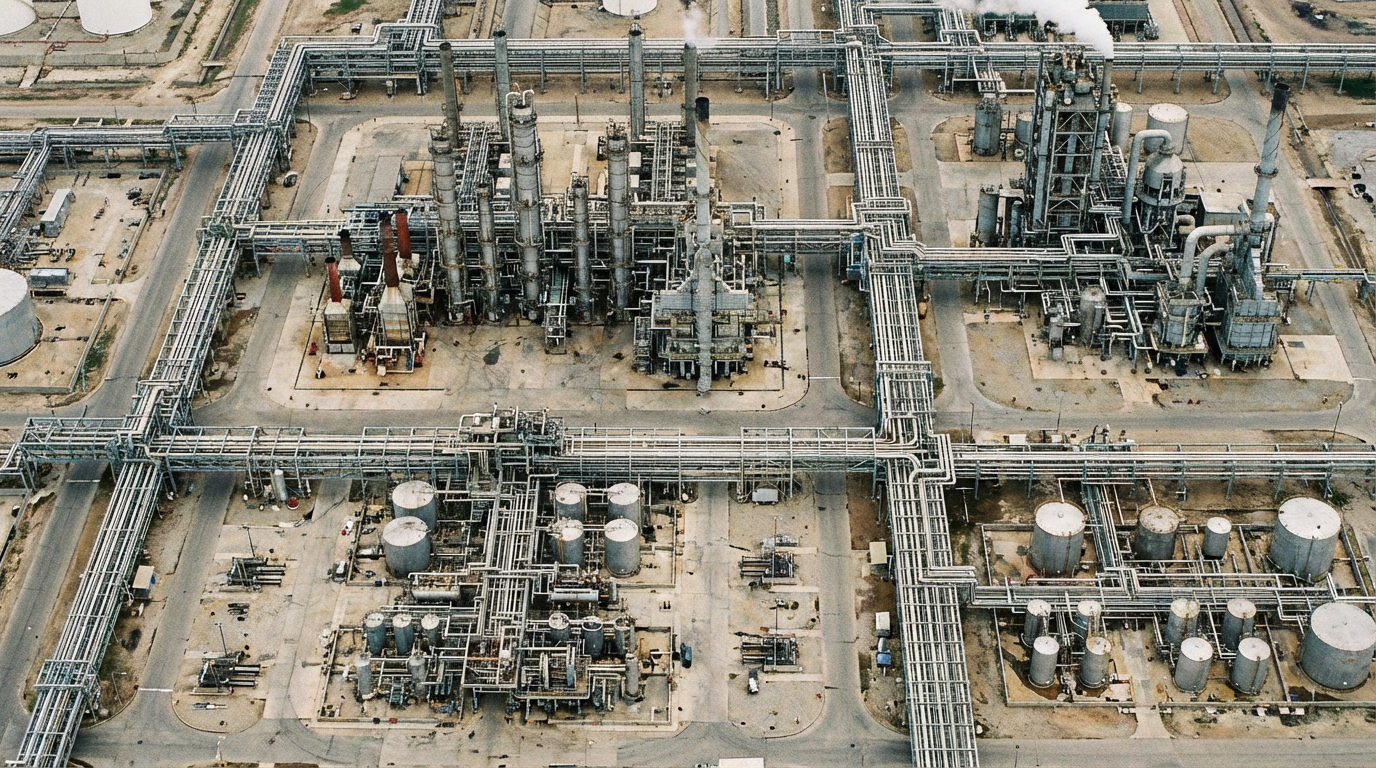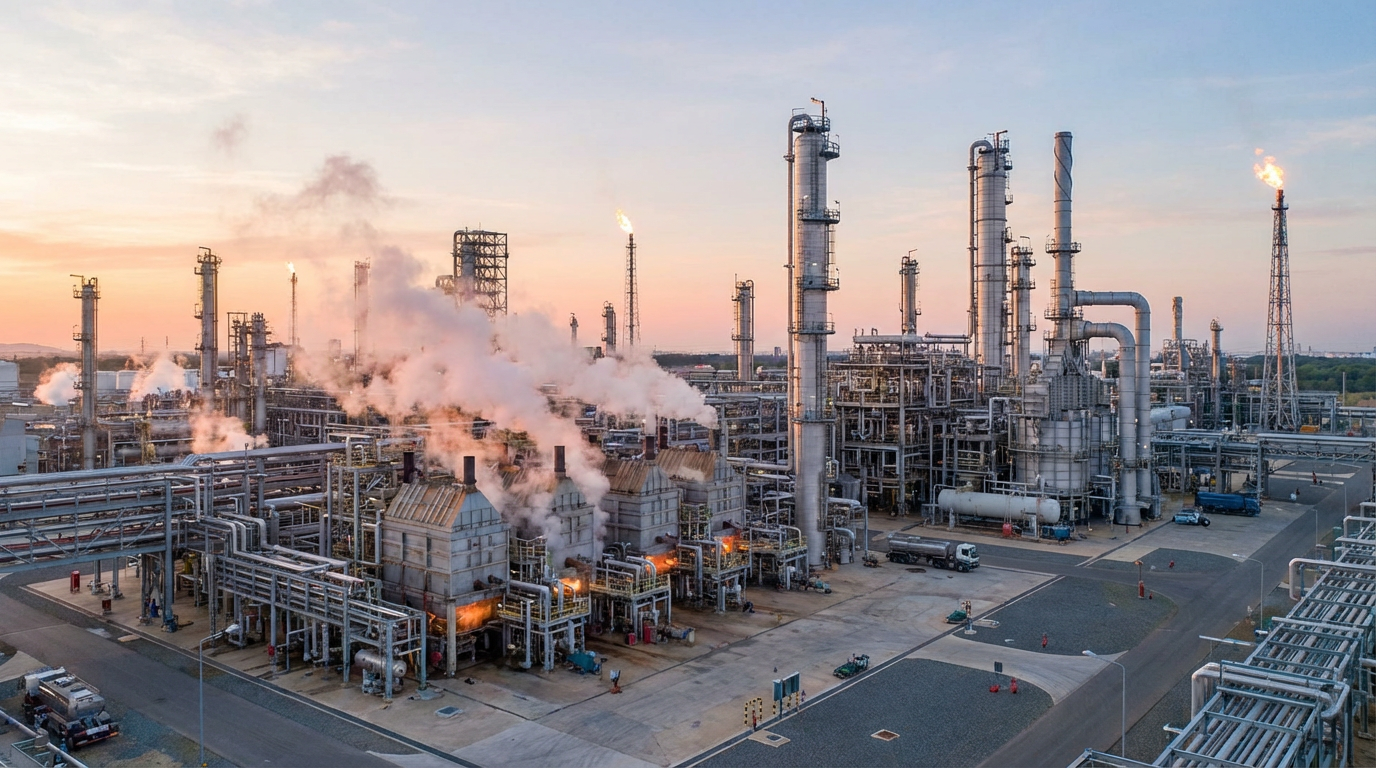
Petrochemical plants run a continuous balancing act between furnace severity, product quality, and energy cost. Feedstock choice shapes everything downstream—from cracking yields and co-product mix to the energy-intensive recovery and fractionation steps that can move margin almost as much as furnace performance. Product transitions compound losses through off-spec material, conservative targets, and delayed recovery. Traditional control layers stabilize operation but lose accuracy during unsettled periods when feed quality, fouling, and catalyst aging introduce nonlinear behavior. AI optimization trained on actual plant history fills those gaps, helping operators coordinate interacting variables and recover margin that fixed models leave on the table.
Every petrochemical complex runs a continuous balancing act: push furnace severity for ethylene yield, hold quality tight enough to avoid off-spec downstream output, and keep energy use from erasing the value of higher rates.
That pressure shows up in financial performance. Average return on capital employed for global petrochemical companies fell from 8% to roughly 4% between 2019 and 2024, partly explaining the closer attention now paid to continuous process control, unit economics, and operating discipline.
A petrochemical plant converts hydrocarbon feedstocks into intermediates for plastics, fibers, and industrial supply chains. Margin depends on feed choice, cracking severity, recovery efficiency, and transition management.
The sections below explore how those constraints shape modern petrochemical plant operation.
A petrochemical plant creates value by converting hydrocarbon feedstocks into reactive chemical building blocks that other units can turn into higher-value products. Unlike a refinery, which mainly separates crude fractions by boiling point, a petrochemical plant changes molecular structure. That difference is why conversion severity, quench timing, and recovery efficiency matter so much to plant economics.
Feedstock selection is one of the most consequential operating decisions in the complex. Ethane, common in the U.S. and Middle East, generally favors ethylene production with relatively few co-products. Naphtha, more common in Asia and Europe, yields a broader slate that includes propylene, butadiene, and aromatics, but it also creates a heavier separation burden downstream.
Managing that feedstock variability is one reason many sites pay close attention to plantwide coordination rather than unit-by-unit optimization alone.
The main conversion step in many sites is steam cracking. Hydrocarbons pass through fired furnace coils at roughly 750–850°C with residence times measured in fractions of a second. Coil outlet temperature, hydrocarbon partial pressure, steam dilution, and residence time all influence selectivity. Small changes in severity can shift yield enough to affect site economics, especially when feed prices move or derivative demand changes.
In practice, that's where tighter process optimization makes the largest difference.
The cracked gas then has to be cooled quickly in a transfer line exchanger and downstream quench system. If cooling lags, secondary reactions continue and consume the olefins the furnace was trying to make. Operators see the effects in ethylene recovery, byproduct formation, exchanger fouling, and the stability of the separation train that follows. In other process units, similar patterns apply: a few minutes of delay shift the rest of the operating window.
After quenching, the mixture enters a demanding recovery section. Compression, acid gas removal, drying, cryogenic recovery, and a sequence of fractionation columns isolate hydrogen, methane, ethylene, propylene, and heavier streams.
These steps are among the most energy-intensive parts of the site. The IEA has identified the chemical and petrochemical sector as the largest industrial energy consumer, with primary chemical production accounting for roughly two-thirds of the sector's total energy demand. Compressor efficiency, exchanger performance, refrigeration balance, and column operation move margin almost as much as furnace yield does.
Sites that keep these interactions visible usually make better plantwide process control decisions when conditions change.
Petrochemical plants produce intermediates, not finished consumer goods. The business case depends on how reliably the plant converts those intermediates into consistent downstream performance.
Ethylene and propylene anchor most olefins chains. They feed polyethylene, polypropylene, glycols, and many other derivatives that end up in packaging, automotive components, construction materials, and textiles. Product value depends less on simple volume than on how consistently the plant holds quality, energy intensity, and downstream unit rates.
Many operations teams connect production targets to off-spec reduction rather than treating rate as the only measure.
Aromatics production follows a similar pattern. Heavy naphtha converts into benzene, toluene, and xylenes. Those intermediates feed styrene, phenol, and polyester chains. Integrated sites that extend into polymer units shift their targets toward product properties and reactor stability.
The highest-value ton is the one that meets spec without forcing extra recycle or rework, which is one reason site-level operating strategy shapes overall performance, not just results within a single unit.
Downstream quality risk often shows up during transitions. A site may need to change product slates because of feed economics, derivative demand, maintenance events, or inventory constraints. Each change introduces a period where composition, temperature, residence time, or additive balance is settling into a new target. In polymer service, that can mean off-spec material.
For intermediates, the result is often inventory imbalances or purity drift that pushes constraints onto downstream units.
Those losses compound because lost margin rarely appears as one dramatic event. More often it shows up as a few hours of downgraded material, extra utilities, a conservative operating target, or delayed recovery after a rate change.
Plants that manage transitions well protect more of that margin than plants that chase peak output without a clean path between products. Better knowledge transfer between shifts often makes the difference, because the next crew inherits both the operating target and the transition logic behind it.
Modern petrochemical plants stay stable through a layered control architecture, with each layer solving a different part of the operating problem. The distributed control system (DCS) forms the base. It keeps temperature, pressure, flow, and level inside target ranges while collecting alarms, operator actions, and diagnostics into one operating picture.
On cracking furnaces, coil outlet temperature is one of the key variables because it sets cracking severity and strongly influences product mix. In separation service, column pressure, reflux ratio, compressor loading, and exchanger approach temperature carry equal weight. Operators work inside a system of coupled constraints, where a move that improves one variable can tighten another within minutes.
That's why many sites use advanced process control to coordinate interactions the base control layer can't manage alone.
Advanced process control (APC) sits above the DCS as a supervisory layer. APC coordinates interacting variables and reduces variability during stable operation, which can improve yield consistency and energy efficiency. It's especially useful in units that spend long periods near steady state, such as compression trains, fractionation sections, or derivative units with repeatable operating windows.
Real-time optimization (RTO) sits above APC in many plants. It calculates economically preferred targets from process models and current unit conditions. In principle, RTO connects planning intent to unit constraints. In practice, performance depends on how well those models keep up with aging equipment, exchanger fouling, feed changes, and shifting process behavior.
That handoff between economics and execution is part of the broader real-time optimization workflow.
Few sites sustain APC and RTO performance over time because model upkeep requires specialized skills that are hard to staff and harder to retain. When model ownership gets thin, controller performance usually drifts with it. That drift shows up as wider operating cushions, more manual intervention, and a growing gap between what planning expects and what the unit can reliably hold.
Traditional control delivers clear benefits, but it doesn't cover every operating condition equally well. APC is strongest when process relationships remain reasonably linear and the unit stays close to steady state. Feed quality changes, startups, shutdowns, catalyst aging, fouling, and product transitions all introduce nonlinear behavior and time-varying responses that fixed linear models can't fully capture.
AI-based process control addresses those unsettled windows directly. These systems learn from a site's actual operating history, not idealized process models. Reinforcement learning, combined with simulated operating scenarios, identifies which setpoint moves tend to produce better outcomes when conditions change.
The model won't capture every instinct behind a thirty-year veteran's judgment call, but it can preserve many of the observable relationships between process state, operator response, and resulting performance.
Advisory mode stands on its own, even when a plant isn't ready to automate control actions. It lets operators compare recommendations against current constraints, likely downstream effects, and the reasoning they already trust. It also gives newer operators a clearer view of why one move is preferred over another when conditions are shifting. In that sense, advisory mode supports both performance and operator training.
Many plants treat optimization as a progressive operating journey rather than a one-time technology decision. They may begin with recommendations that operators review, move into supervised execution where the system acts within defined boundaries, and expand into closed loop use where the process and organization are ready. That progression means a site can see returns well before full automation, especially in units where trust, repeatability, and cross-shift consistency count as much as raw algorithm performance.
And a shared model of plant behavior improves coordination outside the control room. Maintenance, operations, planning, and engineering often work from different assumptions about how the unit behaves.
A common operating view makes tradeoffs easier to see before they become production losses, whether the issue is deferred exchanger cleaning, conservative operating targets, or a production plan built on outdated unit response. That kind of plantwide visibility is part of what it takes to move toward a self-optimizing plant.
For petrochemical operations leaders looking to recover margin from unstable or under-optimized periods, Imubit's Closed Loop AI Optimization solution offers a practical path forward. It learns from actual plant data, writes optimal setpoints in real time through existing control infrastructure, and allows plants to start in advisory mode, move into supervised deployment, and progress toward closed loop control as confidence builds.
Get a Plant Assessment to identify where your petrochemical complex is leaving margin on the table.
Feedstock selection shapes everything downstream. Ethane produces mostly ethylene with a lighter separation load, while naphtha yields a broader product slate that includes propylene, butadiene, and aromatics but demands more energy-intensive recovery. The choice affects cracking severity, co-product value, and how much flexibility the site has when derivative demand shifts. Plants that can adjust feed mix in response to market conditions protect margin better than those locked into a single slate. More on that topic appears in feedstock optimization.
Transitions create periods where the unit is between steady states: compositions, temperatures, and residence times haven't settled into the new target. During those windows, off-spec material accumulates, energy use rises, and operators often hold conservative setpoints to avoid downstream quality problems. The losses aren't dramatic individually, but they compound across dozens of transitions per year. Plants that manage transitions faster and with less waste protect the value that digital transformation is meant to deliver.
In advisory mode, the AI model recommends setpoint adjustments based on current process conditions and historical plant behavior, but operators decide whether to act on them. It works well for building trust because crews can compare the recommendation against their own judgment and see whether the outcome improves. Over successive shifts, patterns emerge showing which advice consistently holds up. That visible track record is what allows a plant to consider expanding toward supervised or closed loop control. Related context appears in plant operations.