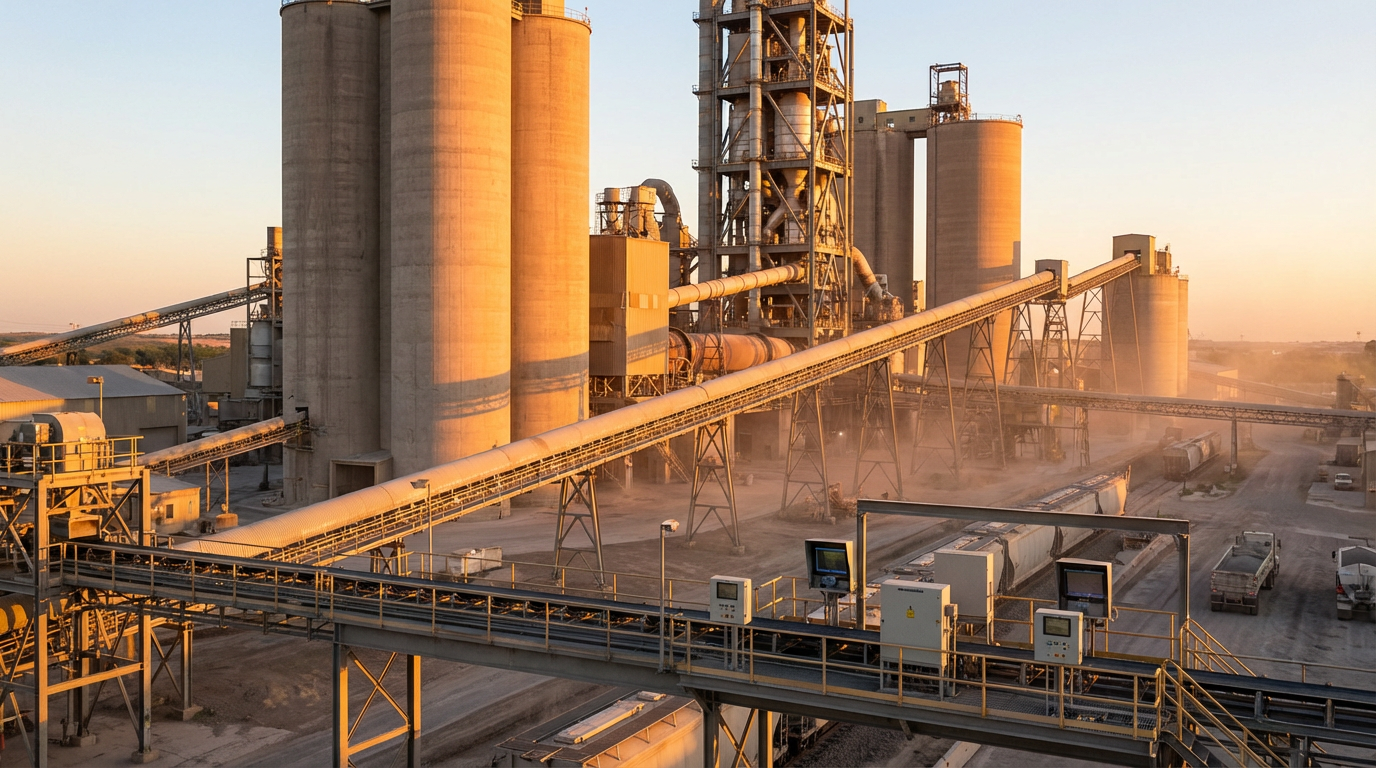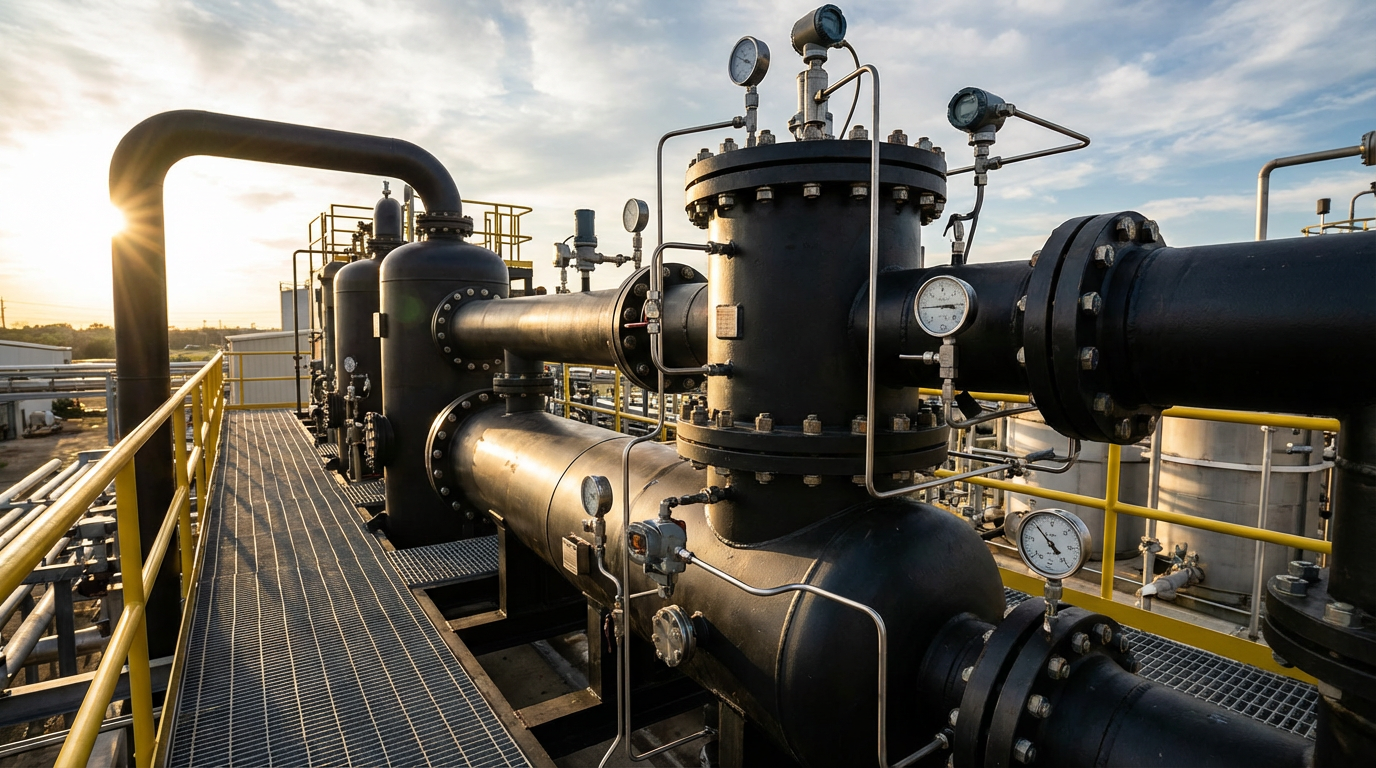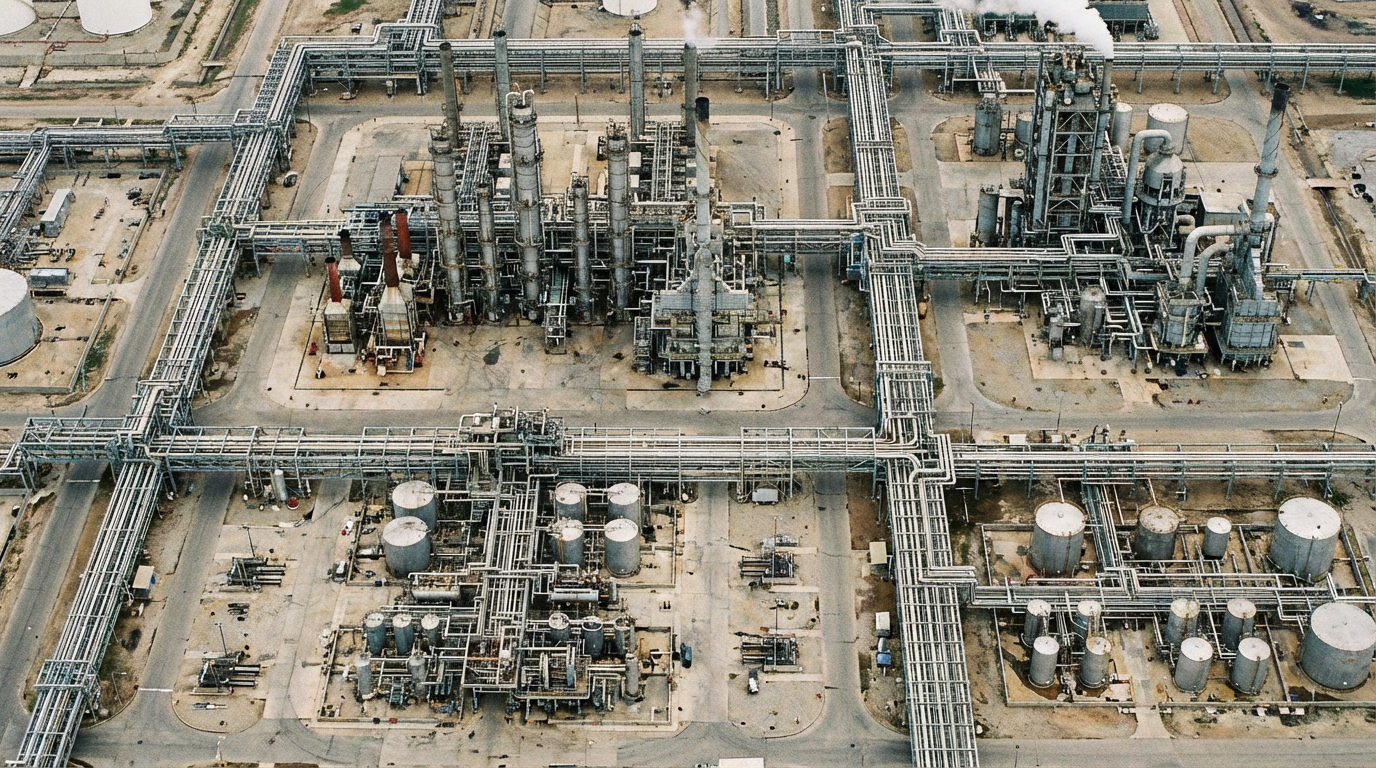
Refinery margin often leaks between units when crude changes at the front end cascade through conversion, treating, and blending without real-time coordination. This article traces those interactions from crude receipt and distillation through FCC and hydrocracker conversion to product blending, showing where static LP plans and unit-scoped APC leave value on the table. Plantwide AI optimization learns cross-unit relationships from actual plant data, coordinating cut points, conversion severity, and blend targets as an integrated system to recover margin across the full crude-to-product chain.
Margin often slips away in the handoff between refinery units, when a crude change at the front end shows up later as tighter hydrogen, weaker conversion, or a harder blend. That pressure has become harder to manage as US Gulf Coast refining margins fell over 50% between August 2022 and August 2025, a compression driven by normalized product spreads and rising operating costs. Refineries that hold profitability through that compression treat the oil refinery process as an integrated system, not a sequence of isolated units.
The difference matters most inside the operating day. Planning sets a margin target, but refinery operations execute against real conditions: crude quality drifting from assay, catalysts aging at different rates across units, and blendstock properties shifting with every cut-point adjustment. The refineries that defend margin are the ones that coordinate those interactions in real time, not just in the LP.
Refinery margin leaks across unit boundaries, from crude handling through blending, when interactions between units aren't coordinated in real time.
The article traces those interactions from crude receipt through finished products.
The refinery's margin potential is largely determined before crude reaches the atmospheric column. Crude selection is both a procurement decision and a unit loading decision: sour crudes load hydrotreaters harder, heavy crudes generate more vacuum residue, and opportunity crudes test desalter limits. When the actual crude differs from the assay the LP used, yield predictions start diverging from plant reality before the first barrel clears the desalter.
Desalting determines whether crude flexibility pays off or creates problems downstream. Salt left in crude deposits in heaters, forms acids that corrode downstream equipment, and poisons catalysts. Chloride carryover can move through atmospheric residue, hydrolyze in the vacuum column, and reach diesel hydrotreater feed streams as hydrochloric acid.
What starts as a desalter issue can surface as a reliability event several units away and weeks later. That connection between crude oil processing cost and equipment problems often only becomes visible when the crude batch is traced back.
The crude distillation unit (CDU) and vacuum distillation unit (VDU) establish the refinery's yield structure. Every barrel shifted from vacuum residue to VGO at the VDU captures a value differential, because VGO feeds higher-conversion units while vacuum residue routes to the coker.
That differential is the single largest lever in the refinery's yield economics, and it shifts with every change in crude quality, column temperature profile, and pumparound flow rate.
Flash zone management controls that split. Higher vaporization recovers more VGO, but it also means higher slop draws to keep metals and asphaltenes out of HVGO. CDU steam injection, pumparound flows, and side-draw control all affect distillation yield and VDU feed quality simultaneously.
Optimizing one without considering the other leaves value on the table.
The FCC and hydrocracker are the major conversion units in a complex refinery, and they compete for the same VGO feed. VGO allocation between those two units, driven by their relative economics against current product spreads, is the central optimization dynamic inside refinery LP planning. But the LP sets that allocation against static assumptions, and when actual crude quality or unit performance shifts mid-cycle, the optimal split changes with it.
The FCC converts heavy feeds into gasoline-range blendstocks, LPG, and light cycle oil. Catalyst selection has to match the crude slate because heavier, more contaminated crudes introduce metals that deactivate catalyst and compress the operating window. Small reductions in FCC bottoms yield can have an outsized effect on total bottoms production, and that effect compounds downstream blending constraints.
The relationship between feed contaminants, catalytic cracking severity, and product slate is nonlinear enough that unit-level controllers can miss the broader impact.
The hydrocracker converts VGO into middle distillates under high hydrogen pressure. Hydrocracker optimization carries increasing weight in refinery economics as diesel and jet spreads fluctuate, with fractionation scheme design, heavy polycyclic aromatic management, and equipment margin all shaping the unit's contribution.
When refineries don't coordinate these conversion decisions against downstream blending needs, each unit ends up optimized within its own boundaries while the system-level margin leaks between them.
Hydrotreating links the whole refinery. Naphtha hydrotreaters prepare reformer feed, diesel hydrotreaters meet sulfur specifications, and FCC naphtha hydrotreaters manage the sulfur-octane trade-off before gasoline blending. Hydrogen consumption across those units ties back to the catalytic reformer, which is both an octane unit and the primary hydrogen source. A reformer outage constrains hydrogen for hydrotreaters and hydrocrackers at the same time.
Those trade-offs are invisible to individual unit controllers. That hydrogen balance is one of the most consequential cross-unit interactions in a complex refinery, and it shifts every time feed quality or unit severity changes.
Blending is where upstream improvements are either captured or lost. Specification giveaway at blending can erase value created in process units, and the economics are direct: at a refinery producing 100,000 bbl/day, even small quality giveaway on every batch compounds into significant annual margin loss. Most refinery ROI discussions focus on throughput and yield, but blending giveaway reduction is often the fastest path to recoverable value.
Every blend carries built-in giveaway. Blenders keep average quality below specification limits so batches pass consistently, but that margin of safety comes at a cost. The harder constraint is that octane, sulfur, RVP, cetane, and distillation targets all move against each other as blendstock qualities change from multiple upstream units.
High-octane blendstocks often carry elevated RVP, which creates direct trade-offs at the blend header that can't be resolved one property at a time.
Those blendstock qualities aren't static. Every cut-point adjustment at the CDU, every severity change in conversion, every shift in feed quality propagates forward as a changed property in a component stream arriving at the blend header. Under rundown blending, where unit streams route directly to finished product tanks, correction options narrow sharply.
Giveaway doesn't accumulate through operator error; it accumulates through repeated conservative decisions, shift after shift, made to protect refinery quality when blendstock properties are moving targets. Over weeks and months, those small margin concessions add up to a measurable gap between what the refinery could have captured and what it actually shipped.
The conventional refinery optimization stack has a gap between its two layers. The LP operates with a global optimization horizon, but it produces static plans that can't adjust to shifting conditions. Advanced process control (APC) executes in real time, but each controller typically sees only its local objective. The coordination problem sits between those two layers, and it's where an effective operating strategy has the most to recover.
When CDU cut points shift in response to a crude slate change, FCC feed quality changes with them. That alters conversion, yield structure, and blendstock availability at the blend header. Unit-scoped APC can't coordinate that full cascade because each controller optimizes within its own boundaries.
LP models add another limitation. Even well-maintained LPs work from simplified representations of nonlinear reactor behavior, and those simplifications compound when multiple units interact. When actual crude quality drifts from assay assumptions, yield predictions diverge from plant reality, especially in conversion units with strong feed-quality sensitivity. That leaves operations with a planning target they can't reach using the tools at their disposal.
Plantwide optimization addresses that gap by learning relationships across unit boundaries from actual plant operating data rather than simplified linear models. It can identify interactions that no individual operator or unit-scoped controller can track simultaneously.
Advisory mode is often where that coordination becomes most visible. The model recommends setpoint changes that operators evaluate against their own experience, useful for what-if analysis when throughput, quality, hydrogen, and blending constraints conflict simultaneously. Planning teams can test scenarios against the same plant-specific relationships that the operations team relies on during the shift.
Engineering can evaluate whether recurring trade-offs reflect equipment limits, degradation, or changing feed behavior. Instead of each group working from separate assumptions, they align around the same self-optimizing plant model when discussing constraints and priorities.
Deployment can progress at the refinery's pace. Many teams start with recommendations, move into supervised operation once recommendation quality is validated, and only then move to closed loop operation where it fits their objectives and operating comfort. Operators retain authority throughout, because the model works inside boundaries they define and recommendations remain subject to plant judgment.
It won't capture every instinct behind an experienced judgment call, and unusual disturbances or novel operating conditions still require operator and engineering judgment. But it captures what the data shows about which operating moves produced the best outcomes across similar conditions.
For refinery operations leaders seeking to recover margin across the full crude-to-product chain, Imubit's Closed Loop AI Optimization solution learns from actual plant data to write optimal setpoints in real time across unit boundaries
Rather than optimizing each unit independently, the platform coordinates CDU cut points, conversion severity, and blending targets as an integrated system. Plants can begin in advisory mode, move into supervised deployment as confidence builds, and progress toward closed loop operation when that fits the refinery's objectives.
Get a Plant Assessment to discover how AI optimization can close the margin gap between your LP plan and actual refinery operations.
Crude slate changes affect multiple units simultaneously, and those effects aren't proportional. A modest shift in CDU feed quality can alter VGO composition, shift hydrogen demand, and change blendstock properties in ways that amplify through the crude oil refining process. Traditional APC operates unit by unit, so no single controller sees how a feed change at the front end cascades through conversion, treating, and blending.
It depends on where the main constraint sits and how quickly operators can act on recommendations. Blending giveaway reduction and cut-point optimization often show results first because the margin effect is easier to audit. Broader coordination builds over time as the model captures more operating scenarios and teams build confidence through day-to-day use. Manufacturing process control typically delivers measurable value within the first operating quarter.
LP-based planning sets strategic targets using a simplified, static refinery model, usually on weekly or monthly cycles. Data-driven real-time optimization learns plant relationships from operating history and adjusts setpoints as conditions change. The two approaches are complementary: real-time optimization closes the gap between plan assumptions and actual plant performance, especially in operations like heavy oil processing where crude quality or unit performance drifts significantly from LP assumptions.