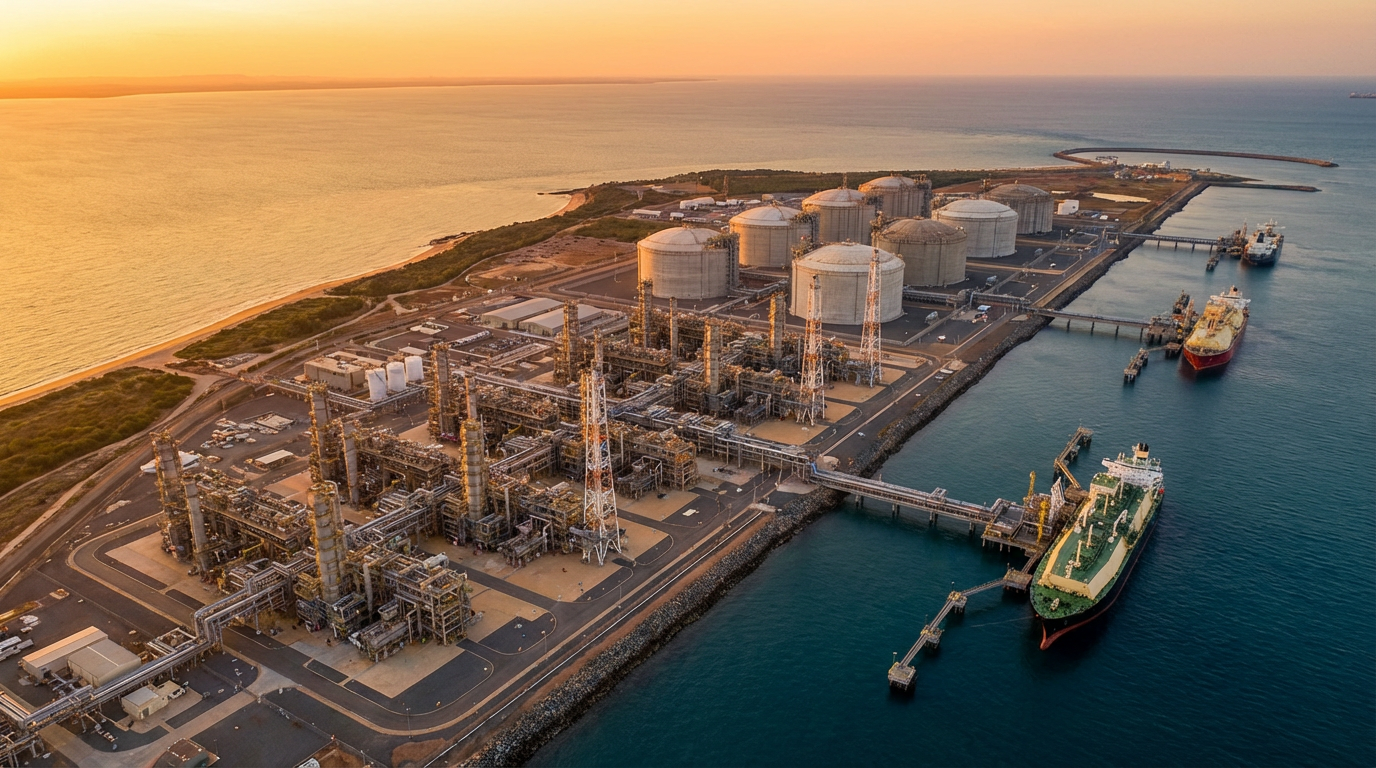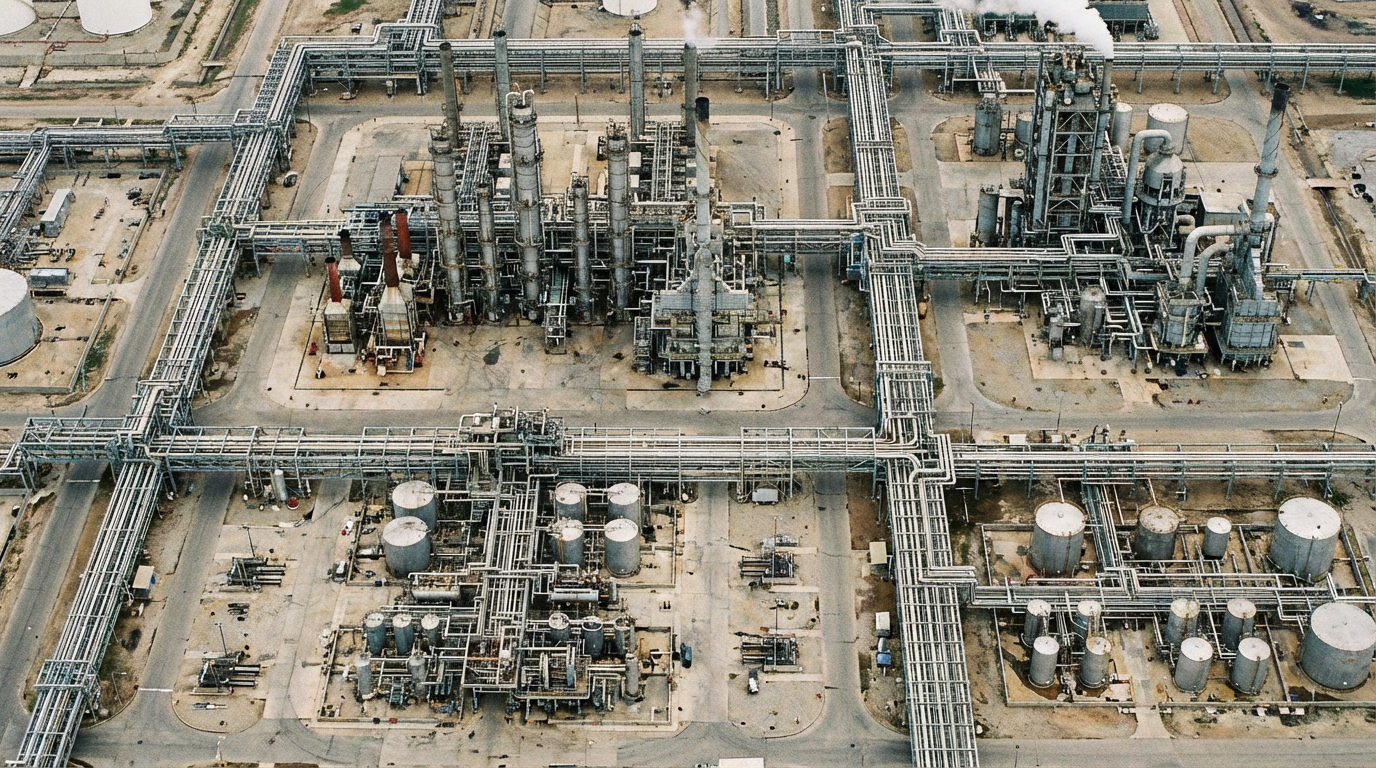
LNG train output falls below nameplate when process dependencies across sections interact in ways single-loop control can't coordinate. This article traces how AGRU loading, dehydration performance, and scrub column separation consume operating margin before gas reaches the MCHE, why the ambient-fouling-feed cascade is the most persistent throughput constraint, and where coordinated optimization across compressor load, MR composition, and temperature profiles recovers capacity that conventional control leaves unrealized.
Every LNG operations leader knows the number: the gap between what a liquefaction train was designed to produce and what it actually delivers in a given year. That gap costs real margin, and the causes are rarely isolated to a single section.
When those shortfalls compound across operating fleets, the effect on global supply is measurable: according to the IEA, global LNG supply grew just 2.5% in 2024, well below its 8% average from 2016 to 2020, with feed gas constraints and production issues at legacy plants among the factors holding output back.
Operators see the pattern inside the train itself. Output depends on how process constraints interact across sections, and understanding those interactions is central to sustained throughput improvement.
LNG train output depends on coupled process sections, not isolated limits. The visible bottleneck often shows up at the cold end, but the lost margin was set upstream.
The sections below trace those dependencies through the full train.
An LNG train is a sequential, interdependent system where a constraint in one section propagates downstream, often without an obvious signal at first. Feed gas enters through a slug catcher for bulk liquid removal, then acid gas removal strips CO₂ and H₂S to specification.
Molecular sieve dehydration dries gas to below 1 ppmv water content. Moisture breakthrough directly threatens the MCHE because ice formation reduces heat transfer and can block passages. Regeneration gas may be recycled either to the molecular sieve unit inlet or to the AGRU inlet, depending on the process configuration. That recycle creates a direct coupling between the two sections and affects amine load.
AGRU performance also sets molecular sieve regeneration gas volume and composition, which in turn affects sieve bed cycle times and available dehydration capacity. When amine systems are running near their design limit, even modest changes in regeneration gas composition can shift the loading profile enough to reduce capacity in the dehydration section.
Heavy hydrocarbon removal, typically through a scrub column, keeps heavier components from freezing in the cold section. Feed that is leaner than design can still increase heavy hydrocarbon slip to the MCHE. Scrub column separation changes when feed composition moves away from the design basis, and those changes aren't always visible in the control room until the cold section sees their effects.
The precooling circuit then lowers gas temperature before the MCHE completes liquefaction and subcooling. By that point, the cold section is already carrying the consequences of upstream operating conditions. An operator watching MCHE temperature approach widen may not immediately connect it to a subtle shift in AGRU loading three sections upstream, but the connection is real and often the root cause of the lost margin.
The MCHE is the single most critical performance variable in an LNG train. Its behavior has a direct effect on unit economics because it responds simultaneously to ambient conditions, upstream gas quality, and refrigerant system state.
Operational data from Sakhalin LNG provides a useful diagnostic framework. Total LNG production downstream of the MCHE moves with gas temperature at the inlet from the precooling circuit, LNG temperature at the outlet reflected in the rundown setpoint, available mixed refrigerant compressor driver power, and the MR cycle coefficient of performance, or COP.
When output falls below target, one or more of those variables usually explains it. MR cycle COP is worth watching closely because mixed refrigerant composition directly affects how efficiently the cycle converts driver power into cooling duty. The MR mixture of nitrogen, methane, ethane, propane, and butanes is selected to closely match the natural gas heat composite curve inside the MCHE.
When composition drifts, the cycle works harder for the same output. Warm-end and cold-end temperature approaches inside the MCHE are useful diagnostic indicators: a wider approach at either end points to reduced heat transfer effectiveness from fouling, suboptimal MR composition, or flow distribution problems.
Nameplate capacity reflects a design basis. It assumes reference ambient temperature, feed gas composition, and equipment condition, so it isn't a production target that holds under all operating conditions.
The most persistent throughput constraint is the interaction between ambient temperature, equipment condition, and feed variability. Industrial gas turbine output falls by roughly 0.7% per °C above design ambient. At the same time, higher ambient temperature raises refrigerant condensing pressure and compressor power demand. Available power falls while required power rises.
Air cooler fouling adds another layer. As fins foul, condensing temperature rises above what ambient temperature alone would cause, and compressor demand climbs in the same direction as a hotter day.
Feed gas variability acts through a different mechanism. In some operations, actual feed acid content has exceeded the design basis, which limited AGRU capacity and constrained throughput even when the liquefaction section was otherwise capable. Over longer periods, reservoir depletion can produce leaner feed that shifts scrub column behavior and propane constraints.
These conditions often arrive together. The hardest operating periods are the ones where ambient derating, fouling, and feed changes have all tightened the available operating room at once.
Conventional regulatory control manages individual loops: one PID controller holds one temperature, one pressure, or one flow. In an LNG train, scrub column control influences both fractionation and liquefaction behavior, so separate loops can miss how the full train is actually moving.
MR composition optimization shows that limit clearly. Identifying the best composition requires an invariant performance indicator such as the Carnot factor rather than isolated temperatures or compressor load. Direct composition control is impractical because analyzer latency and component interdependency slow the feedback path. At Sakhalin LNG, the operations team used indirect control through calculated inventories instead.
Even when individual controllers perform well, the interactions between them can still consume margin. A temperature controller on the precooling circuit and a pressure controller on the MR compressor may each hold their setpoints, but the combined effect on MCHE performance may not match current operating conditions. When ambient temperature shifts or feed quality changes, setpoints that were appropriate an hour earlier can become suboptimal without either loop signaling a deviation.
That coordination gap is where throughput improvement opportunities tend to concentrate.
Coordinated changes to compressor load, MR composition, and temperature profile control can recover capacity that single loop operation leaves unrealized. But sustaining those improvements requires tracking how multiple constraints shift in response to ambient conditions, feed changes, and equipment degradation over time.
That tracking works best when the underlying model learns from the plant's own operating history rather than design-case assumptions, because real trains don't behave the way they were drawn.
The coordination problem extends beyond the control room. Maintenance timing affects refrigerant efficiency, and production targets sometimes reflect planning assumptions that don't match current equipment health. When planning, operations, maintenance, and engineering work from different views of the train, those conflicts stay hidden until throughput drops.
LNG plants typically run with lean crews, and even experienced operators can't continuously reoptimize MR composition, compressor loading, and temperature profiles while also managing alarms and routine operations. AI optimization can track more constraint interactions simultaneously, though it can't replicate every judgment call that experienced operators make about equipment condition and safety margins.
Advisory mode is often a practical and valuable operating choice, not just a preliminary step. The model recommends setpoint changes, and operators decide whether to apply them. That gives newer operators a clearer view of how coupled constraints are moving, while experienced operators can compare recommendations against their own reading of the unit. The same model can support more consistent decisions across shifts, show what-if tradeoffs before changes are committed, and track how fouling or feed changes are tightening the train over time.
When planning, operations, maintenance, and engineering work from the same model built on the plant's own data, they can evaluate throughput targets, maintenance timing, or realistic operating margin with a common understanding of where the train actually stands. In practice, many plants progress from advisory recommendations to supervised automation within operator-defined boundaries, and then toward later stages of automation when that fits their operating strategy.
Trust builds from operating results, not from a demand to hand over control on day one. And for many facilities, the margin recovery available through better coordination across these functions is larger than what any single control loop improvement can deliver.
For LNG operations leaders seeking to recover train margin where ambient derating, feed variability, and fouling cascades erode operating room daily, Imubit's Closed Loop AI Optimization solution learns from plant data, builds a plant-specific model of train behavior, and can write optimal setpoints to the DCS in real time.
Plants can begin in advisory mode, use the same model for decision support and cross-functional alignment, move into supervised automation within defined boundaries, and progress toward closed loop optimization as confidence builds.
Get a Plant Assessment to discover how AI optimization can close the margin gap between your LNG plan and actual operations.
The MCHE receives the accumulated effects of upstream conditions rather than a single upset. AGRU loading, dehydration performance, scrub column separation, and feed composition can all consume margin before gas reaches liquefaction. By the time operators see cold-end constraints clearly, part of the throughput loss was already set earlier in the train. Understanding these coupled dependencies is central to effective capacity recovery.
Nameplate capacity reflects a design basis, not a year-round operating target. Actual train output moves with ambient temperature, feed composition, equipment condition, available driver power, and mixed refrigerant cycle efficiency. The same train can run close to design in one period and then lose margin when hotter weather, fouling, or feed changes tighten several constraints simultaneously. That variability is why LNG plant optimization needs to account for current conditions, not just design assumptions.
A shared model gives planning, operations, maintenance, and engineering the same view of how the train responds to current conditions. That visibility helps when maintenance timing affects refrigerant efficiency, production targets don't reflect equipment health, or engineering evaluates changes without the latest operating context. In practice, the model supports advisory recommendations first and can later support broader automation when that fits site strategy.