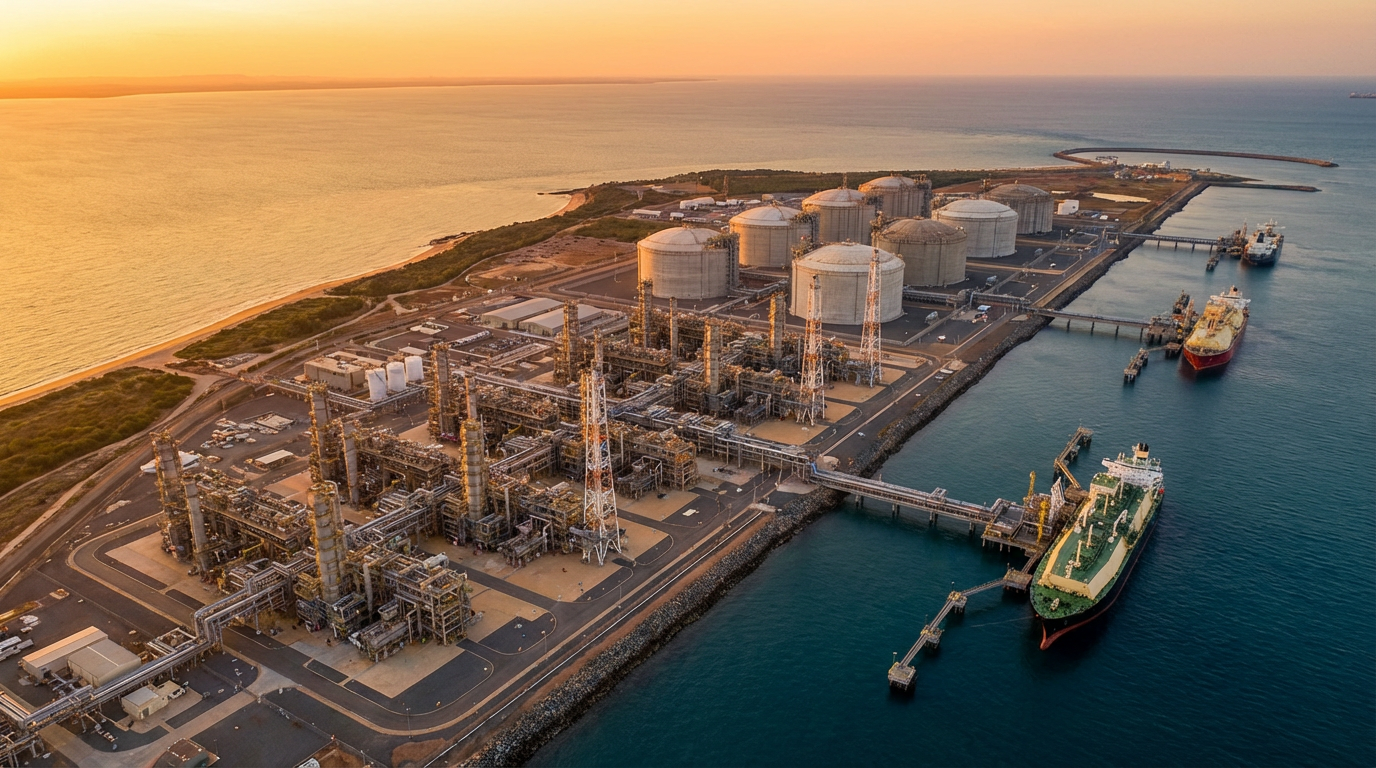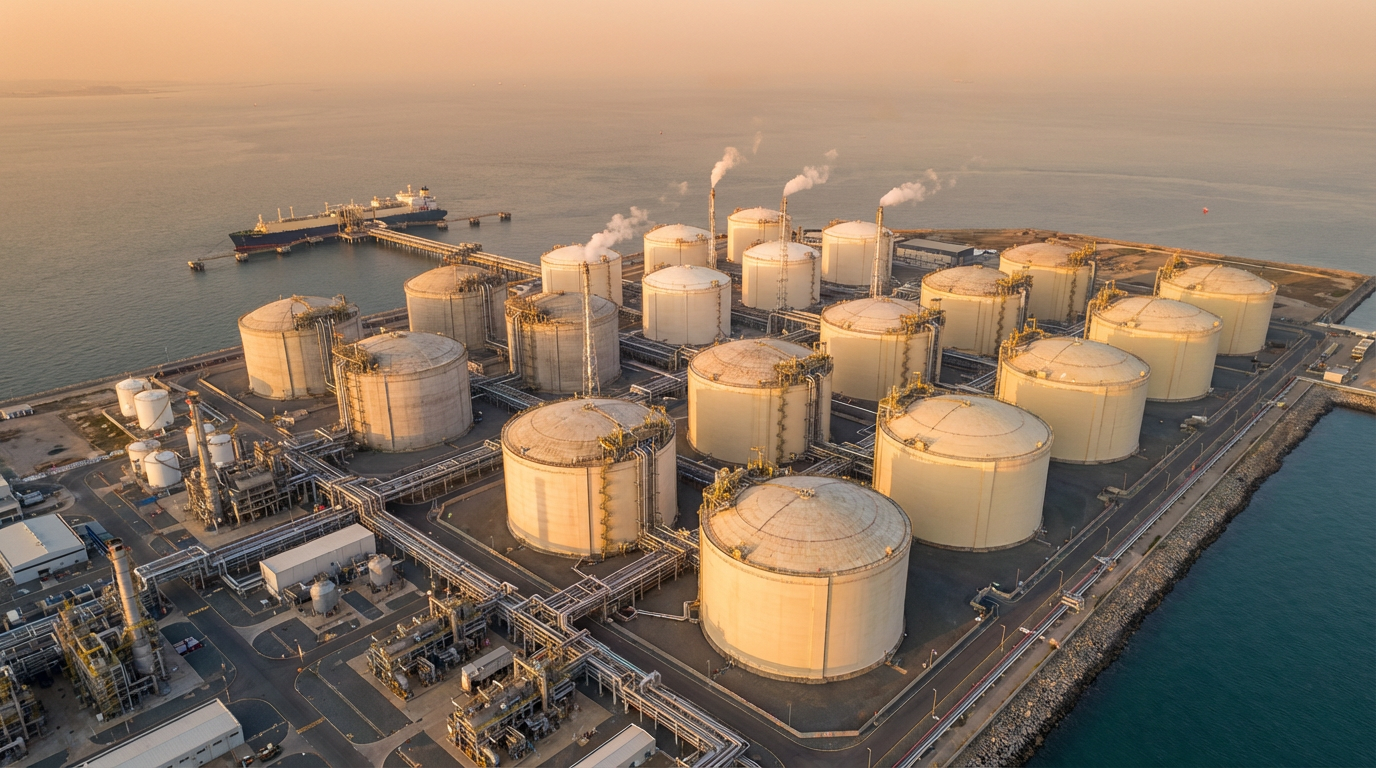
LNG storage tanks face pressure excursions and BOG losses that shift with operating mode, insulation performance, and unloading surges. AI optimization matches disposal pathway to mode, uses the pressure band as a buffer rather than on/off triggers, and lets operators progress from advisory mode toward closed loop control. This closes the gap between design BOG and actual losses while operators retain authority throughout.
LNG tank pressure can creep up fast during zero-sendout periods or carrier unloading, even when normal-day boil-off gas looks manageable. With global LNG supply set to grow roughly 50% by 2030 as new export capacity comes online, more terminals face pressure excursions, insulation condition questions, and BOG disposal economics on an hour-by-hour basis.
Over a tank's decades-long service life, the gap between design-basis BOG rates and actual operational BOG rates translates into substantial recovered or lost product value each year.
Tank management turns on how containment, insulation, and operating mode interact. Design BOG is just a starting point.
The sections below trace how these play out in practice.
Tank pressure responds to operating mode as much as to raw heat ingress: sendout, unloading, and zero-sendout each change where BOG goes and how quickly pressure can be absorbed. Heat ingress causes preferential loss of more volatile components, and that vapor has to be routed somewhere.
During active sendout, the recondenser absorbs BOG efficiently. Carrier unloading is harder: vapor displacement and flashing generate surge BOG, and the loads change fast enough to overrun conventional single-loop controllers. Zero-sendout is different again, because the recondenser can't run at all and that disposal path disappears entirely.
A tank that runs predictably during steady sendout gets much harder to manage when unloading schedules, compressor availability, and sendout conditions no longer line up, which is most terminals' day-to-day reality. That mismatch is one of the recurring LNG plant challenges that shows up on shift, not in the annual planning review.
Stratification happens when LNG of different densities settles into distinct layers in the tank. A falling BOG rate can mask growing risk, because the upper layer suppresses surface evaporation while heat builds underneath. When those layers eventually mix, the trapped energy releases fast and BOG spikes.
Pressure management therefore depends on more than normal-day heat ingress estimates. Controllers have to read BOG trends against fill history, composition, and tank age, not as isolated signals. Reading those combined signals goes beyond what advanced process control (APC) tuned around fixed operating envelopes handles well on its own.
Modern LNG tanks are engineered to hold BOG to about 0.05% of tank volume per day. In practice, actual rates often drift above that target. Containment design, locked in at construction, sets a fixed starting point. Insulation performance, which shifts over decades, determines how much the gap widens.
Most modern flat-bottom LNG storage tanks use 9% nickel steel for the inner wall, which stays ductile at cryogenic temperatures. What surrounds that inner wall varies by containment type, and that choice sticks with the plant for the life of the tank. Single containment relies on an external earthen embankment to capture spilled LNG if the inner tank fails.
Double containment adds an outer tank capable of retaining liquid but not vapor. Full containment adds a prestressed concrete outer shell designed to contain liquid and allow controlled venting of vapor after a credible leak event.
For operations leaders weighing control strategies across their tank farm, containment type sets more than safety margins. It defines the available pressure operating band, the vapor management architecture, and the BOG compressor sizing baseline. Downstream decisions about reliquefaction capacity, recondenser load, and flare headroom all inherit those baseline choices.
That's why BOG retrofit work usually operates within the existing containment design rather than against it, and why industrial process control earns its keep by using the available operating band more skillfully as conditions shift.
An LNG tank's insulation system is engineered around expanded perlite filling the annular space between inner and outer walls, fiberglass blankets covering the suspended deck and roof, and perlite concrete blocks at the tank base. After a decade or more of operation, that system performs differently than it did at commissioning.
Expanded perlite tends to self-compact under its own weight, thermal cycling during cooldowns, and vibration, which can cause the fill level to drop in the annular space. Cold spots then appear on the outer wall as local thermal conductivity increases.
Moisture ingress and the limits of non-intrusive inspection compound the diagnostic challenge. Elevated BOG rates can come from any combination of those factors, and the financial consequence is direct: more vapor has to be compressed, recondensed, used as fuel, or flared.
Many terminals still rely on periodic external inspection (thermography passes, visual checks, and spot gauge readings) rather than continuous insulation performance tracking. That gap matters because compressor duty and pressure-handling headroom drift together, and external indicators often lag the process signals that would reveal the problem earlier. By the time the BOG trend becomes obvious, the operating band has already narrowed, and pressure events are harder to absorb.
Tying BOG and ambient trends to broader plant reliability data makes insulation-related drift easier to diagnose before it shapes daily compressor loading.
At any meaningful LNG price, the value at stake justifies systematic recovery over disposal. With LNG prices expected to stabilize around $7 to $10 per MMBtu by 2030 based on recent buyer-side survey data, the economics of recovered versus flared or fuel-consumed BOG compound quickly across a large tank farm.
The operational question turns on which disposal pathway remains available in a given mode: recondensation, reliquefaction, fuel gas consumption, or flare.
Flash generation, unloading surges, and insulation-related heat ingress do not stress the system in the same way. Recondensation works well during active sendout but becomes unavailable during zero-sendout periods. Dedicated reliquefaction systems remain available across a wider range of schedules, while flaring and fuel use usually represent a lossier fallback.
Treating these pathways as interchangeable during planning tends to create the pressure excursions that operators have to absorb later.
AI optimization handles the problem differently from traditional single-loop controllers. It uses the available tank pressure band as an operating buffer rather than treating pressure limits as simple on/off triggers. Predictions about where pressure will head over the next several hours can inform compressor staging, recondenser loading, and reliquefaction dispatch well before pressure approaches those limits.
Self-optimizing gas processing operations depend on exactly this kind of coordinated behavior.
No AI system captures every instinct behind a veteran operator's judgment during an unusual unloading sequence. But continuous process control that anticipates pressure trends can handle constraints that even the most experienced operators can't resolve at the speed cryogenic systems demand.
The implementations that hold up over time tend to rely on a shared operating model of tank behavior: when compressor staging accounts for carrier berthing schedules and operating plans reflect insulation performance trends, the BOG management chain runs with fewer surprises.
In advisory mode, AI optimization shows recommended setpoint adjustments alongside the predicted impact on tank pressure and BOG recovery. Operators see the trade-offs before any change takes effect, and they can validate each recommendation against current conditions.
Even on its own, that visibility reduces shift-to-shift variability and surfaces judgment calls that usually live in a few operators' heads. Human AI collaboration like this lets tank expertise scale across new operators and shifts, not just the most tenured crew.
As confidence builds over time, teams can progress from advisory recommendations to supervised execution and then toward closed loop control. Operators retain authority throughout, and the system works through the existing distributed control system (DCS) infrastructure.
For LNG operations leaders seeking to close the gap between design-basis BOG rates and actual operational losses, Imubit's Closed Loop AI Optimization solution learns from actual plant data and plant-specific operating behavior across changing conditions. Teams can start in advisory mode, progress through supervised execution, and move toward closed loop control as confidence builds. The system writes optimal setpoints in real time through existing control infrastructure.
Get a Plant Assessment to discover how AI optimization can tighten BOG recovery and pressure control across changing operating modes.
A falling BOG rate can signal stratification inside the tank. The upper LNG layer can suppress surface evaporation while heat continues to build below, so the lower reported rate may hide greater pressure risk. If those layers later mix, vapor release can rise quickly. Operators typically read a declining BOG rate in the context of operating mode, fill history, and composition tracking, especially during zero-sendout periods when disposal options are already narrower.
Advanced process control works best when underlying PID loops respond predictably. If base control is unstable, pressure handling becomes more reactive, compressor loading gets harder to manage, and higher-level coordination has less room to improve performance. That matters even more during unloading surges or changing sendout conditions, when weak base control can undermine broader plantwide process control performance and constrain how much of the available tank pressure band is actually usable.
Increasing spot LNG trade makes BOG management harder because unloading timing, sendout conditions, and disposal options shift more often. Recondensation may be available in one mode and unavailable in the next, especially around zero-sendout periods. Terminals then rely more on compression, fuel use, or flaring, each with different trade-offs. Flexible, coordinated gas processing optimization that adapts to changing tank behavior earns its keep in that environment.