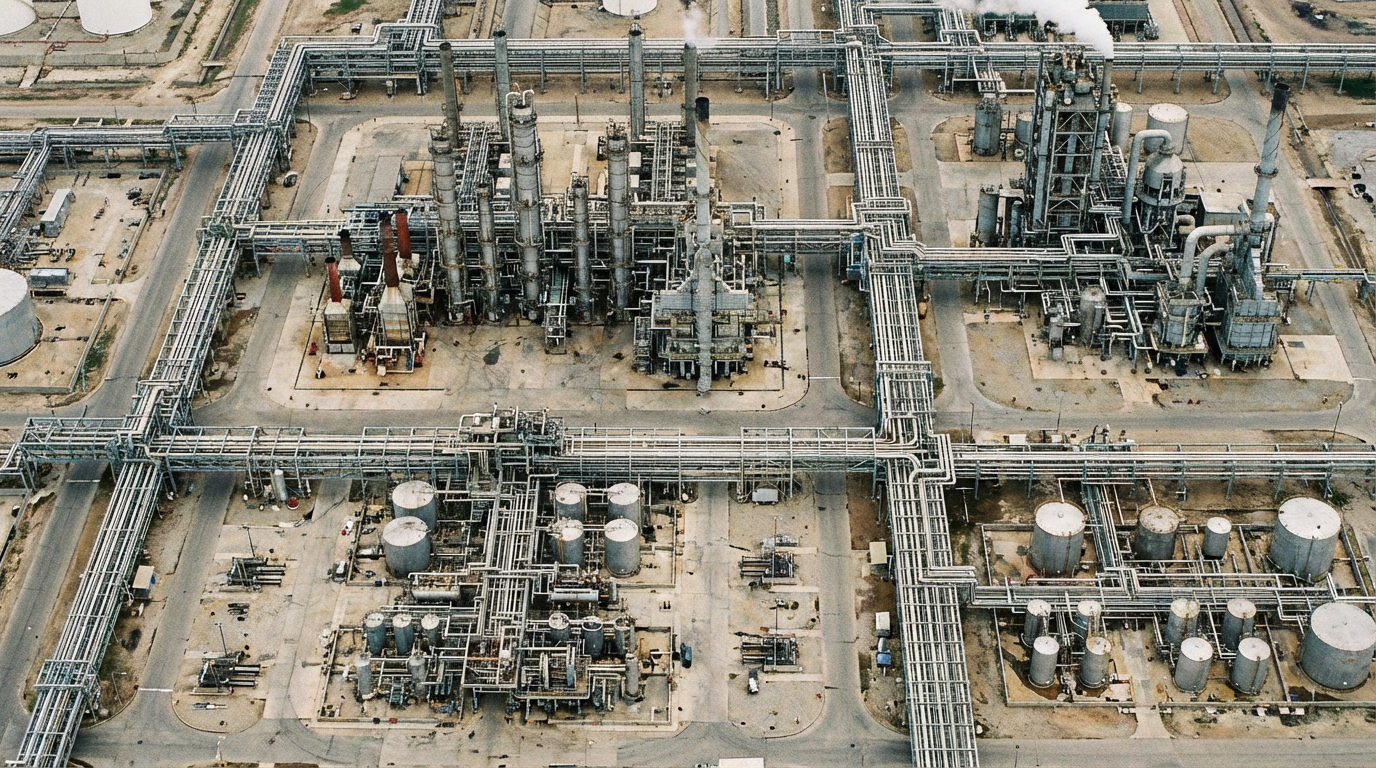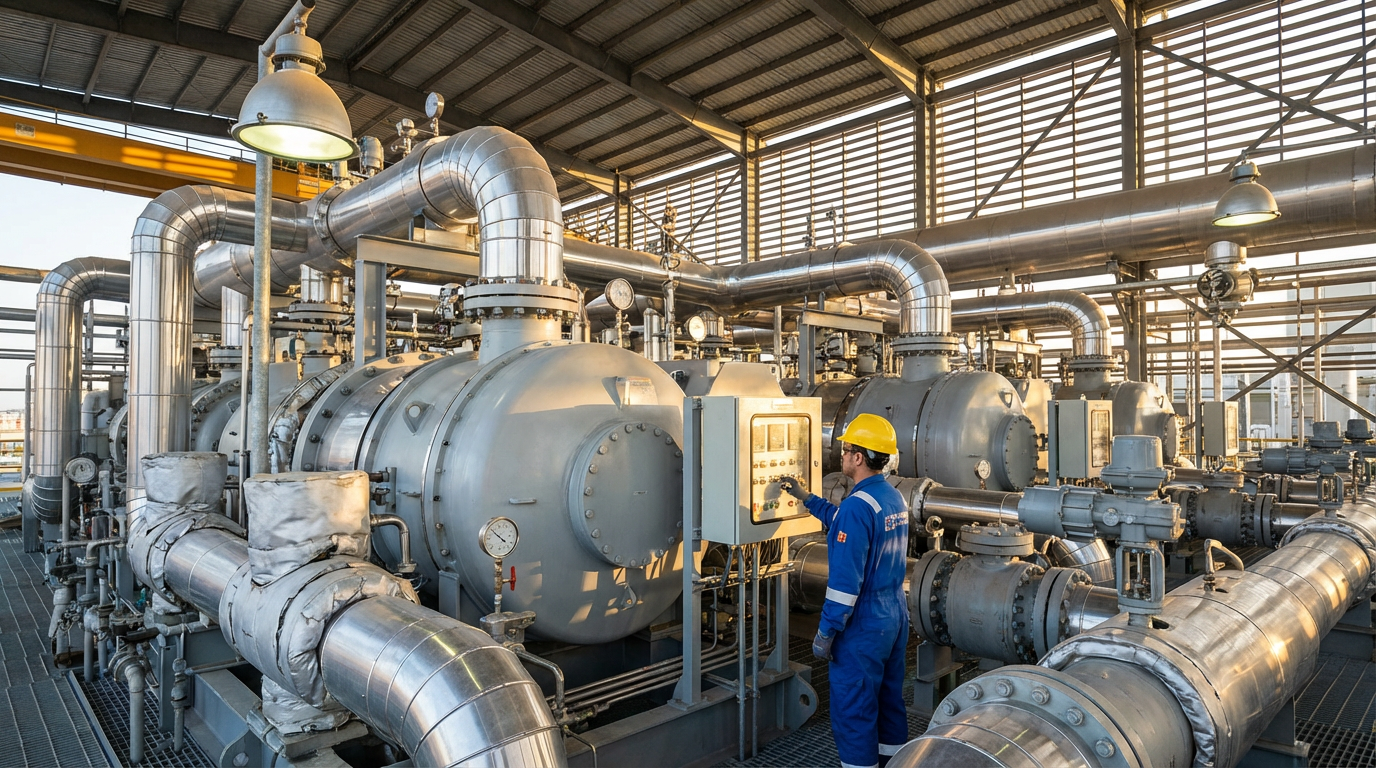
In LNG plants, the real capacity limit often shows up first at the refrigerant compressors. Recycle valves open, specific power rises, and the train absorbs extra megawatts while production looks steady. Daily penalties from anti-surge recycle, exchanger degradation, ambient swings, and refrigerant composition drift compound quietly—power costs increase before throughput loss becomes obvious. The largest improvements come from coordinating the refrigeration system as a whole rather than tuning compressors individually, because suction conditions, discharge targets, composition, and exchanger performance all move together. AI optimization tracks those interactions continuously and helps operators recover energy and train capacity without equipment modifications.
In an LNG plant, the real limit often shows up first at the refrigerant compressors. One machine edges toward minimum flow, recycle starts to open, and a parallel compressor still carries unused margin.
Across industrial processing plants, operators applying AI have reported 10–15% production increases and 4–5% improvements in EBITA, and LNG plants feel that gap directly in compressor driver load and specific power. Small loading changes can recover energy and train capacity without equipment modifications, which is why a clear operating strategy often matters before operators trust a new recommendation.
In LNG refrigeration service, usable capacity and specific power depend more on loading and recycle behavior than on compressor nameplate design.
The sections below show how those interactions shape daily LNG operating decisions.
Refrigerant compressor architecture sets the physical envelope for LNG train performance, but control strategy determines how much of that envelope stays usable day to day. LNG plants commonly rely on multistage centrifugal compressors for propane, mixed refrigerant, or dual mixed refrigerant services.
Centrifugal compression remains the dominant architecture for these duties because it fits high-flow cryogenic service and accommodates large driver sizes.
In LNG operations, feed gas conditions, liquefaction train balance, and exchanger approach temperatures all shape refrigerant compression duties. The main question for operations teams is which handles can be adjusted independently as ambient temperature, feed composition, and production targets change.
In a propane pre-cooling section, the practical constraint may sit in compressor head and condenser duty. In a mixed refrigerant loop, the tighter limit may come from composition, suction pressure, or available driver margin.
The distinction matters during rate changes and turndown. Trains with more independent compression handles give operators more room to balance specific power against throughput and equipment protection. In tighter configurations, changes in one loop can narrow the operating window across the rest of the train.
Control equipment and protection strategy shape the real operating window just as much. Plants with inlet guide vanes, variable-speed capability where installed, and modern control logic generally have more flexibility than older machines with tighter minimum-flow limits. Older configurations reach anti-surge recycle sooner at reduced rates.
That narrows the useful envelope and makes stable load distribution harder, especially when plantwide process control has to manage interacting constraints rather than one machine in isolation.
Recycle losses, heat-transfer degradation, ambient swings, and refrigerant composition drift all move LNG compressor efficiency on a daily basis. Those penalties often stay hidden because production can look steady while the train absorbs extra power.
Anti-surge recycle is the clearest loss. When recycle valves open, the compressor continues to consume driver power while that recirculated flow adds no net refrigeration duty. LNG plants can carry that penalty for extended periods because product storage and ship-loading schedules may hide the immediate impact. More detail on surge margin optimization shows why those margins tighten faster than many dashboards suggest.
Heat-transfer degradation adds a subtler penalty. As condenser performance slips or cryogenic exchanger approach temperatures widen, operators often increase circulation or compression effort to hold the same cold-end duty. Specific power rises first. Train capacity usually falls later, once driver limits, suction pressure limits, or exchanger constraints become binding.
Power penalties usually appear before throughput loss becomes obvious in high-energy process units, and industrial energy efficiency experience across sectors bears that out.
Ambient conditions create another opening. Hot weather can tighten compressor power margins and condensing constraints, especially in air-cooled or marginal utility conditions, while cooler periods can relax them.
LNG sites that adapt loading and pressure balance to those shifting conditions often recover performance without changing equipment, and industry analyses of energy-intensive operations confirm that operational discipline remains one of the most cost-effective performance levers available.
Refrigerant composition shifts quietly in LNG service. A mixed refrigerant loop can look stable on headline variables while the compressor train moves away from its best operating region because composition, molecular weight, and pressure balance have drifted. Operators usually compensate through loading moves or setpoint changes elsewhere in the train. The train keeps running, but it may be doing so at noticeably higher specific power than the current conditions require.
Those penalties become more visible when viewed over a full shift or a week instead of one control-room snapshot. The economics are straightforward: the train consumes extra megawatts now and gives up practical capacity later when a hotter afternoon or a slightly heavier feed pushes a constrained machine to its limit.
The hidden cost of throughput often sits in exactly this kind of slow, compounding penalty.
The largest improvements usually come from coordinating the refrigeration system rather than tuning one compressor at a time. Suction conditions, discharge pressure targets, refrigerant composition, and exchanger performance all move together, and compressor behavior has to match feed variability, ambient temperature, and production targets simultaneously.
Parallel compressors are where that coordination matters most. Nominally similar machines rarely behave identically after months or years of continuous operation, and small differences in fouling, wear, or internal clearances mean one compressor may approach surge well before its neighbor.
The same interaction shows up across pressure balance and refrigeration duty: a small shift in one pressure level can move constraints into a different compressor case or a different exchanger approach. Sequential tuning misses those interactions because each variable can look acceptable on its own while the train as a whole operates below its practical optimum.
Stable control and optimal coordination aren't the same thing, as related context on advanced process control makes clear.
Traditional APC and the distributed control system (DCS) remain essential in LNG plants. They stabilize the process, enforce equipment and safety constraints, and keep the train inside a safe operating envelope. The limit of conventional control appears when real-time operating conditions move faster than fixed margins and static models can adapt.
No AI optimization technology replaces the operational pattern recognition that comes from decades of experience at the board. The value comes from tracking more interactions, more consistently, than any operator or controller can manage at once.
A lower recycle rate in one case can free enough driver margin to support a colder approach elsewhere, or enough stability to keep the train at target through a hotter part of the day. The best loading pattern keeps the full refrigeration system away from avoidable recycle while preserving capacity where the train is most likely to bind, even if individual machines carry unequal loads.
Advisory mode makes that coordination practical. Operators see recommended setpoint optimization values beside current values, evaluate each recommendation, and accept or reject it based on operating context. Experienced operators can test the model against plant reality before trusting it with live moves
Newer operators get a clearer view of how compressor loading, recycle risk, and energy use interact during different LNG conditions.
Many decisions that affect refrigerant compressor efficiency don't originate with the compressor team. Feed gas conditioning changes alter refrigeration balance. Maintenance timing shifts fouling risk into the hottest part of the season. Planning assumptions can push the train toward a rate target that looks achievable on paper but forces one compressor string into persistent recycle.
When a shared model tracks those trade-offs, maintenance, planning, and engineering teams can see how their decisions affect compressor loading and specific power before those effects become binding. More on human AI collaboration shows why siloed decisions often leave capacity behind.
In practice, many sites move progressively from advisory recommendations to supervised deployment, where operations teams validate recommended actions before enabling broader automation, and then to closed loop as confidence builds. Some LNG plants may choose to stay in advisory mode for specific services because it still delivers value through cross-shift consistency, clearer trade-offs, and better coordination.
AI adoption experience in process industries confirms that advisory mode is a practical operating choice in its own right.
For LNG operations leaders seeking to close the gap between current refrigerant compressor performance and thermodynamic potential, Imubit's Closed Loop AI Optimization solution, or AIO, learns from existing plant data, writes optimal setpoints in real time, and coordinates across the interdependent variables that determine refrigerant compressor efficiency. Plants can start in advisory mode, progress through supervised deployment, and move toward closed loop operation as trust builds through demonstrated results.
Get a Complimentary Plant AIO Assessment.
Persistent recycle during otherwise stable LNG operation usually points to a wider system imbalance rather than a single compressor problem. Common causes include pressure imbalance, refrigerant composition drift, condenser degradation, or uneven load sharing between parallel machines. The clearest sign is repetition across shifts or ambient conditions instead of isolated upset response. More context on LNG plant challenges shows how those constraints interact across the train.
The most useful data combines compressor flow, suction and discharge pressures, recycle valve position, driver load, and key exchanger or condenser temperatures. Ambient context is equally important because weather and production targets often explain why one machine reaches its limit before another. Sites usually get better results when those variables are reviewed together through structured plant operator training.
Maintenance and planning decisions affect LNG compressor efficiency by shifting load distribution long before throughput visibly drops. Deferred cleaning, delayed valve or seal work, and aggressive production assumptions can all increase hidden recycle and specific power. Those effects often develop gradually, so operations compensate without seeing the full penalty at first. Cross-functional review tied to broader gas processing optimization priorities makes those trade-offs easier to see.