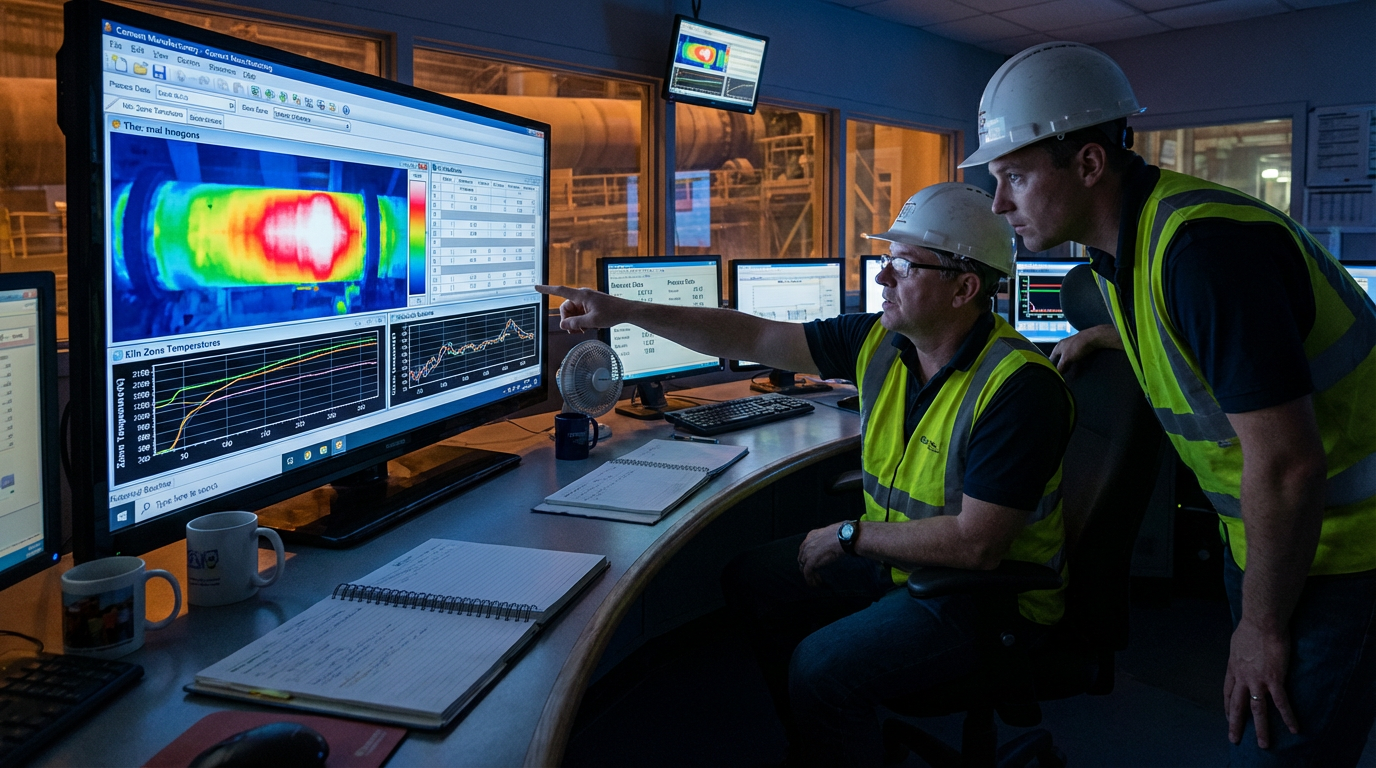
Kiln refractory campaigns usually fall short because of operating instability, not brick quality. Thermal cycling from stops and starts, uneven coating from feed chemistry variation and combustion instability, and inconsistent upset recovery across shifts accumulate refractory damage that no material selection can overcome. Shell monitoring becomes a planning tool when crews trend temperatures by zone against historical baselines and connect patterns to coating condition. AI optimization helps by coordinating the variables that shape refractory life (feed changes, fuel variability, secondary air, kiln speed, and flame behavior) more tightly than manual coordination can sustain across a full shift.
Kiln refractory performance shapes uptime, fuel efficiency, and clinker quality long before a shutdown makes the problem visible. Often, the first warning appears indirectly: pyroprocessing optimization slipping, hotter shell areas, or coating that stops behaving as expected. Most refractory failures aren't really about the brick.
Operating instability, coating loss, and uncoordinated responses to burning zone upsets account for more campaign shortfall than material selection does. And when lining fails early, the cost goes beyond brick: unplanned relines can shut a kiln down for one to two weeks, with each lost production day far exceeding the replacement lining cost.
Industrial processing plants using AI to coordinate process variables more tightly have reported production increases of 10–15%. In a kiln, those variables include the ones that determine whether refractory lasts or wears out early.
Kiln refractory campaign life depends as much on operating stability as on brick selection.
The sections below connect those patterns to refractory protection and tighter process coordination.
The burning zone usually determines how long a refractory campaign lasts. Conditions are harsher there than in other kiln sections, and coating quality often makes the difference between gradual wear and a fast deterioration event.
A stable coating acts as the working barrier between the process and the brick. It forms when liquid phase chemistry, flame position, and material bed stability align consistently enough for the layer to build evenly and bond to the refractory surface. When that coating holds, it reduces direct exposure to flame, clinker contact, and volatile species in the kiln atmosphere. When it breaks away, shell temperatures can rise quickly and the refractory sees a harder thermal and chemical load.
That relationship is one reason plants watch cement kiln optimization so closely when lining life starts to shorten.
Refractory management can't sit only with maintenance. Burning zone temperature profile, feed consistency, and combustion stability all affect whether coating forms, adheres, and survives routine operating swings. The control room influences lining life every shift.
A long, soft flame can shift peak heat farther down the kiln. A tight, aggressive flame can overload a smaller area of coating and brick. Secondary air variation, alternative fuel swings, and uneven material bed behavior all change how the burning zone loads the lining.
In plants pushing alternative fuels, those interactions become harder to judge consistently by feel alone.
Thermal cycling is one of the clearest operating causes of refractory damage. Refractories can perform well at elevated temperature, but repeated heating and cooling puts stress on the lining, especially around stops, starts, and unstable burning conditions. That pattern of thermal fatigue is why plants with frequent upset recovery usually see the consequences in coating behavior first.
Feed chemistry and combustion conditions shape coating formation together. Raw mix variation changes liquid phase behavior in the burning zone, while flame shape and air conditions change how heat is distributed along the lining. Operators often see the result as a coating that grows unevenly, sheds unexpectedly, or refuses to build where protection is needed most.
Similar interactions show up in broader clinker quality discussions because chemistry drift rarely stays isolated to one outcome.
False air and shift-to-shift inconsistency add another layer. Air leaks can cool the process and disturb combustion, while inconsistent responses to the same temperature pattern create avoidable swings. In heavy industry more broadly, inconsistent maintenance practices can reduce capacity by 5–20%, and refractory wear follows the same pattern.
It rarely comes from one dramatic mistake. More often, it reflects many small operating deviations that accumulate over time.
Short stops deserve more attention than they usually get. A kiln that stops briefly and restarts can still lose coating in patches, especially if the coating was already thin or uneven. The restart may recover production quickly, but the lining often carries the real penalty into later shifts.
That's why crews dealing with repeated instability often benefit from comparing refractory symptoms against clinker production trends rather than treating each stop as an isolated event.
Local overcorrection is another common wear path. A shell hot area appears, the flame is pulled back aggressively, coating begins to rebuild, and then the kiln runs too cool for several hours. Refractory campaigns usually last longer when plants agree on how to interpret hot zones, coating loss, and recovery windows before the next upset arrives.
Thermal monitoring protects lining life when shell temperature changes move quickly into operating action. Continuous shell scanning gives operations and maintenance a shared view of where conditions are changing before a shutdown inspection confirms the problem.
The most useful plants do more than acknowledge alarms. They trend shell temperatures by zone, compare new patterns against historical baselines, and connect those shifts to coating condition and process instability. That approach turns monitoring into a planning tool. It also gives better context for related rotary kiln operations such as shell scans and thermal profiling.
Baselines matter because one hot zone number on its own says very little. A section that normally runs warm may still be stable, while a smaller increase in a historically quiet zone can signal coating loss or localized thinning. Crews that review scanner data by zone, shift, and restart history usually catch those changes earlier.
Restart history is especially useful after short stops. A zone that reheats faster than normal after a restart may point to coating loss that wasn't obvious during the stop itself. If the same area returns after each interruption, the pattern points to campaign-level lining risk.
When thermal data feeds the distributed control system, maintenance systems, and operating review routines, response becomes faster and more consistent. A hot area becomes a documented operating event with a defined follow-up path. Plants that connect refractory monitoring to energy management in cement often see both sides of the same relationship, since coating loss and overburning drive up specific heat consumption in the same kiln.
That visibility also improves cross-functional decisions. Operations may read a hot zone as a coating issue that can be stabilized during the shift. Maintenance may read the same area as lining loss that needs inspection, while process engineering may see a combustion imbalance or feed chemistry drift.
When all three groups work from the same thermal evidence, the plant can judge campaign risk earlier and avoid unnecessary disagreement.
AI optimization becomes useful when the variables that shape refractory life move together in ways that are hard to coordinate manually across a full shift. Feed changes, fuel variability, secondary air conditions, kiln speed, and flame behavior can all drift at the same time. Tighter control of those relationships usually supports steadier coating and lower thermal stress on the lining.
No optimization model captures every instinct behind a veteran operator's judgment call. Experienced operators still notice sound, flame appearance, and process behavior in ways a model can't fully explain. What AI optimization can do well is keep multiple variables in tighter coordination over long periods, especially when attention is divided across routine process demands.
And because data-first models learn from actual operating history rather than idealized equations, they can reflect how a specific kiln actually behaves under real feed and fuel conditions.
Advisory mode is usually where trust starts. The model recommends setpoint changes, and operators decide whether those recommendations fit current conditions. That comparison also surfaces refractory-relevant patterns. Different shifts may respond to coating loss events in different ways, upset recovery practices can vary between crews, and the kiln's return to stable burning after a stop may be less consistent than any single shift suggests.
Both newer and experienced operators can test the model's logic against what the kiln is actually doing. Confidence builds through direct observation, and plants move toward supervised or closed loop deployment at their own pace. Over time, that visibility supports better kiln process optimization.
The connection between day-to-day operating decisions and refractory outcomes becomes clearer when both are tracked consistently.
Where monitoring gives each function the same picture of kiln behavior, AI optimization gives them a coordinated basis for action. Instead of three groups reading the same scanner data through different lenses, the model provides a single recommendation that already accounts for the trade-offs between production targets, thermal protection, and combustion balance.
That consistency can support steadier cement operational efficiency across shifts and campaigns.
For cement operations leaders seeking steadier kiln conditions and longer refractory campaigns, Imubit's Closed Loop AI Optimization solution learns from actual plant data and writes optimal setpoints in real time. Plants can start in advisory mode, move into supervised deployment as recommendations are validated, and build toward closed loop control as operator trust grows.
Get a Plant Assessment to discover how AI optimization can extend refractory campaign life in your kiln.
Crews usually distinguish the two by watching whether the rise is isolated, settles quickly, or keeps returning in the same zone. A short-lived increase after process recovery often points to coating behavior, while a persistent or repeating pattern suggests deeper lining loss. Comparing that signal against broader cement plant performance baselines helps separate noise from campaign risk.
Even high-quality refractory can't compensate for repeated thermal cycling, coating loss events, and uncoordinated upset recovery. The brick provides the structural barrier, but coating stability, which depends on feed consistency, combustion control, and flame management, determines how long that barrier lasts. Plants with steadier operations routinely get longer campaigns from the same brick, and the pattern holds across cement plant performance metrics.
When operations and maintenance read shell temperature trends from the same data, decisions about inspection timing, flame adjustment, and shutdown scheduling become less reactive. Stop frequency, restart behavior, and zone-by-zone trends give both groups a shared basis for judging campaign risk earlier. That common reference point turns refractory planning into a coordinated process efficiency practice rather than a reactive scramble after damage has already progressed.