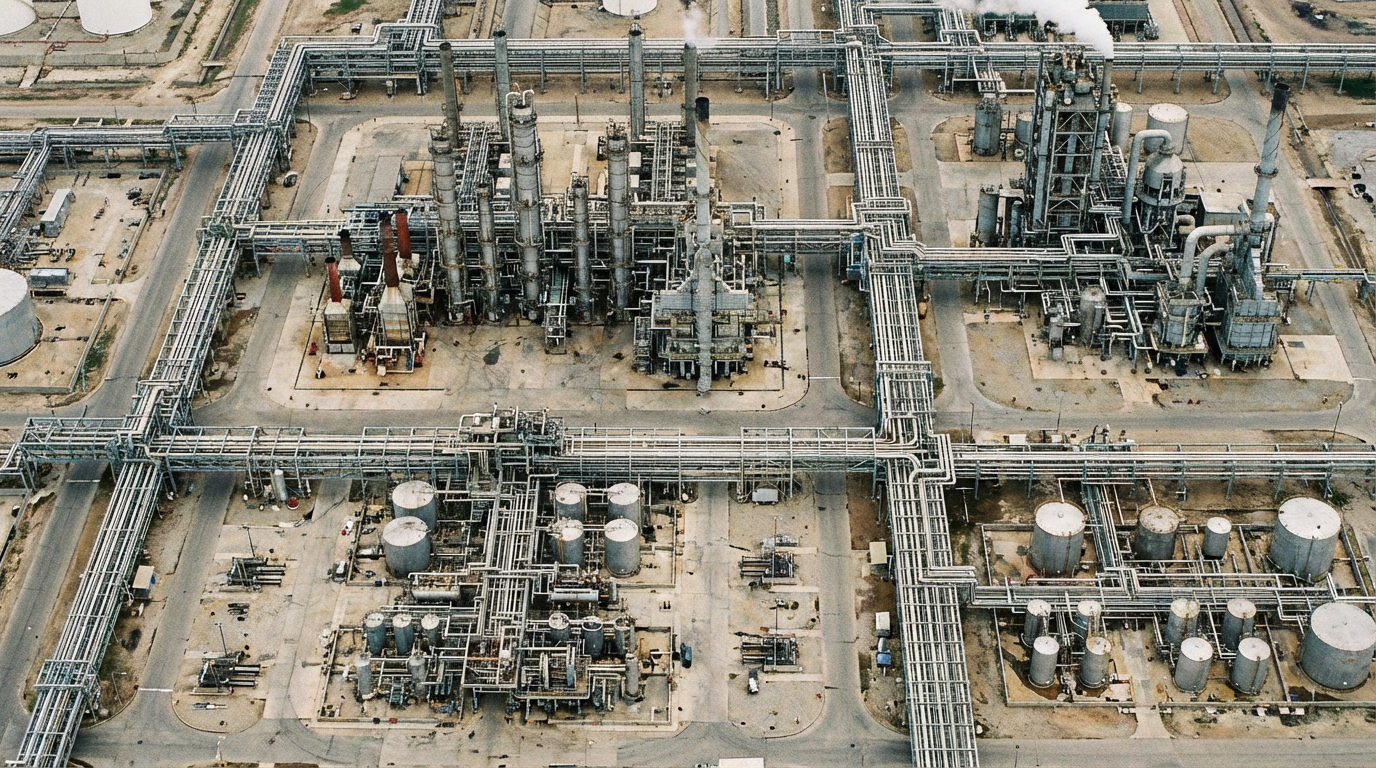
FCC units are among the hardest refinery units to optimize because every variable connects to the next—riser temperature affects coke make, which constrains the regenerator, which limits catalyst circulation and conversion. Traditional APC flattens these nonlinear interactions into fixed coefficients, leaving margin on the table when multiple constraints bind simultaneously. AI optimization trained on actual plant data tracks catalyst drift, coordinates constraints continuously, and adapts to feed quality shifts in real time, helping refiners close the gap between stable operation and best operation.
Every variable in an FCC unit connects to the next. Raise riser temperature and coke make increases. Coke stresses the regenerator, the regenerator constrains catalyst circulation, and circulation determines conversion. That coupling is why the FCC remains one of the hardest refinery units to run near its economic limit, and why small misalignments between equipment, targets, and control execution compound into measurable refinery operations margin loss.
Refiners that work all available cost levers can recover up to $3 per barrel of input crude. In downstream refining alone, technology-driven optimization of yield, energy, and throughput has delivered over $1 per barrel in savings. In the FCC, even a 1% shift in conversion changes the product distribution across gasoline, light cycle oil, and slurry. The margin gap comes from how equipment limits, operating targets, and control execution line up in daily operation.
FCC margin depends on how equipment layout, operating mode, and control strategy align in daily operation.
The sections below trace those interactions to show where FCC margin recovery is most practical.
The reactor and regenerator loop defines the core performance envelope. Hot regenerated catalyst meets feed vapor at the riser base, crack reactions proceed upward, and coked catalyst cycles back through the regenerator at temperatures above 625°C. Whether the regenerator is single-stage partial burn or two-stage full combustion changes the temperature profile, coke selectivity, and ultimately how much feed the unit can process before air supply becomes the binding constraint.
Each equipment choice inside that loop affects the next operating limit.
Riser termination design shows the point. Upgrading from a semi-closed-coupled system to a closed cyclone system minimizes over-cracking and secondary reactions. Feed nozzle design affects droplet size and riser coverage, and better atomization and spray distribution can lift FCC selectivity and yields.
The feed preheat train also matters: higher preheat reduces the catalyst-to-oil ratio needed for a given riser outlet temperature, which changes the coke balance and, in turn, regenerator headroom.
The main fractionator often becomes the plant debottlenecking constraint that limits FCC throughput. Replacing conventional trays with structured packing can reduce pressure drop and create room for throughput increases without modifying major rotating equipment.
The gas concentration section creates a second ceiling. In maximum olefins operation, added propylene production also generates more dry gas. That loads the absorber, deethanizer, and C3/C4 splitter at the same time, so the olefins ceiling can bind before the reactor reaches its theoretical limit.
Higher conversion also increases LPG volumes that load the wet gas compressor. When the compressor approaches its surge margin, operators may have to back the unit off within minutes. These limits compound. The performance ceiling reflects how all the equipment interacts under specific feed and operating conditions, not any single piece in isolation.
FCC units are economically flexible because the same equipment can target different product slates with a small set of variable changes. That flexibility only matters inside the limits created by feed quality, regenerator air capacity, and downstream separation equipment.
In maximum distillate mode, operators lower riser outlet temperature by 10–30°F below gasoline-max conditions. Conversion drops and shifts the yield slate toward light cycle oil and slurry at the expense of gasoline. Catalyst circulation rate also decreases, often through increased feed preheat. Favorable diesel crack spreads or winter heating fuel demand can justify that move. Maximum gasoline mode sits at intermediate severity.
Maximum light olefins mode pushes severity higher through elevated riser temperatures, increased catalyst-to-oil ratio, and ZSM-5 additions that boost olefin selectivity. That mode can materially increase propylene recovery throughput on fresh feed, but extra dry gas can make full olefin-max operation uneconomic without gas plant investment.
Feed quality constrains every mode. Higher metals content accelerates catalyst deactivation, and processing heavy oil with high Conradson Carbon Residue increases coke per barrel, which raises regenerator air demand and can constrain the unit's heat balance.
Together, those effects compress the range between distillate-max and olefins-max. What looks flexible on a planning spreadsheet can become narrow in the control room, particularly late in a catalyst cycle when equilibrium activity has declined. Mode changes that appear profitable in the LP may yield less benefit than expected when equipment limits, catalyst condition, and feed variability are all in play.
Traditional advanced process control (APC) delivers measurable value in FCC service, but the limitation is structural: FCC units don't behave like the steady-state, linear systems that APC models represent best.
The relationship between ZSM-5 additive dosage, riser outlet temperature, and olefin selectivity is nonlinear. The effect depends on catalyst activity, feed quality, and regenerator constraints at the same time. Linear models flatten those interactions into fixed coefficients, which creates blind spots where the actual FCC response diverges from the model's prediction.
Constraint coordination creates a second gap. When the air blower, wet gas compressor, and regenerator temperature all approach limits together, constraint handling often becomes conservative. The best response requires those variables to move together, not one after another.
Much of APC performance in FCC service depends on inference quality, particularly for non-measured variables like naphtha endpoint, coke make, and severity. Operations teams compensate by carrying margin on each important constraint, holding throughput rate below what equipment could support.
That keeps the unit stable, but it leaves conversion and yield below what the equipment can actually deliver. The gap becomes more visible when feed quality shifts or catalyst activity drifts between model updates, and model re-identification cycles may lag those changes by weeks or months.
In practice, FCC APC models often run on parameter sets that reflect conditions from the last turnaround or the last time an engineer had bandwidth to retune, not what the unit is actually doing today.
Advanced optimization methods trained on years of actual plant data can model the nonlinear behavior that APC misses. These models learn from operating history and live sensor streams, then generate updated setpoints every few minutes instead of waiting for the next steady-state calculation.
Catalytic cracking optimization benefits directly from continuous activity compensation. Even minor catalyst drift can shift yields toward heavier products and away from olefins. Data-driven methods track that drift and adjust more continuously, while traditional model update cycles can leave the gap open for weeks.
The same logic applies when wet gas compressor loading and regenerator temperature bind together. A single model that spans all the constraints can find the best feasible point at once, rather than handling each limit one at a time.
Feed adaptation also captures downstream effects as feed quality changes during a shift, before those changes fully appear in product quality.
No industrial AI method replaces the pattern recognition that experienced operators build over years at the board. What advanced optimization handles is the continuous process control load across dozens of interacting variables. Operators still own the judgment calls, especially when the unit moves outside familiar patterns or when mechanical condition starts to matter more than model fit.
Trust usually builds first in advisory mode: the model posts recommended setpoints, and operators decide whether to act. That gives experienced operators a way to test recommendations against what they know, and it improves cross-shift consistency across crews.
When recommendations consistently match or improve on board judgment, plants can progress toward supervised execution and, where appropriate, toward broader closed loop operation.
For refinery leaders seeking to close the gap between achieved and achievable FCC performance, Imubit's Closed Loop AI Optimization solution addresses exactly this kind of complexity. The technology learns from actual plant data, tracking feed quality variations, catalyst aging, and constraint interactions as they happen. It writes optimal setpoints directly to the distributed control system (DCS) in real time.
Plants can begin in advisory mode, where operators compare AI recommendations with their own judgment, and progress toward closed loop operation as confidence builds. Oversight and manual override remain available at every stage.
Get a Plant Assessment to discover how AI optimization can recover FCC margin from the constraints your current control strategy leaves on the table.
Feed quality sets the ceiling on mode flexibility before any process variable changes. High-metals or high-CCR feeds compress the range between distillate-max and olefins-max by constraining catalyst life and regenerator capacity at the same time. Even a strong control strategy can't remove feed-imposed limits on severity, which is why crude oil refining feed decisions have outsized influence on FCC economics.
Yes. Advanced optimization methods typically layer alongside existing APC and control system infrastructure rather than replacing it. Plants with mature APC installations often see clearer improvements because data-driven methods address FCC dynamics and simultaneous multi-constraint coordination that linear APC architecture doesn't capture as effectively. This refinery AI augmentation approach preserves existing control investment while extending its reach.
FCC catalyst circulates continuously through the reactor-regenerator loop, and its activity changes over time due to deactivation, although regeneration restores much of its activity each cycle. Traditional control systems update models on slower cycles, so drift can remain uncompensated between updates. Models trained on continuous plant data can track that drift more closely and adjust setpoint optimization accordingly, which is why the FCC benefits disproportionately from data-driven approaches.