Cracker furnaces lose run length as coke builds on tube walls, and fixed schedules often miss the actual binding constraint, whether that's tube metal temperature, coil pressure drop, or transfer line exchanger fouling. AI optimization predicts when each furnace will reach its limit, recommends severity adjustments to delay it, and coordinates decoking across the fleet. Plants can start in advisory mode and progress to closed loop optimization, extending profitable runs and recovering capacity that calendar-based scheduling leaves on the table.
A cracker furnace starts losing run length as soon as it returns to hydrocarbon service. Coke begins building on radiant tube walls immediately, and operators have to judge how fast each furnace is moving toward its real limit. Naphtha cracker margins in Western Europe have shrunk, which leaves less room for fixed schedules that miss changing furnace condition. In that environment, better visibility into run-end timing matters because furnace efficiency degrades non-linearly through each run.
Decoking timing depends on how feed, furnace condition, and the tightening constraint evolve through each run, not on a fixed calendar.
The sections below examine timing signals, decoking economics, and run-length trade-offs in more detail.
Coke buildup forces decoking because three plant constraints tighten on different schedules. Tube metal temperature, coil pressure drop, and transfer line exchanger (TLE) fouling each begin as soon as hydrocarbon feed enters the radiant coil. Catalytic coking forms early on bare tube metal, then pyrolytic coking dominates later on the growing coke layer. Heavy aromatics also condense in the TLE, so the binding limit is not always in the radiant coil.
The operational problem reinforces itself. As coke insulates the tube wall, operators adjust control setpoints to maintain cracking temperature, which affects yield trade-offs and demands still more firing as more coke accumulates. Pressure drop rises as coke narrows the effective tube diameter, and higher hydrocarbon partial pressure accelerates deposition further.
Tube metal temperature rises through the run even when firebox temperature stays constant, but it doesn't rise linearly. Degradation is slower at the start and faster near the end, which is one reason fixed schedules often miss the most important part of the curve.
TLE coke deposition can accelerate faster than radiant coil deposition as temperature rises. Teams focused only on radiant coil performance may miss the actual limit when TLE fouling determines when the furnace must come down.
Steam-air decoking is the traditional method, and each cycle costs production hours, tube life, and emissions. Feed flow stops, steam purges the coil, and a controlled steam-air mixture oxidizes coke into CO₂ until CO₂ concentration confirms the coil is clean. Depending on coil configuration, the full cycle from isolation through return to service typically takes 1 to 3 days, though it can stretch longer when coke removal is slow or when downstream conditions delay the return to hydrocarbon service.
Every day a furnace is offline removes production capacity, and repeated decokes create structural downtime across the year. Each cycle also consumes tube life through thermal fatigue and generates CO and particulate emissions. The hottest coil sections take the most damage from aggressive decoking conditions.
Cycle duration itself varies more than the textbook description suggests. Coil layout, decoking medium ratios, hold times at temperature setpoints, and the experience of the team running the procedure all change how long a cycle takes on a given furnace. Two furnaces of the same design at the same plant can run cycles that differ by several hours, and the same furnace can run faster or slower from one decoke to the next. Documenting that variation, then narrowing it, is one of the more underrated levers in furnace-limited operations.
For furnace-limited plants, where the cracker section caps overall ethylene output, decoking duration matters almost as much as run length. A typical olefins plant runs 6 to 12 furnaces with at least one in decoke and one in hot standby at any time, which means downtime on a single furnace is a meaningful share of available capacity. Cutting hours from each decoking cycle recovers capacity that would otherwise stay unavailable. That opportunity often receives less attention than run length extension, even though the economic effect can be similar.
Beyond the physical constraints inside the coil, feed type and severity drive most of the variation in run length from one furnace to the next. Naphtha furnaces typically run for 30 to 60 days between decokes, while ethane furnaces can extend further under favorable conditions, often 60 to 90 days. The range reflects how feed quality, reactor material, severity, and design choices interact. Even within naphtha-only operations, batch-to-batch petrochemical feedstock variability in aromatic content changes run length outcomes at similar severity settings.
Mixed-feed crackers face a harder scheduling problem. Different feeds create different coking velocities, and multiple furnaces usually cannot be decoked at the same time without unacceptable production loss. Run length, feed assignment, and decoking sequence therefore have to be managed together across the fleet, which is a plantwide optimization problem more than a single-furnace one.
Feed supply and maintenance conditions also change continuously. Decoking schedules work better when they adapt to current conditions instead of following a fixed calendar. Those current conditions are tied not just to coil limits but also to yield trade-offs across severity, feed quality, and available furnace time.
AI optimization extends profitable run length by predicting when each furnace will reach its end-of-run constraint and recommending severity adjustments that delay it without compromising yield. Observed run lengths vary widely because coking rate responds to many interacting parameters, including tube metal temperature, dilution steam ratio, coil pressure ratio, coil outlet pressure, feed composition, feed rate, firing rate, excess oxygen, burner configuration, and venturi ratio. No single-variable rule captures that interaction well.
Traditional advanced process control (APC) delivers value in furnace stabilization, but its accuracy can drift as coke accumulates because the gap between the controller's design basis and actual conditions widens through the run. Accuracy then falls off near decoking limits, which is exactly the period when better predictions would matter most.
Industrial AI trained on plant data can establish correlations between the broader parameter set and tube metal temperature trajectory. In practice, that gives operations a forward view of when each furnace may reach its threshold under current conditions. The model does not require a clean, complete data foundation to start being useful. Most plants already have years of historian data at the resolution needed to learn from past runs, and data quality typically improves as the model surfaces gaps that the team then closes.
McKinsey has documented one petrochemicals operator that applied advanced analytics to its cracker furnaces and saw throughput and yield improvements without changing the underlying equipment. Manual decision support can combine feed quality, severity, and real-time coil condition in one view, but doing that across eight furnaces with shifting feed slates and staggered run phases stretches the limits of what a team can hold in mind. No model replaces the pattern recognition that comes from decades at the board, but coordination at that scale is difficult to optimize in real time without one.
When planning, operations, and maintenance share a single model of plant behavior, decoking scheduling becomes a coordinated decision instead of a negotiation between siloed functions. Planning can set LP targets from actual furnace condition, and operations and maintenance can align on which furnace to pull next. That kind of coordination is what makes self-optimizing petrochemical plants viable beyond a single unit.
Plants can capture value in advisory mode without moving beyond recommendations. The model compares decoking timing against current furnace condition, shows how feed quality and severity shift run-end risk, and gives different shifts a more consistent view of which constraint is tightening first. That forward view also helps planning and maintenance evaluate feed assignment and decoking sequence together. Advisory deployments routinely deliver standalone value, even at sites that never plan to move beyond recommendations.
Practical advisory scenarios include feed switches that change coking velocity mid-run, severity decisions when a downstream unit constraint emerges, and shift handovers where the outgoing crew has been managing a tightening constraint that the incoming crew may not yet see clearly. In each case, the model gives the team the same picture, which compresses the time it takes to reach a decision and reduces the chance that conservative operating margins quietly accumulate across shifts.
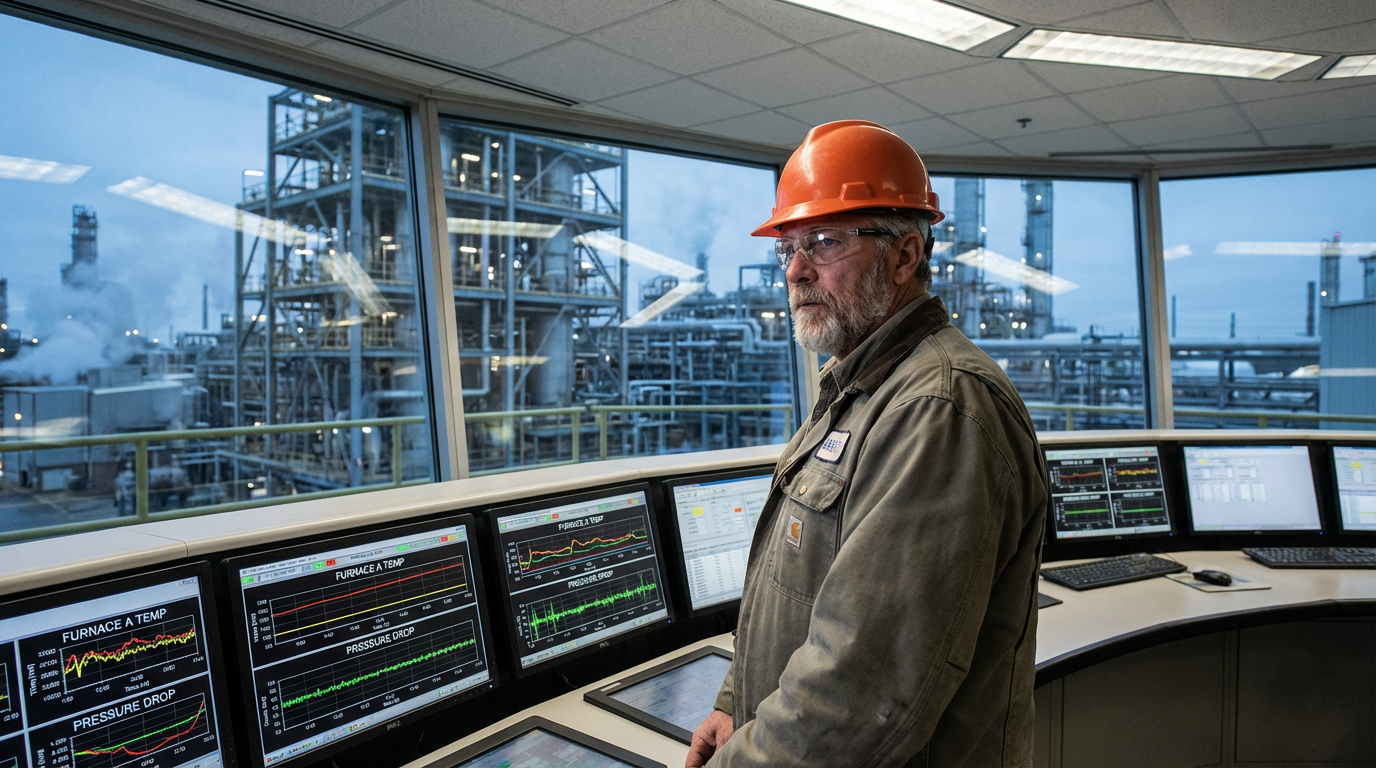
Human AI collaboration is where that value compounds. The model recommends decoking timing and severity adjustments, and operators decide whether to act. Experienced operators compare the recommendations with their own judgment, learn where the model adds value, and identify where it needs refinement. The same side-by-side period supports operator training by giving newer operators a clearer view of how furnace condition, feed quality, and run-end risk fit together.
For petrochemical operations leaders moving from calendar-based decoking to data-driven run length management, Imubit's Closed Loop AI Optimization solution offers a path forward. The platform learns from historical and real-time plant data, recommends severity adjustments, and writes optimal setpoints directly through existing control infrastructure. Plants can start in advisory mode, where operators evaluate recommendations against their own judgment, and progress toward closed loop optimization as confidence builds. Value accrues from the first day of deployment, not just at full automation.
Get a Plant Assessment to see how AI optimization can extend profitable run length and recover decoking-related capacity in your steam crackers.
Shared visibility makes decoking a coordinated operating decision instead of a series of siloed calls. When planning, operations, and maintenance use the same view of furnace condition, they can compare run-end risk, feed assignment, decoking sequence, and outage timing in context. That helps LP targets and maintenance timing reflect current unit condition, which is part of why a coherent operating strategy depends on a common view of the active constraint rather than a fixed maintenance calendar.
The most useful data tracks the constraint tightening first. For decoking, that includes tube metal temperature, coil pressure drop, TLE outlet temperature, feed composition, severity, dilution steam ratio, and firing conditions. Looking at one variable in isolation usually misses how coking develops through the run. Forecasting also depends on data quality, which is why solid process data historian practices matter as much as the modeling layer that sits on top of them.
Advisory mode matters because operators can test recommendations against live furnace behavior before any automatic action is allowed. The model recommends timing or severity changes, and operators decide whether those moves fit current conditions. That side-by-side period builds trust, improves shift-to-shift consistency, and gives newer operators a clearer view of how feed quality, coil condition, and run-end risk connect. It mirrors how a successful AI pilot typically progresses.