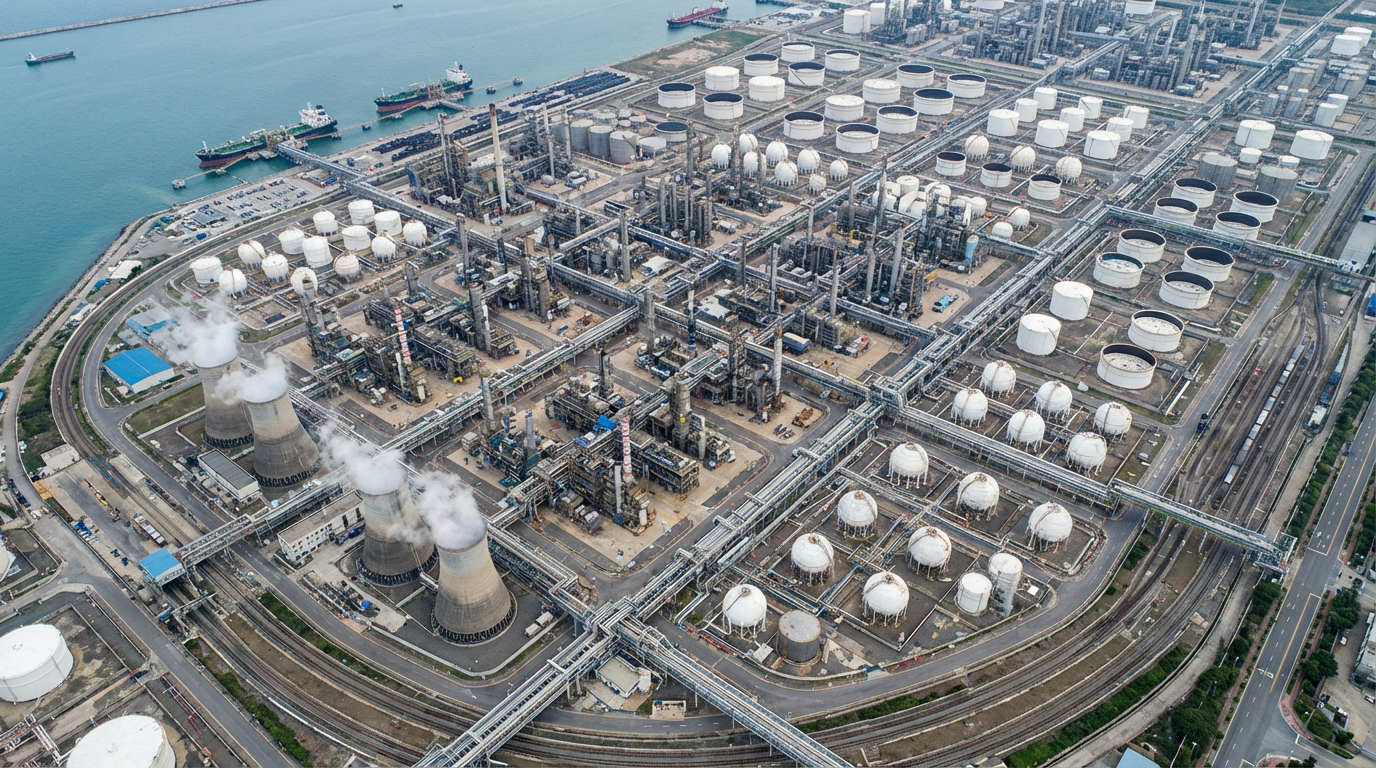
Petrochemical plants consistently produce below nameplate capacity because bottlenecks shift with feed changes, catalyst aging, and seasonal conditions. This article covers why constraints migrate, where periodic studies and static controllers fall short, and how AI optimization tracks shifting bottlenecks across the full process train. Plants can start in advisory mode, validate recommendations, and progress toward closed loop control to recover lost throughput.
Every petrochemical operations leader knows the frustration. A unit rated for a specific throughput consistently falls short, and the constraint responsible shifts depending on the day, the feed, or the season. Global petrochemical margins fell significantly between 2019 and 2024, while new cracker capacity pushed global ethylene utilization to around 80–82%.
That combination leaves less financial room for capital-intensive fixes. The gap between nameplate capacity and actual production is a throughput rate optimization opportunity left on the table. Finding and relieving capacity constraints through operational means, before committing to major capital projects, is often the most practical way to protect margins.
Debottlenecking works better when the plant is treated as a moving target, not a fixed design case.
What follows covers why constraints move, where traditional approaches fall short, and what changes when optimization can keep up with the plant.
The textbook version of debottlenecking treats a plant as a serial system: find the slowest unit, fix it, and move on. In a petrochemical operation, the binding constraint can migrate as feed composition changes, catalyst activity declines over the run cycle, and seasonal ambient temperatures reduce cooling capacity across multiple units.
Consider what happens as catalyst deactivates in a reactor section. Operators compensate by raising inlet temperatures. That can push the constraint away from the reactor and toward the cracker furnace or recycle gas compressor. The bottleneck at start-of-run conditions is often different from the bottleneck later in the run, and the shift happens gradually enough that the lost production optimization opportunity goes unnoticed until throughput drops.
Feedstock variability creates similar migration patterns. When feed ratios shift, downstream olefins fractionation sections that were running comfortably within design limits can become hydraulically constrained. The constraint moves because feed composition changes how the rest of the plant loads up.
In a cracker complex, switching between naphtha-heavy and ethane-heavy feed slates can redistribute heat duties and separation loads across units, from the deethanizer through the propylene splitter, that weren't designed to operate at those conditions simultaneously.
Seasonal effects compound the problem. High summertime ambient temperatures degrade air-cooled exchanger capacity and reduce overhead condenser duty in distillation columns. Compressor performance drops as suction temperatures rise. Multiple units can hit their limits at once, often when demand peaks and energy efficiency becomes hardest to maintain.
Traditional debottlenecking starts with a test run, feeds the data into a calibrated simulation, identifies the binding constraint, and implements modifications. The method is sound, but the plant may not hold still long enough for that answer to remain current.
By the time a simulation-based study is complete and its recommendations are implemented, the constraint that drove the study may have migrated. Plants processing variable feedstocks or managing catalyst deactivation can see those shifts quickly enough that a model calibrated against test-run data captures a snapshot of plant behavior that may already be outdated.
Advanced process control addresses part of this gap by optimizing within defined operating envelopes. But APC controllers operate within constraint limits that may not be updated frequently enough to track changing conditions.
As conditions drift, the mismatch between the controller's model and current plant behavior widens. Operators compensate by manually adjusting limits, but that puts the burden back on shift-by-shift judgment rather than systematic optimization.
Unit-level optimization also leaves a gap. Relieving a constraint in the reactor section can simply move the bottleneck to the fractionation train, and without plantwide process control visibility, that shift goes unrecognized until throughput stalls again.
Periodic studies and static APC provide useful answers, but those answers reflect a point in time. A plant changes continuously, so constraint tracking has to change with it.
AI optimization trained on streaming plant data closes that gap by learning from the process as it runs. Rather than relying only on a model calibrated during a test run, these systems update their picture of where constraints are binding and how process variables interact. When catalyst activity shifts the bottleneck from the reactor to the fired heater, the AI setpoint optimization target can shift with it.
The difference from traditional approaches is how the model stays current. Physics-based simulators require periodic recalibration against test-run data. AI optimization systems learn from the data the plant generates during normal operations: historian tags, controller outputs, and quality measurements that already exist. That means the model can maintain accuracy between test runs in ways that static simulations often cannot.
This matters most during periods of rapid change: catalyst end-of-run conditions, seasonal transitions, or major feedstock shifts. These are exactly the conditions when static models and conservative APC limits leave the most capacity on the table.
The way plants validate debottlenecking recommendations matters as much as the optimization technology itself. Many start in advisory mode, where the system identifies shifting constraints and recommends setpoint changes.
Operators compare those recommendations against what they see at the board: is the suggested move actually targeting the active bottleneck, or has the constraint already migrated? That validation step delivers value on its own, even before any move to closed loop control.
Advisory mode also changes how debottlenecking knowledge transfers between shifts. Senior operators know which constraints reflect hard equipment limits and which reflect conservative settings that were never updated after a previous turnaround. When the optimization system's recommendations align with that experience, both sides gain credibility.
When they don't, the conversation itself surfaces operating assumptions that might otherwise go unexamined. Operator training becomes embedded in daily constraint analysis rather than limited to classroom sessions.
No optimization technology replaces the pattern recognition that comes from decades at the board. But it can track the simultaneous movement of many interacting constraints across a complex process train in a way that's difficult to do manually across an entire shift.
Human AI collaboration works when operators retain authority over debottlenecking decisions and the AI handles the math connecting reactor conditions, fractionation limits, and compressor loading.
The transition from advisory to closed loop can compress the time between identifying a shifting bottleneck and adjusting setpoints from hours to minutes. But that transition happens at the plant's pace, based on accumulated evidence that the recommendations consistently target the right constraint.
Debottlenecking efforts often stall because of organizational fragmentation as much as technical complexity. Operations optimizes the reactor section, maintenance schedules exchanger cleaning on calendar intervals rather than actual fouling rates, and planning sets targets from models that may not reflect current equipment health. Each function makes locally rational decisions that still cost the plant throughput.
A shared optimization model makes those constraint interactions visible across functions. Maintenance can see how deferring a heat exchanger cleaning shifts the active bottleneck to separation limits.
Planning can update throughput targets to reflect actual equipment capability rather than design-basis assumptions. When debottlenecking decisions account for cross-unit interactions, chemical operational excellence becomes a coordinated effort, not a series of disconnected optimizations.
Shared visibility also eases the tension between run-length targets and throughput objectives. When a reactor's catalyst is approaching end-of-run, the model can show how backing off reactor severity to extend the run affects downstream unit loading and overall plant economics. That trade-off analysis happens across the full process train, not just within one unit's operating envelope.
For petrochemical operations leaders seeking to close the gap between nameplate capacity and actual throughput, Imubit's Closed Loop AI Optimization solution offers a path forward. The platform learns from actual plant data, builds a model of process behavior that updates as the plant runs, and writes optimized setpoints in real time through existing DCS infrastructure. Plants can start in advisory mode, validate recommendations against real operating conditions, and progress toward closed loop control as confidence builds. This approach keeps debottlenecking aligned with the constraints the plant is actually facing, while delivering value at every stage of the journey.
Get a Plant Assessment to discover how AI optimization can identify and relieve the capacity constraints limiting your petrochemical plant's throughput.
Different feed compositions change hydraulic loads, heat duties, and separation requirements across the plant. A unit optimized for one feed slate may find its downstream fractionation section hydraulically constrained when feed ratios change. Continuous feedstock optimization through AI tracks how those changes propagate through interconnected units so operators can adjust setpoints before throughput losses become sustained.
Yes. Capacity improvements often come from operational optimization before equipment modifications are justified. Setpoint optimization, better coordination between process units, and more precise constraint tracking can relieve bottlenecks that initially look like equipment problems. Capital projects still matter when the plant reaches a hard equipment limit, but plant debottlenecking through operational means is often the first practical lever to evaluate.
APC constraint logs show where the process is being throttled. When a controlled variable sits at its limit for a high share of operating time, that limit is the active bottleneck. Reviewing constraint activity across multiple controllers reveals which limits bind most often and how patterns shift with conditions. The limitation is that traditional APC usually covers unit-level variables, so continuous process control with plantwide visibility is still needed to see the full picture.