Every cracking furnace loses efficiency across a run as convection fouling reduces heat recovery, coke insulates radiant coils, and firing rates climb to compensate. These variables compound: severity decisions affect coking rates, coking rates affect run length, and run length determines whether a throughput gain actually shows up in margin. AI optimization trained on plant data learns the nonlinear, time-varying relationships that conventional linear control cannot maintain across a run cycle, starting in advisory mode so operators can validate recommendations before progressing toward closed loop control.
Every cracking furnace loses efficiency across a run. Convection section fouling reduces heat recovery, coke insulates radiant coils, and firing rates climb to compensate. The IEA's analysis of naphtha steam cracking shows a wide spread in energy intensity per tonne of high-value chemicals across the installed base, which means the gap between average and top-performing cracking furnace efficiency is largely tied to controllable operating variables.
In olefins plant optimization, the hardest part is that the severity, run length, and energy trade-off keeps shifting within the same run.
What makes this particularly hard to manage is the compounding. Each variable pulls on the others: severity decisions affect coking rates, coking rates affect run length, and run length determines whether a throughput gain actually shows up in the margin. The furnace you are controlling at hour 400 of a run is not the same furnace you started with.
Cracking furnace performance shifts within the same run as severity, coking, and heat recovery move against each other.
The sections below walk through how these constraints compound, where conventional control falls short, and what AI optimization offers.
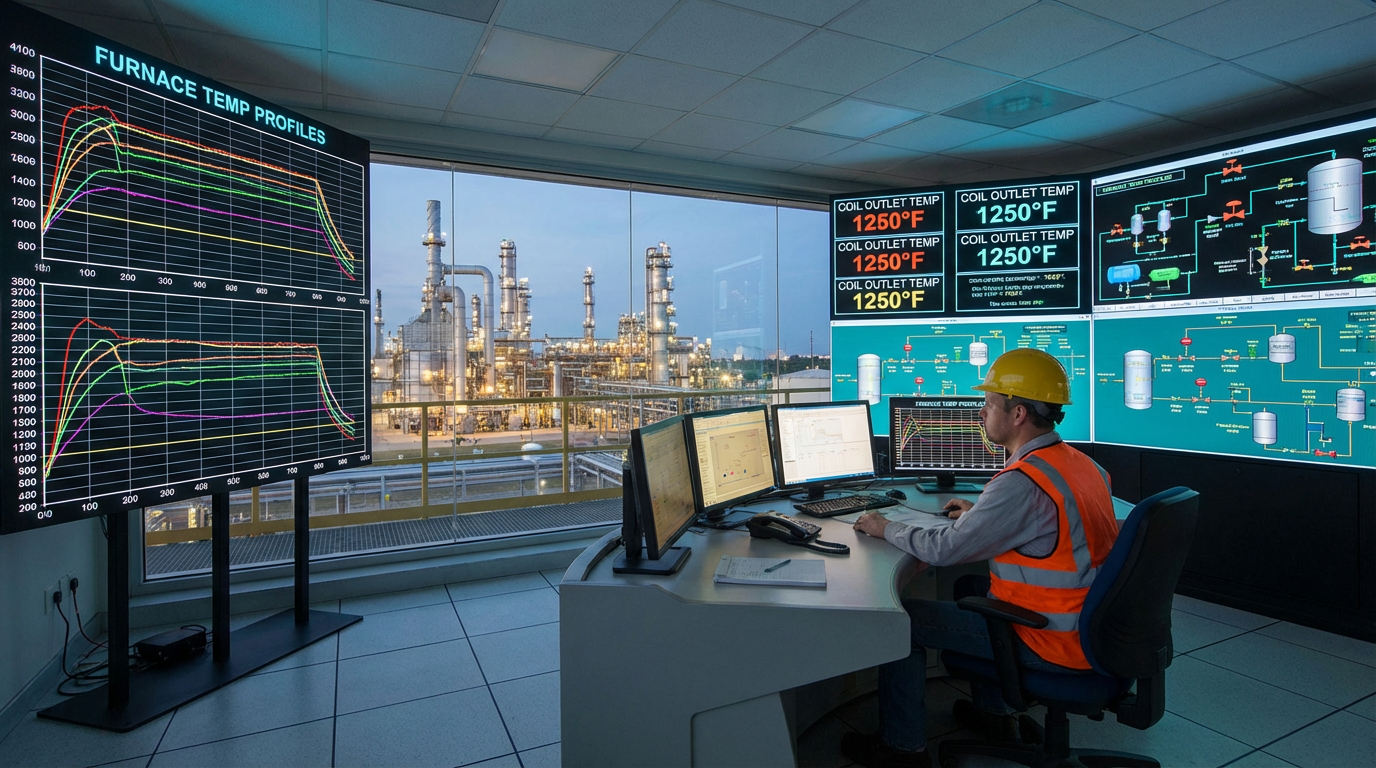
Coil outlet temperature (COT) is the primary severity lever in a steam cracking furnace. Higher COT produces more ethylene, but it also accelerates coke deposition on tube walls. Coke acts as thermal insulation and forces higher firing rates to maintain temperature, a dynamic that compounds across the campaign and drives up energy costs in chemicals.
As coke accumulates, tube skin temperature rises under the same firebox conditions. When tube metal temperature approaches its metallurgical limit, the furnace must come offline for decoking. The economic window sits between acceptable severity and the point where coking forces the run to end.
Each decoking event costs production during downtime. It also increases energy consumption from thermal cycling and contributes to cumulative thermal fatigue on tube materials. More severity can improve near-term yield, but only if the run length penalty doesn't erase that value.
The most underappreciated lever in that equation is pass balancing. If one pass cokes faster than the others, the entire furnace must decoke early. Production from passes that had not yet reached their practical limit is forfeited.
Most operations teams try to equalize coking rates across passes so they reach their limits together. It's also one of the hardest objectives to maintain manually, because the variables that drive differential coking rates, including feedstock variability, flow maldistribution, and tube condition, shift continuously during the run.
Severity also affects the product slate beyond ethylene. Changing COT shifts propylene-to-ethylene ratios and can alter the value mix coming out of the quench and fractionation sections. An operator who increases severity to chase ethylene yield may give back margin on propylene or butadiene without realizing it until the accounting closes.
The efficiency question, in other words, isn't just about energy; it's about the total value the furnace produces per run.
The convection section recovers heat from flue gases to preheat feed and generate steam. When it fouls, the consequences don't stay local; they spread through the entire furnace.
The sequence is predictable. Convection fouling reduces heat recovery and forces higher firing rates. Higher firing rates increase radiant section stress and accelerate coke formation. Faster coking shortens run length and increases decoking frequency. Per-tonne energy efficiency declines with each cycle. What begins as convection fouling becomes a furnace-wide throughput and energy problem.
Within the installed base of naphtha steam crackers, the IEA data suggests that much of the spread in energy intensity per tonne of high-value chemicals is tied to these controllable operating variables: how well plants manage the fouling cascade, how effectively they balance passes, and how closely they can operate to the true limits of the current run rather than conservative assumptions from earlier in the campaign.
The plants at the efficient end of the curve aren't necessarily running newer equipment; they're running closer to their actual constraints instead of estimated ones.
Advanced process control (APC) and model predictive control (MPC) have delivered real value in cracking furnaces for decades. APC stabilizes multivariable furnace operation and keeps operators on target. Its limitations appear when the furnace changes faster than the model can be maintained.
Cracking models must contend with unknowns such as feed composition shifts, coil temperature profiles, and maldistribution among coils. Few online measurements capture feedstock variation with enough speed and precision to keep the model fully anchored in real time. That uncertainty matters most when operators are trying to weigh throughput against the run length penalty that follows.
Fouling remains a major unresolved constraint. Throughput may rise when severity increases, but the value disappears if the run ends early enough to reduce average throughput across the campaign. A controller that optimizes throughput without accounting for run length can't reliably optimize margin.
Coking changes heat transfer, pressure drop, and temperature profiles continuously within each run cycle. A model identified near the start of a run degrades as the run progresses, then resets to a different baseline after decoking. Re-identifying the model after each decoke takes engineering time that most sites don't have in surplus. These time-varying dynamics sit outside the design envelope of conventional linear MPC.
Single-objective control adds another limitation. A controller tuned for ethylene selectivity can undervalue propylene yield, and the scheduling decision about when to decoke often sits apart from the real-time severity decision. Those choices should be linked, but in many installations they're not. The decoke timing decision gets made by a different team, on a different cadence, using different assumptions about where the furnace stands in its current run.
None of this diminishes the operational expertise that comes from decades at the board. Conventional approaches struggle to jointly optimize severity, run length, and energy consumption while adapting to conditions that keep changing within the same run: that is the specific gap.
These control gaps share a common pattern: nonlinear, time-varying relationships across variables that don't stay still long enough for a fixed linear model. AI optimization trained on historical plant data learns those relationships directly, including feed-to-coking behavior, convection-to-radiant interactions, and severity-to-run-length trade-offs that shift through each cycle.
The practical starting point is usually advisory mode. The model recommends setpoint adjustments, and experienced operators decide whether to act on them. In cracking furnaces, those recommendations can be checked against what operators already watch: whether one pass appears to be coking faster than its neighbors, whether stack temperature trends suggest convection fouling is progressing, or whether severity targets from planning still reflect the furnace's current state.
Trust builds through repeated accuracy. A recommendation to rebalance a pass or adjust steam ratio can be compared with board-level observations before a change is made. That visibility also gives newer operators a window into the reasoning behind setpoint decisions, turning the model into a training tool alongside its optimization role.
As confidence grows, some plants choose to move toward closed loop operation where the model writes setpoints directly. Others find that advisory mode alone delivers sufficient return by tightening the gap between how the furnace is running and how it could be running.
A shared model changes cross-functional decisions too. When planning, operations, and process engineering look at the same furnace behavior, severity targets can be weighed against run length consequences and energy cost in one view. LP targets can be tested against the furnace's current coking state instead of against a stale assumption from earlier in the run.
The decoke timing decision, often made by a separate team on a different cadence, can draw on the same data that informs the real-time severity choice. That kind of coordination is where petrochemical operations often leave the most margin on the table.
For operations leaders trying to protect margin in a tight olefins market, the opportunity is concrete: avoid premature decoking, reduce the energy penalty tied to fouling, and operate severity with a clearer view of the run length consequence. Plants can start in advisory mode to build trust and demonstrate value, remain in advisory mode when decision support alone delivers the needed return, or progress toward closed loop operation as confidence builds.
Imubit's Closed Loop AI Optimization solution learns from actual plant data and writes optimal setpoints in real time. The platform gives cracking furnace operations a single model that adapts to current conditions rather than relying on assumptions from the start of the run.
Get a Plant Assessment to discover how AI optimization can recover margin from your cracking furnaces' severity, run length, and energy trade-offs.
Stack temperature becomes a useful warning when it rises consistently above design expectations, not just from day-to-day fluctuation. A sustained 50°C increase above design stack temperature indicates lost heat recovery in the convection section. At that point, the furnace is burning more fuel than it should to maintain the same radiant section performance.
Alignment breaks down when LP targets are set at the start of a run and never revisited as the furnace changes. A practical fix is to build regular checkpoints into the run where operations shares current coking state, stack temperature trends, and pass balance data with planning teams. When both sides can see where the furnace actually stands, severity targets can be adjusted before the gap between plan and reality becomes a margin problem.
In advisory mode, the AI model recommends setpoint adjustments for severity, steam ratios, and pass balancing based on current furnace conditions. Operators compare those recommendations against their own board readings before deciding whether to act. Repeated accuracy over multiple runs is what builds the trust needed to consider further automation.