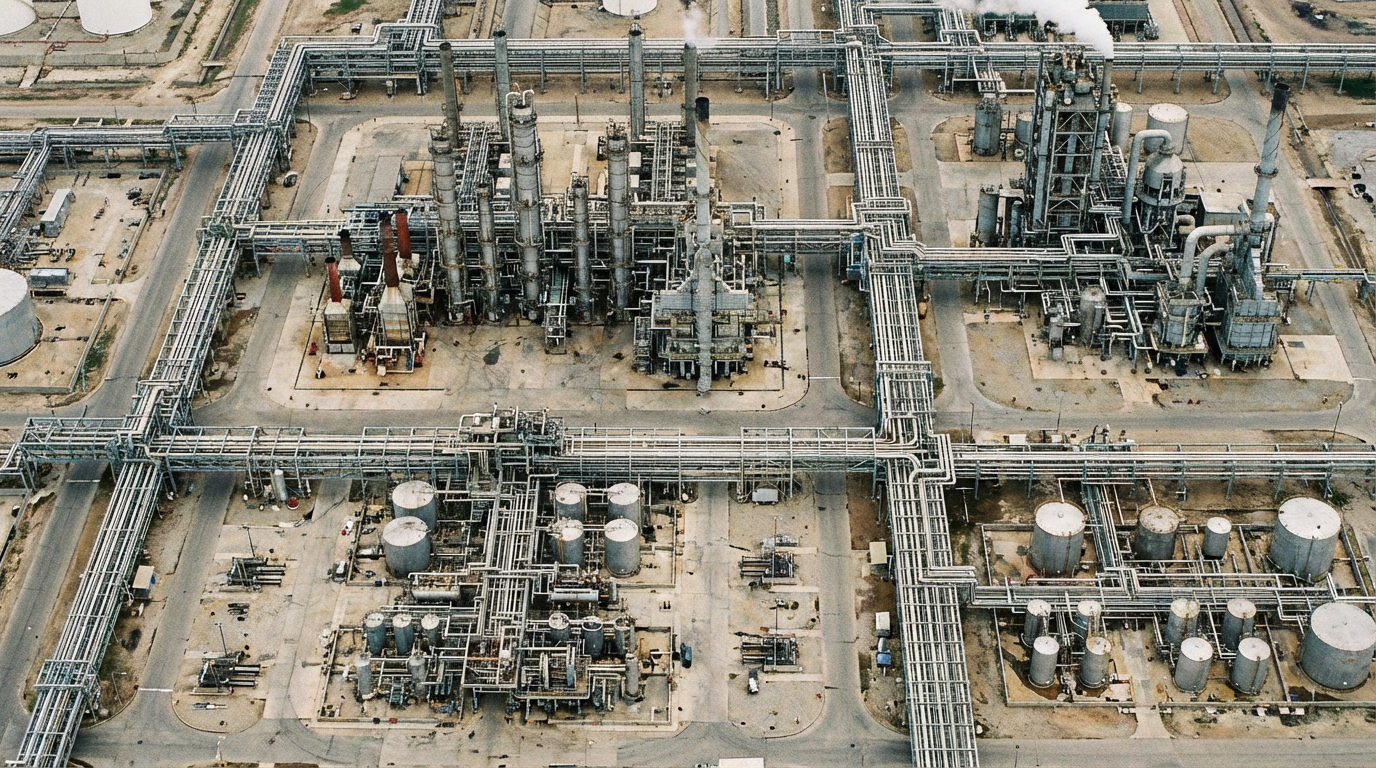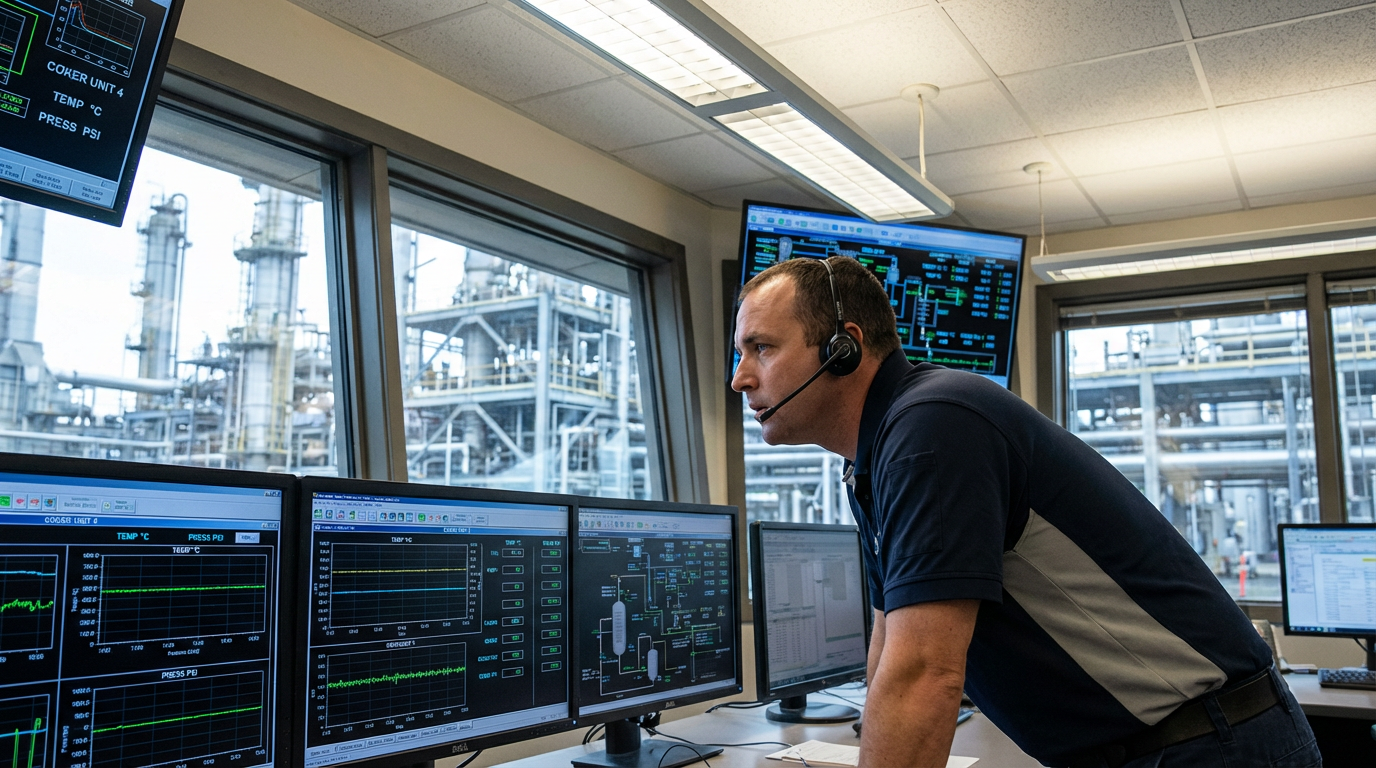
Delayed coking is one of the toughest daily trade-offs in refining: every hour taken out of the drum cycle boosts throughput but adds thermal stress to expensive equipment. Yield levers like oil partial pressure reduction, recycle ratio adjustment, and temperature management are well established but unevenly applied because each one touches multiple constraints that shift as heater fouling progresses and feed quality changes mid-cycle. Conventional control struggles at this intersection because the coker is semi-batch—drum switches send cascading disturbances through the fractionator that linear models can't anticipate. AI optimization trained on site-specific cycle data coordinates these transitions and adapts to fouling progression continuously, helping refiners push capacity and yield without trading away drum life.
Delayed coking is one of the toughest trade-offs to run day to day. Every hour taken out of the drum cycle boosts throughput, but it also adds thermal stress to equipment that's expensive to replace. A mid-size refinery can recover $0.50–$1.00 per barrel in margin through better value chain optimization, and the coker is one of the units with the highest impact in that chain.
The real operating question is how to push capacity and yield without trading away drum life.
That tension sits at the center of coker unit economics. The coker converts the lowest-value stream in the barrel into liquid products that feed the FCC unit and hydrocracker. Its yield structure is a direct driver of refinery-wide profitability, and the gap between average and top-quartile coker performance is well documented.
Closing that gap starts with understanding where margin lives in the drum cycle, which yield levers matter for a specific site, and how to apply them consistently across shifts.
Delayed coker economics hinge on drum cycle management and yield lever selection.
Here's how these dynamics interact, why they resist conventional control, and where AI optimization changes the calculus.
Cycle time directly determines coker capacity. In a two-drum system running 16-hour cycles, each drum sees roughly 548 cycles per year (8,760 hours ÷ 16), producing about 1,095 total drum cycles across the pair. Stretch that to 18 hours and relative capacity drops to about 89% of the baseline (16/18 ≈ 0.89). The arithmetic is simple, but the operating reality behind it is not.
A delayed coker runs as a semi-batch process with six discrete phases: online coking, drum switching and steam stripping, water quenching, draining, coke cutting, and warm-up. Each phase has different constraints and different failure modes, and the bottleneck is usually one or two offline steps that quietly expand over time.
During online coking, the main economic drivers are heater outlet temperature, drum pressure, coil velocity steam, and feed rate. Pushing rate can be limited by heater duty, fractionator stability, or wet gas compressor loading.
Heater fouling shifts the practical limit over the run, which means the operating envelope that's available at day one of a heater cycle is different from what's available at day ninety.
Water quenching sharpens the throughput-integrity trade-off. The largest thermal stresses occur during this phase, and quench rate determines how much fatigue accumulates per cycle. The pattern of temperature gradients through the shell, skirt, and nozzle regions matters more than a single temperature reading, and poor draining or uneven internal wetting can leave hot spots that complicate cutting downstream.
Cycle studies at high-performing sites often find that a small number of repeatable deviations drive most of the lost capacity: slow drains after foaming episodes, extra quench soak added without a clear trigger, or switch sequences that were modified over the years and never re-optimized.
Better analytics and tighter plantwide process control can recover that time without treating every cycle as a special case.
Inaccurate yield estimation in refinery LP models can cost a facility millions of dollars in gross refining margin through misaligned secondary unit loading and suboptimal crude oil processing.
The levers to recover that margin are well established but unevenly applied, largely because each one touches multiple constraints.
Oil partial pressure reduction delivers the largest documented single-parameter impact. Published commercial plant test results (at constant heater outlet temperature) have shown gas oil yields climbing by more than 10 percentage points when oil partial pressure was cut roughly in half.
In operations, lowering oil partial pressure typically involves reducing drum pressure, increasing steam dilution, or both. Each route carries knock-on effects that show up in the next drum switch: lower pressure increases volumetric vapor traffic that can stress the fractionator overhead and wet gas compressor, while higher steam dilution changes fractionation behavior and can move constraints to sour water handling.
Recycle ratio adjustment is the most accessible lever. Lower recycle ratios reduce coke production and can increase liquid yield by several wt%, with the exact shift dependent on unit constraints and feed. No capital investment is required, though operations teams must balance against refinery furnace capacity and coking rate constraints.
The "best" recycle ratio is usually not a single number; it's a band that depends on heater fouling state, drum cycle position, and downstream capacity.
Temperature management offers incremental improvement. Higher coking temperatures decrease coke yield and increase liquid recovery, but they can also accelerate heat exchanger fouling and shorten heater run length. High-performing refinery sites treat temperature as a trajectory over the heater run, not as a fixed setpoint.
Feedstock quality underlies everything else. Higher Conradson Carbon Residue means more coke and fewer liquids; higher metals suppress coke grade; higher sulfur increases downstream hydrotreating demand. But feed quality is rarely steady through a cycle.
Tank turnover, blending variability, and upstream unit swings can change the coker feed mid-cycle, and yield optimization that ignores these short-term shifts usually ends up as conservative operation.
Cycle management and yield optimization look like separate problems on paper, but in operations they collide constantly. Lowering drum pressure to improve liquid yield simultaneously increases volumetric vapor flow during the next drum switch, making fractionator stabilization harder. Pushing cycle time shorter to gain throughput narrows the window available to adjust quench protocols when feed quality shifts.
And heater fouling gradually erodes the temperature headroom that yield levers depend on, while also changing the thermal profile that cycle integrity requires.
This coupling makes coker optimization genuinely hard. Every yield lever adjustment propagates into cycle dynamics, and every cycle management decision constrains or enables yield lever flexibility. Optimizing one axis in isolation usually means leaving margin on the other.
Standard advanced process control wasn't designed for this intersection. APC handles continuous, steady-state optimization well, but a delayed coker is semi-batch: every drum switch sends a cascade of disturbances through the fractionating column, and many of the critical decisions during switching are discrete actions tied to permissives, interlocks, and operator timing rather than classic control loops.
Physical constraints like minimum pump-around flow limits force manual intervention at precisely the moment when coordinated optimization would deliver the most value.
Product quality data compounds the difficulty. With laboratory analysis arriving hours later, control systems use tray temperatures as proxies, and operators run conservatively away from specification limits to avoid off-spec production. That deliberate give-away is margin left on the table, and it widens every time an operator faces uncertainty about where feed quality, heater performance, and cycle position have shifted the true constraint boundaries.
Linear models can't track the time-varying interaction between heater fouling, cycle phase, and yield lever position. The result is either frequent model retuning (which requires specialist engineers already in short supply) or accepted throughput rate degradation.
AI optimization built on actual plant data changes the operating picture at this cycle-yield intersection. Conventional control reacts after drum switch disturbances propagate. AI models trained on a site's own historical cycle data can anticipate transitions and prepare coordinated control responses before the fractionator destabilizes, adjusting reflux, pumparound targets, and heater firing as the switch sequence begins.
Because the model learned from the plant's actual operating history (not idealized process equations), it accounts for site-specific constraints that generic models miss.
The models also adapt to heater fouling progression continuously, rather than relying on static linear relationships that degrade between retuning intervals. And industrial machine learning models built from plant data can estimate product quality in real time.
That replaces the slow lab feedback cycle that forces operators to run conservatively away from spec limits. When operators can see where their true constraint boundaries are at any point in the heater run, the give-away shrinks without increasing off-spec risk.
Cycle-by-cycle analytics also strengthen asset integrity. Industry experience shows that a relatively small fraction of operating cycles can drive a disproportionate share of fatigue damage at critical locations. That insight reframes the throughput-integrity trade-off: instead of blanket conservative operating practices, operations teams can make targeted adjustments based on cycle-specific damage signals, separating "fast but safe" cycles from those that create high stress at no economic benefit.
That distinction becomes possible when process data from cycle operations, yield performance, and equipment integrity feed the same model rather than sitting in separate systems that nobody has time to cross-reference during a shift.
Top-quartile coker operations consistently outperform the industry average on availability, heater run length, and maintenance cost. The difference often comes from better transition control, tighter constraint management, and more consistent shift-to-shift execution.
For refineries looking to close that gap, Imubit's Closed Loop AI Optimization solution learns from plant-specific operational data and writes optimal setpoints in real time across the drum cycle. Plants can start in advisory mode, where operators evaluate AI recommendations against their own expertise, and progress toward closed loop control as confidence builds.
The technology integrates with existing DCS and APC infrastructure and addresses the specific control gaps that semi-batch coker operations expose in conventional systems.
Get a Plant Assessment to discover how AI optimization can recover coker yield margin and extend drum life through smarter cycle management.
Refineries can move beyond blanket conservative quench rates by using cycle-specific data. Analyzing the thermal response of each cycle reveals which operating patterns contribute disproportionately to fatigue damage. Operations teams can then adjust quench protocols based on those signals. This approach balances throughput goals with long-term asset integrity without forcing unnecessary trade-offs between speed and thermal fatigue prevention.
Drum switches introduce rapid, large-scale disturbances that conventional control systems aren't designed to anticipate. These systems react to deviations after they occur, often forcing operators to intervene manually to stabilize the fractionator. Traditional process control systems were built for steady-state processes and struggle to manage the semi-batch nature of the coker. Every transition becomes a lost optimization opportunity.
Feed quality shifts within and between cycles are one of the largest sources of yield variability. Properties like Conradson Carbon Residue directly set the coke-making tendency, while mid-cycle changes from tank turnover or upstream unit swings alter the constraint landscape that yield levers operate within. Aligning refinery operations and crude selection with real-time coker capabilities closes that gap, since no amount of operational tuning fully compensates for a suboptimal feed mix.