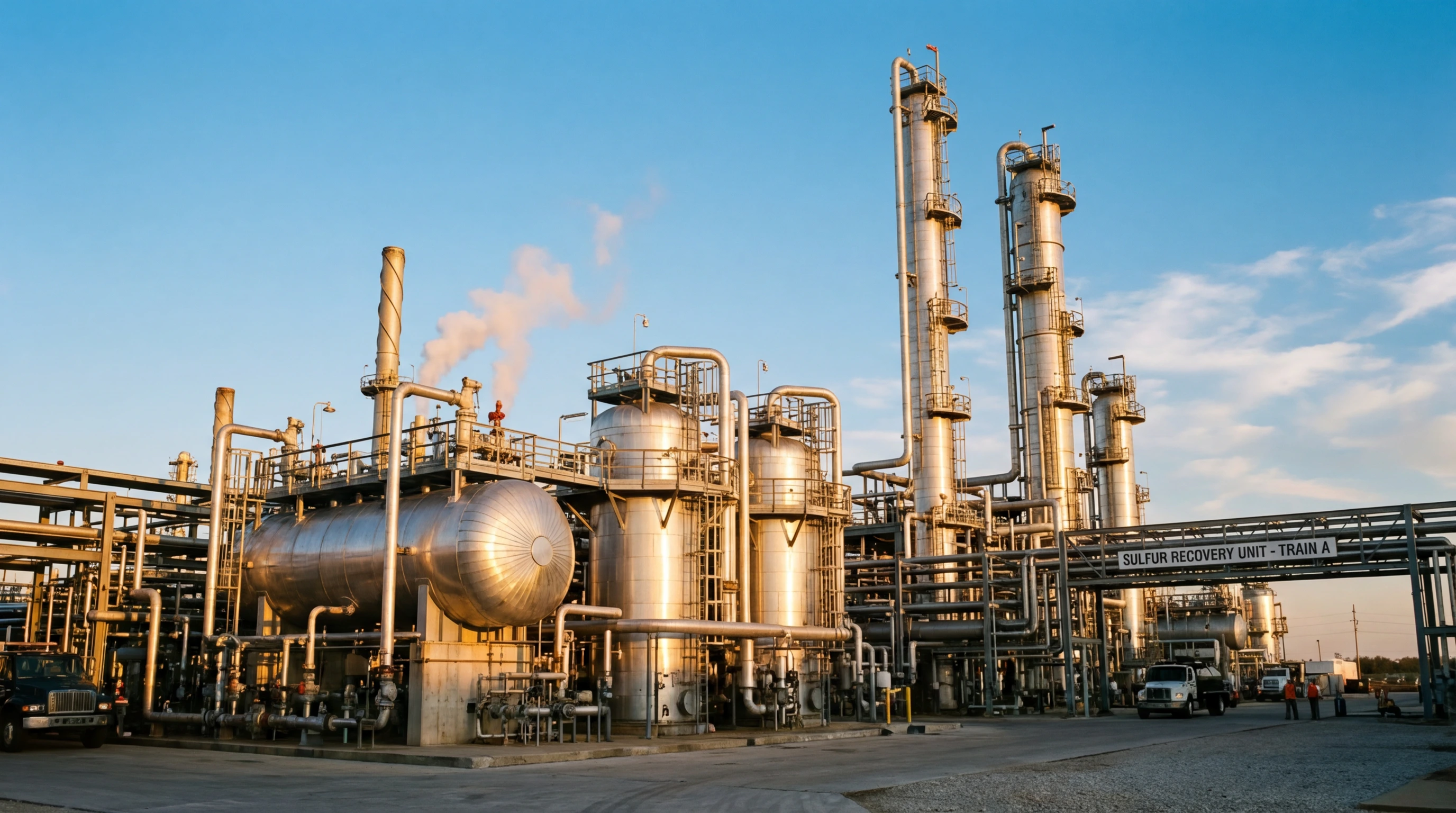
The sulfur recovery unit rarely makes headlines until it limits crude flexibility and erases the margin opportunity from cheaper sour crudes. This article explains how Claus process chemistry caps recovery at 97–98% before tail gas treatment, why feed variability from shifting hydrotreating severity and sour water stripper loads destabilizes SRU performance, and how the unit defines the refinery's practical crude slate ceiling. AI optimization trained on actual operating history adapts to shifting feed conditions and coordinates air demand, bed temperatures, and constraint boundaries in real time.
The sulfur recovery unit rarely makes headlines until it becomes the constraint that limits everything upstream. When the SRU reaches capacity or underperforms, the refinery can't process heavier, cheaper crudes, and the margin opportunity disappears. Refiners that address SRU constraints alongside crude economics and overall operational capability stand to recover margin that's otherwise left on the table.
Recent BCG analysis of refinery cost structures finds that comprehensive improvements in operations and planning can yield up to $3 per barrel in savings on input crude.
The Claus process sits at the center of that equation. It's the point where upstream decisions about crude selection, hydrotreating severity, and product specifications converge into a single thermodynamic and regulatory constraint.
The Claus process sets practical limits on sulfur recovery and emissions performance, and small feed shifts can turn the SRU into the refinery's binding constraint.
The sections below connect those operating limits to the margin exposure refineries face today.
Two acid gas streams converge at the SRU inlet. Amine acid gas from hydrotreater and hydrocracker recycle gas strippers carries primarily H₂S and CO₂. Sour water stripper gas adds H₂S, ammonia, and water vapor.
In the thermal section, approximately one-third of incoming H₂S combusts with air to form SO₂ at thermal reactor temperatures ranging from 980 to 1,540 °C. Hot gas from the combustion chamber passes through a waste heat boiler that generates medium- to high-pressure steam before entering the first sulfur condenser. The SO₂ reacts with remaining H₂S to begin forming elemental sulfur.
Air supply must maintain a 2:1 molar H₂S-to-SO₂ ratio, a stoichiometric control variable that defines the unit's operating precision.
Side reactions produce carbonyl sulfide and carbon disulfide, both of which must be hydrolyzed back to H₂S in the first catalytic converter. That bed operates at the highest temperature in the catalytic section for exactly this reason. If first-bed temperature drops during turndown or feed composition shifts, unconverted COS and CS₂ pass through to the tail gas and reduce overall recovery.
Each subsequent catalytic stage recovers roughly two-thirds of the sulfur entering it. A two-bed configuration typically achieves 92–95% recovery, a three-bed unit reaches 95–96%, and four beds can approach 96–97%.
Even the thermodynamic ceiling sits at just 97–98%. That gap between Claus-only recovery and current emission standards is why tail gas treatment exists, but tail gas units aren't a free pass: when the Claus section underperforms, the TGTU absorbs more sulfur compounds. Chemical consumption rises and the TGTU's own operating margin narrows.
The Claus reaction equilibrium imposes this limit on every refinery operations configuration. Better control can narrow the gap between actual and theoretical recovery at each stage, but the underlying chemistry determines how much sulfur ultimately passes through to tail gas.
Upstream operations largely determine SRU feed composition, and that composition is rarely stable. As hydrotreating severity increases to meet tighter product sulfur specifications, the ratio of sour water stripper gas to amine acid gas shifts upward. Heavier opportunity crudes and more refractory feed streams compound that shift.
The volumetric consequence matters more than most planning models account for. A refinery can overload its SRU without increasing sulfur throughput simply by shifting more of the acid gas load from the amine system to the sour water stripper. The shift changes the operating burden and alters thermal-section combustion conditions, even when sulfur mass flow looks manageable on the planning model.
Ammonia introduces a further complication because furnace conditions and first-bed conversion remain tightly linked. Increasing furnace severity improves ammonia destruction and reduces the risk of ammonium salt deposition in downstream catalyst beds. But pushing furnace temperature higher than necessary wastes energy and can stress refractory linings. When temperature control slips in either direction, product quality and recovery both suffer.
Feed contamination adds its own reliability dimension. Changes in flame temperature and combustion quality can contribute to catalyst fouling and deactivation, even when the root cause isn't obvious from catalyst bed temperature profiles alone. Operators who've run the same SRU through multiple turnaround cycles often develop an intuitive read on these conditions, but that expertise doesn't transfer easily across shifts or to newer crew members.
An SRU at maximum throughput can't increase the sour crude fraction regardless of market conditions. The unit limits how much sulfur the entire refinery can accommodate while meeting stack emission specifications. When sour-sweet crude differentials widen, every barrel of discount the SRU can't support is refinery margin left on the table.
Current regulations have tightened the operating window for imprecise SRU control. Federal NSPS Subpart J sets a stack SO₂ limit of 250 ppmv (dry basis at zero percent excess air) for oxidation control systems, while state-level permits frequently impose limits tighter than federal floors. Those permit conditions apply during startups and restarts, too. Compliance risk peaks precisely when control is hardest.
A restart after an unplanned SRU trip often means running at reduced throughput until the unit stabilizes, and the emissions clock doesn't stop during that recovery period.
The economics cut both ways. SRU overcapacity means carrying capital charge on idle assets. SRU undercapacity means lost heavy oil processing opportunities, forced throughput reduction, and compliance-constrained restarts that can keep units down longer than the underlying mechanical issue warrants.
Planning teams face this tension every time the LP model runs. The crude slate that looks best on margin may push the SRU closer to its constraint boundary than operations is comfortable managing, especially during feed transitions or when catalyst age is a factor. Without a shared, dynamic view of where that boundary actually sits under current conditions, the planning model and the operating reality can diverge.
Operations typically responds by running more conservatively than the LP suggests. The buffer protects compliance but leaves SRU capacity underutilized.
Conventional PID controllers are single-variable and reactive, while model predictive control handles multivariable interactions but degrades as feed composition shifts its underlying process gains. The Claus process presents exactly the conditions where both architectures struggle. Multiple variables interact simultaneously, constraints shift with feed composition, process control time delays compound the difficulty, and the SRU depends on upstream units it doesn't control.
Field experience confirms that PID control produces undesirable oscillations in critical SRU variables when feed composition changes faster than the control response can accommodate.
In SRU service, feed conditions change more frequently than in stable downstream units, so advanced process control models can degrade faster than the maintenance cycle refreshes them. Nearly continuous model upkeep becomes necessary, and the value of the initial implementation erodes over time.
Conventional SRU APC often operates in a silo, too, with limited feedforward integration from the upstream units whose decisions determine feed composition.
AI optimization that learns from actual plant operating history captures the nonlinear dynamics and multi-unit interactions that linear models miss. Because the model trains on real process data rather than idealized reaction kinetics, it can adapt as feed quality, catalyst condition, and equipment state evolve.
No optimization technology replaces the pattern recognition that comes from decades of operating an SRU through upset conditions. But when the model handles multivariate complexity, experienced operators can focus their judgment where it matters most: abnormal situations and decisions that models can't replicate.
Implementations that build trust start in advisory mode. The AI recommends setpoint adjustments, and operators compare those recommendations against their own judgment, a human-AI collaboration that builds confidence incrementally. That matters in SRU service because feed shifts don't arrive one variable at a time.
Advisory mode also delivers standalone value. Newer operators gain visibility into how experienced crews weigh competing constraints, and teams can evaluate what-if scenarios before recommendations reach the control system. Consistent recommendations reduce the variability in how different crews respond to the same conditions.
For the SRU specifically, advisory mode can flag when feed composition trends are pushing the unit toward a constraint boundary hours before conventional alarms would fire. That kind of early visibility changes how shifts manage transitions between crude blends.
Cross-functional coordination changes too. When planning, operations, and engineering share a single model of plant behavior, they can evaluate crude severity choices against current SRU headroom before those decisions reach the board. This kind of refinery AI augmentation turns the SRU from a constraint discovered after the fact into one managed proactively.
For refinery operations leaders seeking to protect margins while tightening environmental compliance, Imubit's Closed Loop AI Optimization solution uses plant data to build a dynamic model of the sulfur recovery system, including the thermal section, catalytic stages, and tail gas treatment.
The system writes optimal setpoints in real time through the existing DCS infrastructure, coordinating air demand, bed temperatures, and constraint boundaries as feed conditions shift. Plants can start in advisory mode, where operators evaluate AI recommendations alongside their own expertise, and progress toward closed loop operation as confidence builds.
Get a Plant Assessment to discover how AI optimization can unlock SRU capacity and protect refinery margins against feed variability.
The clearest signs are usually indirect at first. Room for feed changes shrinks, tolerance for control drift tightens, and flexibility to absorb shifts in sour water stripper gas narrows. As those conditions build, the SRU can become the unit that limits crude processing before sulfur mass flow alone looks excessive. The practical signal isn't just sulfur rate, but how close the unit is running to its operating envelope.
The most concrete change is timing. Without shared visibility, SRU constraints typically surface after crude purchases are committed and severity targets are set. A shared model lets planning screen crude candidates against current SRU headroom before procurement, lets operations see the expected acid gas burden of a proposed severity change, and gives engineering real data on whether a bottleneck is a control issue or a capacity constraint. Decisions that once happened sequentially can happen in parallel.
Advisory mode lets operators test recommendations against real unit behavior before the control system acts on them automatically. In SRU service, where feed shifts arrive through several variables at once, that comparison shows crews whether recommendations hold up under changing conditions. It's especially valuable during startups and restarts, when emissions compliance is hardest to maintain and operators benefit from seeing continuous process control recommendations for air demand and bed temperature ramp rates before committing moves to the DCS.