Finish cement grinding is the single largest electrical load in most cement plants, consuming roughly two-thirds of production line electricity. Mill technology sets the efficiency ceiling—ball mills, VRMs, and HPGRs each respond differently to moisture, grindability, and classification limits—but circuit design and control strategy determine how close a plant actually runs to it. Single-loop control falls short because feed rate, separator speed, and airflow interact simultaneously, and adjusting one changes the optimal setting for all others. AI optimization coordinates these variables together, tightening fineness variability, reducing overgrind margins, and delivering throughput and energy improvements that compound over time as the model captures more of the efficiency available within existing equipment.
Finish cement grinding is the single largest electrical load in most cement plants. Grinding circuits can consume roughly two-thirds of electricity across the entire production line, and that share climbs higher when separator fans, bucket elevators, and conveyors are included. Small shifts in circuit stability and fineness control show up immediately in kWh/t, throughput, and quality excursions.
For plants already running tight margins, those shifts translate directly into cement energy intensity that either supports or erodes profitability.
AI optimization applied to finish grinding can deliver up to 10% improvements in both throughput and energy efficiency. But where that headroom actually sits depends on which mill technology, circuit configuration, and control strategy a plant runs.
Each grinding circuit's technology and control approach determine how much energy converts to saleable product versus waste heat.
The sections below cover mill type trade-offs, circuit design, the multivariate control problem, and what AI optimization delivers.
The mill a plant runs sets a ceiling on how efficient the grinding circuit can get. Each technology responds differently to moisture, grindability, and classification limits.
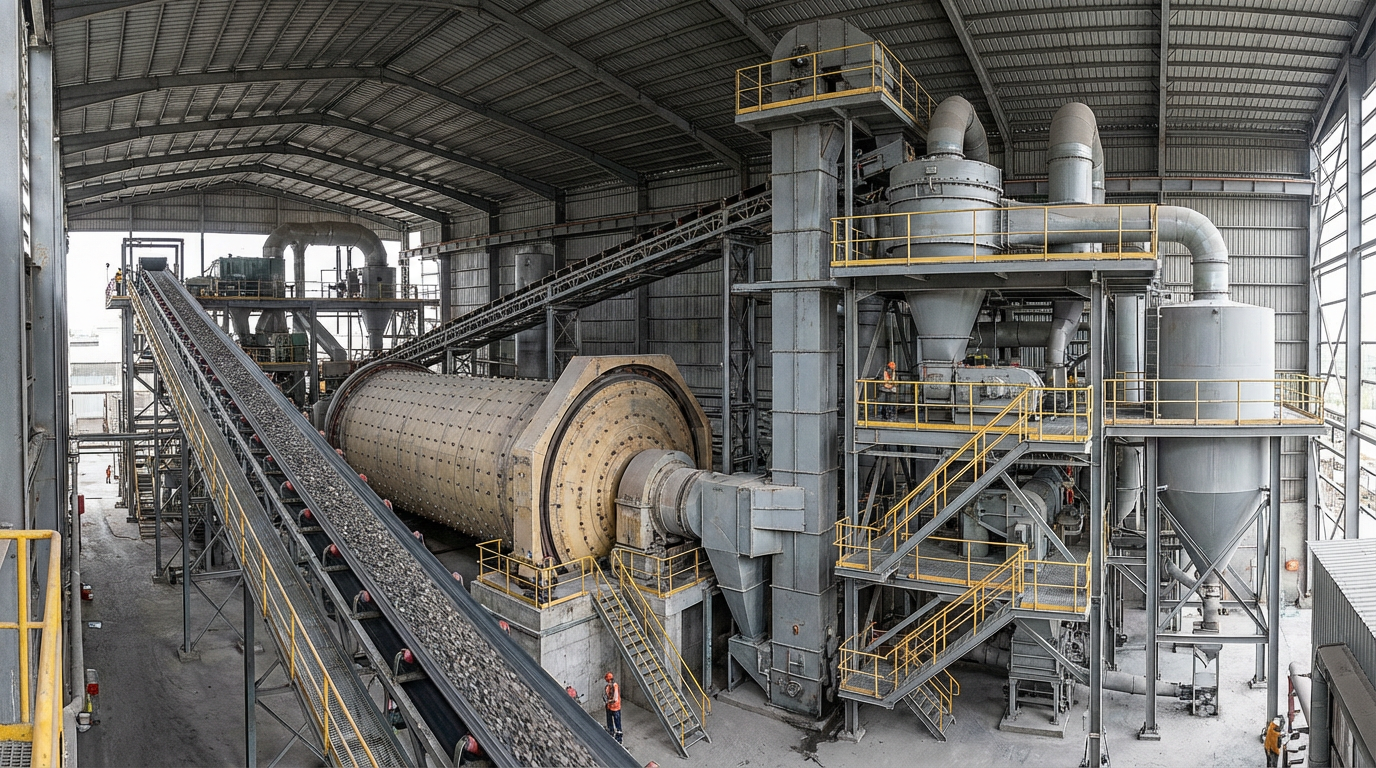
Ball mills remain the most installed finish-grinding technology worldwide, partly because of lower capital cost and a broad operator knowledge base. Operationally, ball mill circuits tend to be more forgiving of swings in feed moisture and additive blend. The trade-off is higher specific energy consumption when the separator, ventilation, or grindability shifts away from the known-good window.
Modern ball mill circuits with high-efficiency separators typically consume 32–37 kWh/t of cement, though older installations running first-generation separators can exceed 40 kWh/t.
Plants often select VRMs for their lower specific energy potential, typically 25–40% below ball mills for equivalent fineness. But they shift more of the circuit's stability work into airflow, classification, and temperature management. VRMs respond quickly to separator and airflow changes, which gives operators more influence over fineness.
That fast response also makes the circuit more sensitive to bed stability, vibration, and the interaction between drying and grinding. Pre-hydration from water spray on the grinding bed can reduce cement performance, a factor that deserves attention during VRM operation.
HPGR and roller press circuits can deliver low specific energy when feed is stable and de-agglomeration behaves consistently. When feed quality shifts, recycle can climb and erase part of the expected advantage. Many plants run hybrid configurations: an HPGR feeding a ball mill, or a legacy ball mill upgraded with a modern separator. These hybrids can capture much of the benefit of a full equipment swap when classification, not breakage, is the binding constraint.
Specific energy comparisons depend on what gets counted as "grinding." Separator drives, bucket elevators, and ventilation fans contribute a visible share of total circuit electricity use. With the cement sector under mounting pressure to reduce energy intensity, reviewing circuit kWh/t rather than just mill motor kW avoids misleading conclusions during grinding technology evaluations.
VRMs shift a larger share of load to fan and classifier power, while ball mills concentrate power in the main motor. Technology selection sets the ceiling. Circuit design and process control determine how close a plant actually runs to it.
Circuit design determines how much fine material gets protected from regrinding and how tightly the plant can hold fineness day to day. That consistency has a direct cost: plants that can't hold a tight fineness window end up overgrinding to build in a safety margin.
In an open circuit, material passes through the mill once. This produces a broader particle size distribution with no mechanism to prevent overgrinding.
Closed circuit systems route mill discharge through a separator that returns oversize material while passing finished product. The recirculating load can run several times the fresh feed. That recirculation prevents overgrinding and enables tighter Blaine fineness control.
Higher recirculating loads increase separator throughput demands but improve the sharpness of classification. The separator returns less already-fine material for unnecessary regrinding.
Separator technology has evolved through three generations: from static grit separators with high fines bypass, through dynamic mechanical classifiers, to today's high-efficiency separators delivering sharp separation curves that reduce energy waste.
High-efficiency separators return less already-fine material to the mill while also enabling higher throughput at equivalent product fineness. Upgrading from an older separator to a high-efficiency classifier can increase mill capacity by 10–15% while reducing specific energy consumption.
When separators bypass fines back to the mill, specific energy rises directly because the mill regrinds particles that already met spec. For plants still running older separator technology, upgrading the classifier can unlock grinding circuit improvements without replacing the mill itself.
As classification sharpness degrades over time, the effects show up in signals operators already watch: rising bucket elevator current, higher separator motor load, and increasing mill differential pressure even when fresh feed stays flat. Widening fineness variability forces operators to carry a larger overgrind margin to protect quality. That margin costs real kWh/t.
Finish grinding performance depends on interacting variables that move together, so single-loop control rarely holds the circuit near its true optimum.
Feed rate drives throughput, but increasing it without adjusting separator speed risks coarser product. Separator speed controls fineness through the classification cut point. Airflow transports material through the circuit, carries fine particles out of the grinding zone, and provides cooling. These variables interact simultaneously, and adjusting one changes the optimal setting for all others.
Elevated mill outlet temperatures can cause material to coat grinding media and liner plates. That coating directly reduces grinding efficiency. Gypsum dehydration at those temperatures also alters setting behavior and creates quality excursions that add another variable the control system has to manage.
Traditional PID control loops manage these variables independently, each responding to one measurement without accounting for cross-variable dependencies. Long conveyors and separator recirculation create high deadtime-to-lag ratios that force controllers to reduce gain. Transport delays from mill discharge through the separator loop make real-time response impractical for disturbances that propagate across the circuit.
Traditional advanced process control wasn't designed for this kind of nonlinear, multivariable coordination.
Fineness feedback compounds the problem. Lab Blaine or residue results can lag by hours. In that window, the circuit produces a large volume of material before the control room sees the outcome of a setpoint change. When production planners push throughput targets, operators hold fineness conservative to avoid discovering a miss too late.
The control room leans on proxy signals: mill power, separator motor load, bucket elevator current, mill draft. Those proxies drift when clinker grindability changes, additive moisture varies, or filtration resistance creeps up.
That drift explains why a move that worked last week can create oscillations today. Grinding performance stays tied to whoever's on shift, and cement operational efficiency varies accordingly.
AI optimization improves grinding performance by coordinating the whole circuit rather than individual loops. The circuit runs closer to the narrow window where kWh/t and fineness stay on target.
PID-based advanced process control stays static unless engineers retune it. AI-driven control keeps learning the joint response between feed rate, separator speed, and ventilation. AI optimization typically treats fineness, temperature, and vibration as constraints, then searches for higher throughput or lower kWh/t inside those bounds.
Instead of stepping one setpoint at a time, it proposes coordinated moves: raising feed while increasing separator speed and opening ventilation to protect temperature.
That AI setpoint optimization across the full circuit goes beyond traditional single-loop tuning. When the circuit response is nonlinear, coordinated moves hold spec with less oscillation than sequential adjustments.
Quality stability often tightens alongside throughput. Lower fineness standard deviation reduces the overgrind-for-safety margin, which supports further energy savings. And the gap between AI-optimized and conventionally controlled circuits tends to widen over months as the model captures more of the grinding efficiency available within existing equipment.
Many plants start in advisory (open loop) mode, using AI recommendations for what-if analysis before any setpoints change automatically. Advisory mode reduces cross-shift variability by giving every crew the same optimization logic to evaluate. Experienced operators still make the call; newer operators see the shape of good decisions faster.
No AI optimization technology replaces the pattern recognition that comes from decades at the control board, and the model can't compensate for mechanical limits indefinitely: worn separator internals, high false air, or drifting instruments will constrain the optimizer regardless of the algorithm.
Over time, many organizations progress from advisory to supervised automation, then to closed loop within defined operating boundaries. Staying in advisory mode remains a valid long-term choice when the goal is operator training, decision support, or cross-team alignment.
For operations leaders looking to recover margin from their largest electrical cost center, Imubit's Closed Loop AI Optimization solution learns from actual plant data and writes optimal setpoints in real time across the full grinding circuit. Plants can begin in advisory mode, validating recommendations against operator expertise, and progress toward closed loop as confidence builds.
Get a Plant Assessment to discover how AI optimization can reduce grinding energy consumption while improving throughput and product consistency.
AI optimization can outperform PID-based control because PID performance stays fixed unless engineers retune it, while AI keeps learning from new operating data. The practical advantage is coordination: feed rate, separator settings, and ventilation move together instead of one loop fighting another. Over months, this reduces oscillations and keeps the circuit closer to its best operating window. That kind of plantwide process control is what single-loop tuning can't replicate.
AI optimization can improve older ball mill circuits because the constraint is often control coordination rather than equipment capability. Many older circuits run conservatively to protect quality, especially when separator performance and mill ventilation vary by shift. Better multivariable coordination can increase throughput while tightening fineness variability and cutting overgrinding. The biggest upside usually appears where specific energy is high and cement plant performance varies significantly by crew.
Advisory mode lets operators evaluate AI recommendations against their own experience before any setpoints change automatically. Every crew sees the same optimization logic, which reduces cross-shift variability even without automation. Teams can compare the model's trade-off analysis to actual outcomes over weeks and build a track record. That trust-building phase makes the progression toward cement production optimization feel like a natural next step rather than a leap of faith.