Cement ball mills often draw full power while specific energy creeps higher and fineness drifts, hiding lost capacity behind charge wear and ventilation imbalance. This article explains how media condition and airflow interact to compound energy losses, why traditional single-loop control can't coordinate the cascading effects of separator, feed, and ventilation adjustments, and how AI-driven coordination across the grinding circuit recovers throughput by closing the quality feedback gap between two-hour lab cycles and real-time process conditions.
Every cement plant engineer recognizes the pattern: the grinding circuit draws full power, but specific energy creeps higher and fineness results drift between lab samples. Optimization and digitization across the cement plant can recover $4–9 per tonne in margin. In many plants, much of that margin hides inside a throughput gap created by ball charge condition, ventilation balance, and the control systems trying to coordinate both.
When one of those variables drifts, the others compensate in ways that are hard to detect and expensive to ignore. Better grinding efficiency starts with understanding where those interactions break down.
Small changes in media condition and airflow raise specific energy while hiding lost grinding capacity.
Here's where those losses develop and how coordinated control recovers performance.
Cement grinding accounts for a large share of total plant electrical consumption, and ball charge volume remains one of the most sensitive mechanical levers in the circuit. Even a few percentage points of deviation in filling degree can raise specific energy consumption. A first chamber slightly under-filled reduces impact energy, while a second chamber that's slightly over-filled increases attrition work on material that's already near target size.
The net result is more kWh per tonne (kWh/t) without a corresponding increase in output.
Chamber-specific ball sizing matters just as much. The first chamber needs larger media for impact crushing, while the second chamber relies on smaller media for attrition grinding. When charge distribution drifts through wear, the coarse chamber under-crushes and the fine chamber works harder than intended.
That imbalance shows up as rising energy intensity before it shows up in the lab.
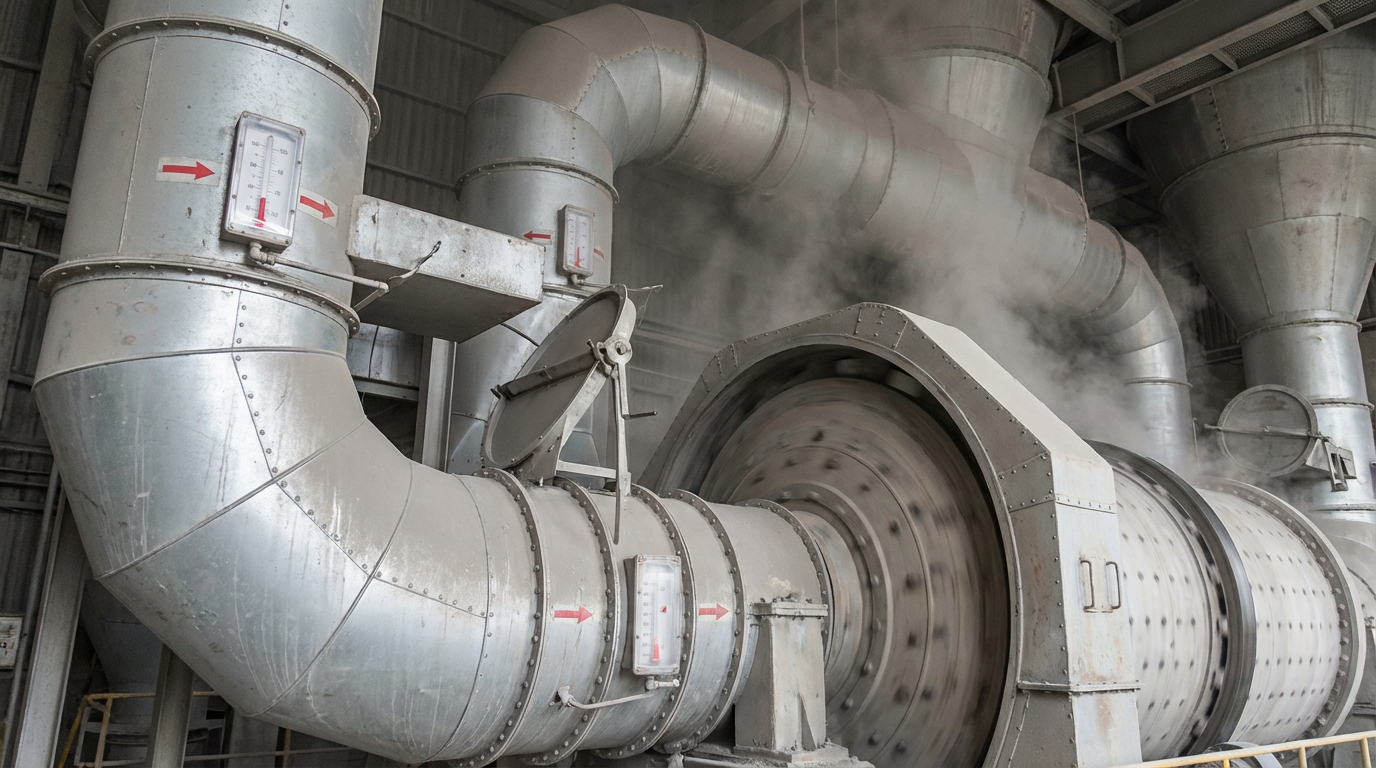
Ventilation gets less attention than charge condition, but it affects grinding performance just as directly. Airflow through the mill removes fines from the grinding zone so media contacts fresh material, and it transports product to the separator for classification. Excessive airflow can sweep particles out before they reach target fineness. Too little airflow has the opposite effect: fines stay in the grinding zone, cushion media impacts, and reduce grinding action.
The relationship between charge and ventilation isn't additive. Proper ventilation clears fines so media impacts land on material that still needs size reduction. Poor ventilation can cancel out an otherwise sound charge pattern, and vice versa.
One useful check: compare filter dust fineness to mill exit product. If the filter dust runs much finer, airflow probably isn't removing fine particles fast enough. That gap can reveal ventilation constraints before they show up in energy cost trends.
The fundamental constraint in cement grinding circuits is architectural. Operators manage several controlled outputs through only a few manipulated variables, while traditional control treats each loop as independent. Mill load, product fineness, circulating load, power draw, temperature, circuit stability, and production rate all interact, but the control system wasn't designed to handle those interactions simultaneously.
Adjusting separator speed to correct fineness shifts circulating load, mill power draw, and residence time distribution at the same time. Water injection changes temperature, material flowability, and separator efficiency in one move. Conventional controls have limited ability to predict those cascading effects before they show up elsewhere in the circuit.
Feed variability adds another layer. Clinker reactivity, moisture content, and the proportion of supplementary materials like slag or fly ash all affect grindability. Under the same charge and airflow conditions, a batch of high-free-lime clinker behaves nothing like a well-burned clinker with lower residual calcium oxide.
When feed characteristics change mid-shift, the optimal balance of separator speed, ventilation, and feed rate changes with them. Fixed-setpoint control can't adapt to those shifts fast enough to prevent the circuit from drifting into a less efficient operating region.
The quality measurement gap compounds the problem. Lab fineness results typically come back every two hours. During that window, operators rely on indirect indicators like mill sound, elevator current, or vibration that don't reliably correlate with actual product quality. This creates a feedback delay where corrections respond to conditions that may have already shifted again.
The result is a longer effective quality lag than most grinding circuits are designed to tolerate.
That delayed quality signal reinforces conservative behavior. Operators build in extra margin against process limits to avoid quality excursions during their shift. Different operators set different margins based on experience and risk tolerance, and the resulting shift-to-shift variability can hide the circuit's real capability.
The circuit may be able to run closer to its throughput limit, but no single shift operates there consistently enough to prove it.
AI-powered process control closes the gap between grinding circuit complexity and conventional control capability. Instead of operating independent loops, the AI learns from a plant's own operational history how charge condition, ventilation, separator speed, feed rate, and temperature interact. The model then coordinates setpoints across those variables simultaneously.
That coordination catches the cross-variable interactions that single-loop controllers miss. When clinker grindability shifts, the model adjusts not just feed rate but also separator speed and ventilation in one coordinated move. The circuit stays in its most efficient operating window instead of drifting while each variable responds in sequence.
Predictive quality changes how the circuit responds between lab samples. Instead of waiting for lab results, the AI can anticipate quality outcomes from real-time process signatures: the combination of mill differential pressure, elevator current, separator return rate, and power draw that historically correlates with a given fineness range.
Those signatures offer a faster quality indicator than the two-hour lab cycle and narrow the feedback gap that drives conservative operation. With a tighter feedback loop, operation doesn't need the same conservative buffers that different operators set independently. AI-based process optimization can support more consistent operation closer to the circuit's actual capability across every shift.
No AI system replaces the pattern recognition that comes from decades at the board. An experienced operator's intuition about unusual vibration or a subtle change in mill sound captures context that models can't fully replicate. The grinding circuits that hold onto those improvements long-term use AI for multi-variable coordination and leave exceptions and judgment calls to the operator.
Research from the IFC's cement study confirms that the energy efficiency gap in cement grinding is real. A separate DOE bandwidth study reaches a similar conclusion. But what any given plant actually recovers depends on circuit condition, measurement quality, and the discipline of day-to-day operations.
The most effective path to recovering grinding performance often starts with advisory mode. The system recommends setpoint changes, and operators decide whether to accept them. That arrangement builds trust gradually because the model has to prove itself against real operating conditions instead of asking for immediate control authority.
In practice, advisory recommendations for a grinding circuit might suggest coordinated adjustments to separator speed, feed rate, and water injection based on current mill conditions. Rather than changing one variable and waiting to see the result, the model can show what a combined move would produce.
That kind of visibility is hard to develop from single-variable experience alone, and it gives operators a way to evaluate coordinated moves before committing to them.
Advisory mode also captures how charge condition, ventilation balance, and separator settings interact during the circuit's most effective operating windows, when specific energy drops and throughput rises simultaneously. Experienced operators develop intuition for those combinations over years; the model makes those patterns available to newer shift teams who haven't seen every scenario yet.
Over time, this builds operational continuity across shifts: one consistent reference point for grinding circuit behavior that doesn't depend on any single person's presence.
Maintenance and process engineering teams also gain visibility into how charge condition connects to energy consumption trends. Conversations about mill liner timing, charge replenishment intervals, and ventilation damper settings start from shared data rather than competing opinions. That shared reference point makes it easier to align maintenance planning with process performance targets instead of treating them as separate decisions.
For cement operations leaders seeking to close the gap between what their grinding circuits can deliver and what they actually produce, Imubit's Closed Loop AI Optimization solution for cement offers a structured path forward. The platform learns from each plant's unique operational data and writes optimal setpoints in real time through existing control infrastructure.
Plants can start in advisory mode, capture value through guided recommendations and cross-shift consistency, move into supervised deployment as confidence builds, and progress toward closed loop control where it fits their operating strategy.
Get a Plant Assessment to discover how AI optimization can recover grinding capacity and reduce specific energy at your cement plant.
Separator adjustments shift fineness, circulating load, power draw, and residence time simultaneously. When operators see product changes, the signal of whether airflow or classification caused the shift gets buried. The typical two-hour quality feedback cycle makes those effects harder to isolate while conditions are still moving. That's one reason ventilation constraints can persist for weeks before anyone connects them to rising specific energy.
Charge wear often appears first as a shift in how grinding work divides between chambers. The first chamber under-crushes while the second chamber picks up more of the duty. Specific energy rises before the lab cycle fully reflects the change. Tracking real-time relationships between power draw, elevator current, and mill operations can make that drift visible earlier than waiting for Blaine results.
Advisory mode delivers optimization recommendations through the existing DCS, so there's no need to replace control hardware or bypass established loops. Operators retain full authority: they review suggested setpoint changes and decide whether to accept them. That same optimization approach can reduce shift-to-shift variability without requiring any changes to control architecture.