LNG amine treating units operate with almost no margin: treated gas must stay below 50 ppmv CO₂ before cryogenic liquefaction, making foaming, corrosion, and solvent contamination direct threats to train availability. Conventional control struggles because amine chemistry is nonlinear and feedback delays leave units effectively open loop on critical variables. AI optimization trained on actual plant data can correct over-circulation, manage solvent health, and adapt to shifting feed and ambient conditions, starting in advisory mode and progressing toward closed loop control as operator confidence builds.
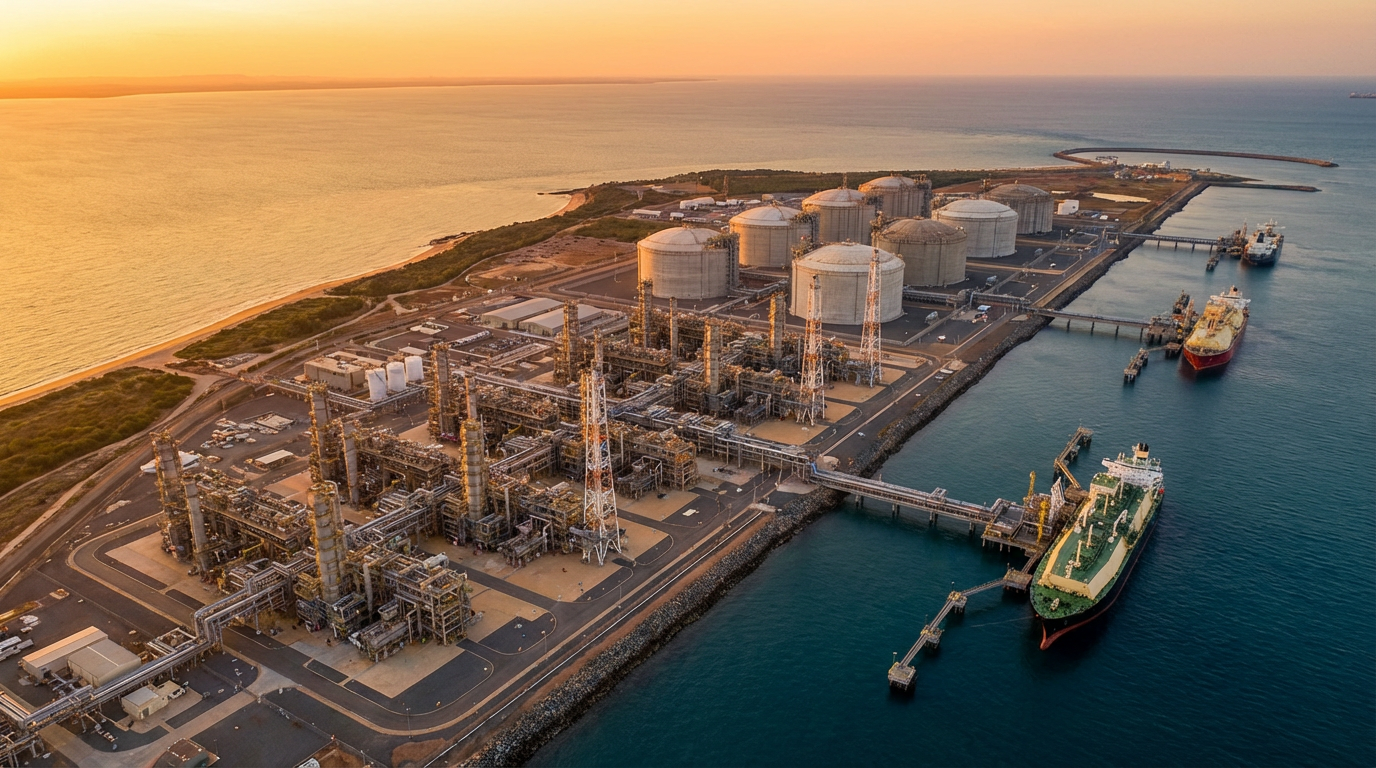
In LNG production, amine treating determines whether gas can move to liquefaction or wait on spec gas. The treated gas must stay below the 50 ppmv CO₂ specification before cryogenic liquefaction to avoid CO₂ freezing and damaging heat exchangers and other equipment. With LNG capacity expansion projected through 2030, additional pretreatment capacity will be needed to maintain tight operating limits.
When foaming, corrosion, or solvent contamination erodes that margin, a treating issue quickly becomes a train availability problem. Plants dealing with these LNG plant challenges are looking more closely at optimization that can adapt as conditions shift, because the amine unit sets the pace for the entire train.
LNG amine units have almost no margin: treated gas must stay below 50 ppmv CO₂ before cryogenic liquefaction. Small solvent or control problems become train availability losses.
The sections below cover where margin disappears, why conventional control struggles, and how to recover it.
Sour feed gas enters the absorber column of the acid gas removal unit (AGRU) and flows upward against a descending stream of lean amine solvent. The countercurrent contact transfers CO₂ and H₂S from the gas phase into the liquid.
In LNG service, the treated gas target is absolute: less than 50 ppmv CO₂ to prevent freeze-out in the main cryogenic heat exchanger (MCHE). Unlike conventional gas sweetening for pipeline specs, there is almost no margin for exceedance.
Rich amine, now loaded with acid gases, routes through a lean/rich heat exchanger to the regenerator, where reboiler-generated steam strips the absorbed gases. The lean/rich exchanger recovers heat that would otherwise add to reboiler energy demand, making it the most important energy recovery point in the loop.
Regenerated lean amine cools and returns to the absorber. These energy recovery steps tie directly into broader boil-off gas management and overall plant heat balance.
One LNG-specific constraint shapes solvent choice. Pure methyldiethanolamine (MDEA) reacts too slowly with CO₂ to achieve the target spec within typical absorber contact time. Promoted MDEA, often activated with a faster-reacting component like piperazine, is commonly used for LNG service.
The promoter concentration itself becomes an operating variable: too little and absorption slows, too much and regeneration energy increases because the faster-reacting component forms a more stable bond with CO₂.
Regenerator performance depends on reboiler temperature, reflux, and stripping steam rate. If the regenerator doesn't adequately strip acid gases, lean loading rises and the absorber loses capacity on the next pass. In tropical LNG facilities, ambient temperature swings between day and night can shift lean amine cooling and change absorber performance within a single shift.
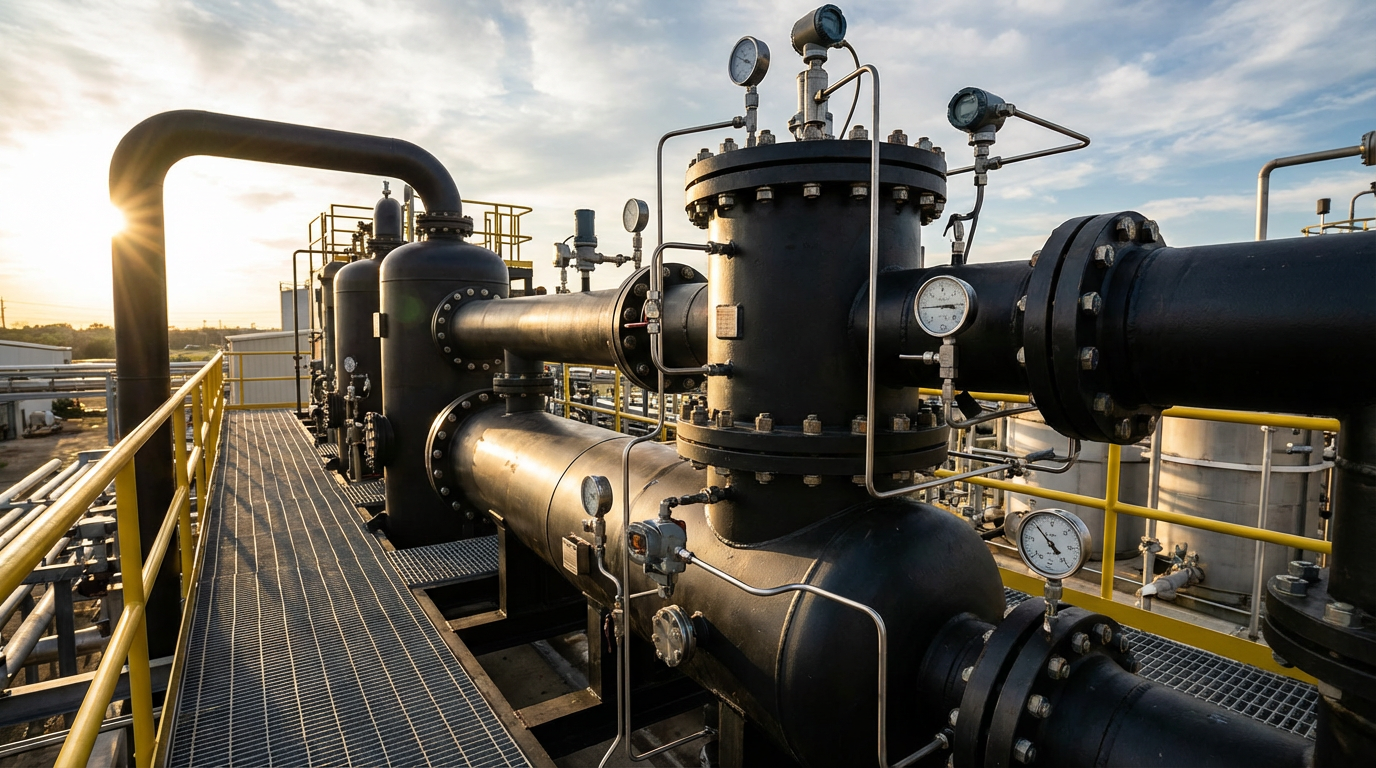
Inlet filter-coalescers upstream of the absorber catch contaminants before they reach the solvent.
In a unit with this little operating margin, contamination control affects both solvent condition and treating stability, which is why plants pursuing self-optimizing gas processing increasingly treat filtration and solvent management as optimization variables, not just maintenance tasks.
Foaming, corrosion, and heat stable salt accumulation are major amine system threats that can affect LNG train availability. Together they form a cycle that widens operating variability and erodes industrial energy efficiency.
Recovery from this cascade takes longer in LNG service than in conventional gas plants. When treated gas drifts off-spec, feed to the MCHE stops. A prolonged disruption can extend the restart and cooldown sequence by hours or even days, depending on how far temperatures deviate during the event.
Because foaming, corrosion, and salt accumulation reinforce each other, breaking the cycle requires intervening on multiple variables simultaneously, not just responding to the most visible symptom. A solvent contamination issue can become a downtime event that affects production schedules and cargo commitments.
Traditional advanced process control (APC) delivers benefits across many process units, but in amine treating, the constraints themselves shift.
Amine absorption involves ionic chemistry that produces fundamentally nonlinear response surfaces. Temperature, acid gas loading, amine concentration, and partial pressures interact in ways that linear dynamic models cannot represent accurately across a realistic operating range. Feed composition variability compounds the problem because changes in the H₂S/CO₂ ratio alter the equilibrium the design-case model assumed.
The delay in analytical feedback adds to the problem. Confirming solvent quality and salt formation through lab analysis requires hours. During that interval, the unit operates effectively open loop on the variables that determine treated gas quality and corrosion risk. Plants with strong data historian practices can partially close this gap by trending solvent condition indicators between lab results, but the fundamental lag remains.
Operators face a choice between conservative constraints that sacrifice energy and throughput or a wider envelope that accepts higher risk. Neither option is satisfactory when the unit is already running near its treated gas limit. Over time, the gap between model predictions and actual behavior widens.
Operators can lose confidence, engineers stop updating models, and the optimization tool either sits unused or runs on outdated assumptions. Amine systems change faster than static models can follow, particularly in facilities that also manage variable feed from NGL recovery or upstream conditioning.
One of the most useful improvements available to most operating teams requires no capital: correcting over-circulation. Solvent circulation rate is directly proportional to reboiler heat duty. When circulation rises beyond what the actual gas composition and loading require, the unit pays for that margin in steam demand. Reducing unnecessary circulation is often the fastest energy efficiency improvement available on an amine unit.
Solvent management provides the next layer. Filtration that reduces total suspended solids cuts the particles that stabilize foam. Heat stable salt concentration requires active management within range, not elimination. Lean amine temperature above inlet gas temperature prevents hydrocarbon condensation that triggers foaming.
Each of these variables interacts with the others: higher filtration rates reduce foam risk but do nothing for heat stable salts, while aggressive salt removal through reclaiming can introduce its own solvent balance problems if not managed carefully.
These levers matter, but they depend on knowing the unit's current state in near-real-time. AI optimization trained on actual plant data can learn the nonlinear relationships between process variables that static models weren't designed to capture. That includes interactions between circulation rate, solvent loading, feed composition, and ambient temperature. The goal is lower solvent, steam, and power consumption while keeping treated gas on spec as ambient conditions shift.
In practice, the deployments that stick start in advisory mode. The AI recommends adjustments, and experienced operators validate each recommendation against their own judgment before any setpoint moves. Operators see predicted impact on treated gas quality, reboiler duty, and solvent health alongside the model's reasoning, and they can accept, modify, or reject before granting any control authority.
The role this plays in building process engineering capability is often underestimated. Many plants begin in advisory mode, move into supervised deployment, and advance to closed loop only when teams are comfortable.
When maintenance, operations, and planning teams share a single model of amine unit behavior, decisions about circulation rate and solvent health reflect a shared view of how each adjustment affects treating performance, energy cost, and equipment health at the same time. That matters when one group is focused on fouling, another on train rate, and another on utility consumption.
No AI system captures every instinct behind a thirty-year veteran's judgment call. But the observable relationships between process states and the actions that produced good outcomes can be preserved in a model that adapts as conditions change.
For operations leaders seeking to improve plant performance and reduce energy costs, Imubit's Closed Loop AI Optimization solution offers a path grounded in plant reality. The platform learns from actual operating data, including absorber loading, regenerator performance, solvent quality, and ambient conditions, and builds a model that captures the nonlinear behavior traditional approaches cannot represent.
That model writes optimal setpoints to the existing distributed control system (DCS) in real time, continuously adjusting as feed composition and temperature shift. Plants can start in advisory mode, move into supervised deployment with operator validation, and progress toward closed loop control as trust builds through proven results.
Get a Plant Assessment for reducing amine system energy consumption and protecting LNG train availability.
LNG amine systems operate with far less margin on treated gas quality. The unit must stay below 50 ppmv CO₂ before cryogenic liquefaction, so a foaming event that might be tolerable in pipeline service can quickly push the unit off-spec and block feed to the liquefaction train. Small contamination or solvent condition problems become availability problems much faster than in conventional gas treating, especially where thermal fatigue prevention during cooldown cycles adds further complexity.
Every increment of unnecessary solvent flow adds reboiler steam demand, so over-circulation is one of the largest controllable energy drains on an amine unit. The challenge is that operators often run higher rates as insurance against off-spec gas, especially after a foaming event or feed change. Correcting over-circulation requires real-time visibility into the relationship between actual acid gas loading and circulation rate, which is why it's often the first target when plants adopt energy-saving optimization.
Yes. AI optimization works alongside existing advanced process control and the plant's control stack rather than replacing them. The model recommends or writes setpoints through the existing control system and leaves regulatory loops and base-layer controls intact. Many plants begin in advisory mode so operators can validate recommendations before moving toward plantwide process control.