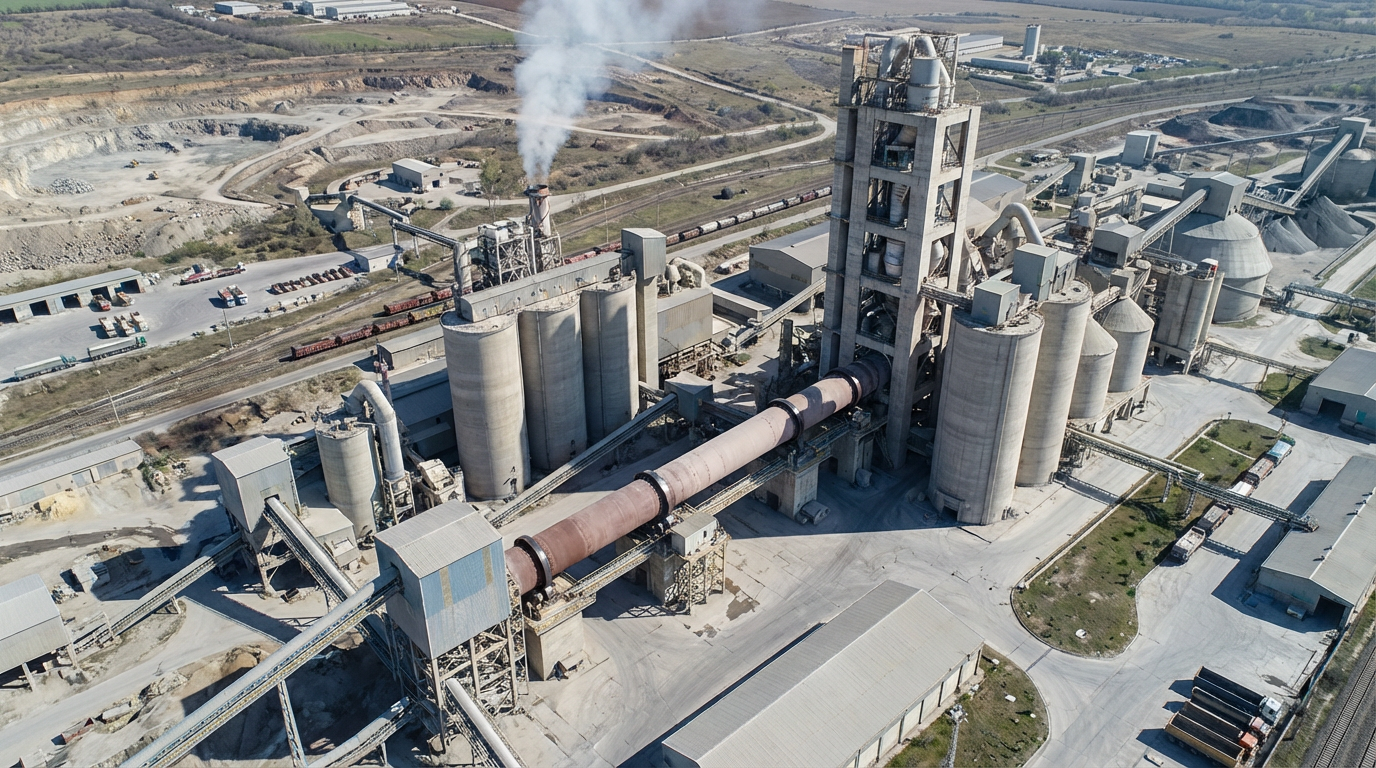
Cement plants pushing higher alternative fuel use face variability that traditional controls can't fully absorb, creating kiln instability and clinker quality risk. AI optimization addresses this through real-time setpoint recalculation, continuous fuel mix decisions, shared visibility across operations and quality teams, and a path from advisory mode toward closed loop operation. These capabilities help plants hold clinker quality and kiln stability as thermal substitution rates rise.
Every cement plant pushing for higher thermal substitution rates runs into the same operational reality: the fuels that reduce cost and carbon intensity are the hardest to burn consistently. Refuse-derived fuel (RDF) arriving at different moisture levels between trucks, tire-derived fuel with variable sulfur loads, biomass that shifts in calorific value with the seasons. Each load introduces fresh uncertainty into a process that rewards stability.
Cement remains one of the most difficult sectors to decarbonize, and IEA tracking shows fossil fuels still dominate the thermal energy input in most kilns worldwide. Energy is also one of the largest cost categories in cement production, which makes energy intensive cement processes the natural target for substitution. Every percentage point of thermal substitution rate (TSR) that stalls below its potential is measurable margin left on the table.
Closing the gap between median operations and leading-producer TSR requires solving a control problem traditional automation was never designed for. At higher substitution, fuel variability stops being a periodic upset to ride out and becomes the baseline operating condition.
Higher alternative fuel use lowers fuel cost and carbon intensity, but variability makes stable combustion harder to maintain.
The sections below follow that constraint from combustion instability to control response.
At higher thermal substitution rates, small variations in moisture, calorific value, and ash chemistry compound because the kiln has less margin to absorb them. Alternative fuel particles, whether refuse-derived fuel (RDF) or solid recovered fuel (SRF), leave the burner tip with different densities, shapes, and chemical properties than pulverized coal. Their moisture content and energy density also shift from load to load in ways coal rarely does.
During winter months, RDF moisture content can exceed 20%, with some streams reaching over 30%. That moisture cools the burner flame and produces weakly burned clinker with elevated free lime, a known path to downstream quality problems in finished cement.
The dosing constraint compounds the variability. Most fuel handling systems operate on a volumetric basis, so thermal energy delivered to the burner fluctuates even when the dosing rate stays constant. Shifts in calorific value between loads still move the real heat input.
Above roughly 50% thermal substitution, the physics shift. Higher fuel volume and lower calorific density reduce burner momentum. The resulting flames are long, soft, and difficult to shape. Secondary air cannot reach all of the fuel, partly burned material lands on the clinker bed, and reducing conditions begin to damage clinker quality and refractory brick.
European producers have demonstrated thermal substitution rates well above the global average, with several national averages above 50%, while globally alternative fuels still supply a small share of kiln thermal energy. This is where rotary kiln operations move from manageable with careful setpoints to routine operation at the edge of the operating envelope.
Burning zone instability from variable fuels propagates through a causal chain that ultimately reaches customers. Proper clinker production optimization requires a stable burning zone temperature, generally reported in the 1400–1450°C range.
Deviations from this range impair the melt phase that converts belite (C₂S) and free lime into alite (C₃S), the primary early-strength mineral phase. When the melt phase is insufficient, unreacted free lime stays elevated above the 1.5% threshold, and alite content drops.
Alternative fuels intensify this through a second pathway. Elevated alkali loads in alternative fuel ash, particularly potassium oxide, affect clinker mineralogy and can interfere with the conversion reactions that produce strong clinker. Fuel variability therefore pressures clinker chemistry from two directions at once, with thermal instability reducing melt phase adequacy and alkali input disrupting the reactions that depend on it.
The downstream effects are measurable. Clinker free lime content can affect grindability, though the relationship depends on burning conditions and clinker mineralogy. The binding constraint for most operations is the 90-minute laboratory free lime measurement lag.
By the time lab results confirm a problem, the kiln has already produced hundreds of tonnes under suboptimal conditions, and any decision about corrective action is effectively retrospective. AI optimized pyroprocessing closes that information gap.
Advanced process control (APC), widely used in cement, was designed for a different operating environment. Its process models are developed and calibrated at installation. As process behavior diverges from those models, performance degrades.
With alternative fuels at high substitution rates, model drift becomes a continuous condition. Each material change in fuel mix constitutes a process behavior shift that invalidates the model, and new fuel sources often lack the well-defined first-principles relationships that traditional control solutions depend on.
Rule-based automation faces a different structural constraint. When fuel energy content diverges from encoded assumptions, fixed actions systematically under- or over-respond. The rule structure itself cannot detect the mismatch.
The long thermal time constants of a rotary kiln compound both limitations. An undetected shift in fuel calorific value propagates through the kiln's thermal mass for the full dead-time duration before any sensor registers its effect. By then, the kiln has already produced off-spec clinker.
Workforce dynamics add another pressure on the control stack. As experienced operators retire, tacit knowledge about how a specific kiln responds to specific fuel combinations leaves with them, and plants default to conservative setpoints that leave TSR potential on the table. That makes cement AI augmentation a planning priority, because the window to capture those patterns closes when the operators do.
AI optimization works differently from traditional APC. Traditional APC holds variables stable at defined setpoints. AI optimization continuously recalculates those setpoints using the plant's real-time process data to meet higher-order objectives like minimizing specific heat or fuel cost. The distinction matters under variable fuel conditions, because the optimal setpoint combination shifts with every material change in the fuel blend.
AI in cement manufacturing covers kiln optimization, real-time clinker quality prediction, energy management in cement, and predictive maintenance. For plants pursuing AI for cement decarbonization through higher substitution, the central capability is real-time quality prediction. AI models trained on a plant's own historical process data can estimate current free lime content in near real time, hours before laboratory confirmation arrives.
Operators see a predicted value alongside the measured one and adjust setpoints before off-spec clinker accumulates.
For fuel mix decisions, machine learning treats blend selection as a continuously re-solved problem rather than a fixed recipe. The model correlates real-time process data, combustion air ratios, kiln thermal profile, and precalciner temperature with clinker quality outcomes under different fuel combinations.
As fuel properties shift, the model adapts its recommendations.
A shared AI-driven process model also gives operations, quality, maintenance, and planning teams visibility into the same predicted outcomes. Shared visibility matters because those teams often make decisions in isolation, each optimizing for their own constraint without seeing how the others' choices interact.
Plants that deploy AI kiln optimization successfully tend to start in advisory mode. The system recommends setpoint changes, and operators evaluate whether to accept them. No model fully replaces the pattern recognition that experienced operators develop over decades, and edge cases in fuel chemistry still require human judgment.
Human AI collaboration is how that knowledge gets encoded before the operators who have it retire.
Over time, as confidence builds, plants can move from advisory mode into supervised execution and, where appropriate, toward closed loop operation. Advisory mode also changes how experienced and newer operators work together, because both can evaluate recommendations against the same current process picture.
For cement operations leaders pursuing ambitious thermal substitution targets, Imubit's Closed Loop AI Optimization solution addresses the core constraint: maintaining kiln stability and clinker quality as fuel variability increases.
Built on a Foundation Process Model that learns from each plant's unique operating history, the platform predicts quality parameters ahead of laboratory confirmation and writes optimal setpoints in real time through existing distributed control system (DCS) infrastructure. Plants typically start in advisory mode so operators can validate recommendations against their own experience, then progress toward closed loop operation as confidence builds.
Get a Plant Assessment to see how AI optimization can stabilize combustion and clinker quality at higher alternative fuel rates.
Winter loads are often the harder operational problem because RDF moisture can exceed 20–30%. That moisture pulls heat from the burner flame and risks weakly burned clinker. Summer conditions are typically drier and more stable, so heat input is easier to manage, though dust generation and handling can increase. Short-cycle variability is the more useful operational framing. How fast moisture and calorific value change between loads determines how quickly kiln optimization with AI needs to detect and correct the thermal profile before quality drifts.
Yes. AI optimization typically deploys as a layer above the existing distributed control system (DCS) and APC installation rather than as a replacement. It reads process data from the current control architecture and writes setpoints through the same infrastructure operators already use. That lets APC continue handling regulatory stabilization while AI optimization addresses higher-order objectives such as specific heat consumption and clinker quality under variable fuel conditions. This preserves existing investments in cement plant operational efficiency while extending their reach.
Free lime is a key indicator because many producers target levels below about 1.5% to avoid downstream cement quality problems. Burning zone temperature stability also matters because thermal swings affect clinker formation directly. Plants often watch liter weight as a faster proxy for burn quality between lab cycles, while reducing conditions from incomplete alternative fuel combustion can signal drift before laboratory confirmation arrives. That keeps clinker quality optimization a continuous priority as TSR rises.