Alkylation units lose recoverable margin when acid behavior, feed composition, temperature, and isobutane ratio shift together in ways that traditional APC handles one at a time. This article examines how those interacting variables erode octane and throughput, why linear controllers and inferential measurements fall short, and how AI optimization learns from actual plant data to coordinate setpoints across the FCC-to-alkylation boundary. Plants can start in advisory mode and progress toward closed loop control as operator confidence builds.
Every refinery with an alkylation unit knows the tension: acid costs eat into margins, octane targets keep pressing, and the FCC unit upstream sends whatever olefin composition it happens to produce that shift. Meanwhile, cooling water temperatures change with the season, isobutane availability tightens, and feed contaminants drift in ways that inferential measurements don't always catch.
A recent BCG outlook underscores how narrow the margin window has become across refinery operations. In alkylation, the recoverable margin through better optimization is harder to ignore than it once was.
Alkylation margin erodes when feed composition, acid behavior, temperature, and isobutane ratio shift together rather than one at a time. Protecting that margin requires visibility across variables that traditional control handles separately.
The sections below examine where that margin slips away and how plants can address it.
Finished gasoline is a blended product, and alkylate's value comes from what it doesn't contain. It combines low sulfur, low vapor pressure, and high octane in a way no other major blendstock can match. That matters more than it used to.
EPA Tier 3 sulfur limits at the refinery gate have increased the value of blendstocks that preserve octane while supporting regulatory compliance. FCC naphtha hydrotreating can cost octane, while reformate blending runs into aromatics limits. Alkylate avoids both tradeoffs. That premium is structural, anchored to sulfur regulations rather than cyclical crack spreads.
Capturing that premium depends on how the unit is operated, and alkylate quality depends on multiple variables interacting at once. Octane varies with the isobutane-to-olefin ratio and reactor temperature, and feed contaminants can shift the relationship between those variables. Each one can move independently, and their interactions are nonlinear: a change in I/O ratio at one temperature profile may produce a different octane response at another.
Acid strength sits near the center of that interaction. In HF units, acid behavior directly affects both operating cost and unit performance.
Some facilities have deployed online analyzers for direct measurement, but many plants still depend on inferential relationships that can drift as acid-soluble oil concentrations change with feed quality and operating conditions. When the inferential drifts quietly, every control layer above it responds to weaker information.
The margin impact compounds when multiple variables drift together. Shift-to-shift variability remains one of the most persistent sources of recoverable margin in alkylation. One crew may run a more conservative acid strategy while another pushes throughput harder, and that inconsistency shows up as shifting I/O ratios, uneven acid draw-off rates, and reactive responses to feed changes that a more coordinated approach could anticipate.
Temperature adds another dimension. When reactor cooling falls short, throughput, octane-barrels, and acid consumption can all move in the wrong direction at the same time. Seasonal cooling water shifts make that a recurring operating reality, not a one-time disturbance.
Feed composition arrives from the FCC, outside the alkylation unit's immediate control boundary. A shift from C4 olefins to C3 olefins changes yield, octane output, and isobutane demand simultaneously. In any crude oil refining process, upstream changes cascade through downstream units in ways that aren't always predictable from the control room.
Protecting octane, throughput, and acid use depends on seeing those variables together rather than tuning any one of them alone.
Advanced process control delivers measurable value in alkylation units when operating within its identified envelope. Those limits appear when the unit moves away from the conditions used to build the model. And in alkylation, the unit moves away from those conditions regularly.
Model accuracy becomes harder to sustain when acid strength drifts, FCC feed composition changes, or cooling water temperatures shift with the season. The controller's assumptions can go stale before anyone formally retunes them.
When process responses no longer match the embedded models, model-based control may compound disturbances instead of rejecting them. Standard linear MPC then settles for local optima that leave margin on the table.
Inferential acid strength creates a particularly stubborn weak point. When the base inferential drifts, every APC layer above it works from flawed inputs.
The problem can remain hidden because the controller still appears to be functioning normally, even while it responds to conditions that no longer reflect the unit's actual state.
Traditional control also stays inside the unit boundary. The FCC-to-alkylation olefin balance is a live economic variable: a shift in C3/C4 ratio changes alkylation yield, octane output, and isobutane demand. But the alkylation APC layer has no proactive mechanism for anticipating those upstream changes or evaluating their effect on refinery ROI before they arrive as disturbances.
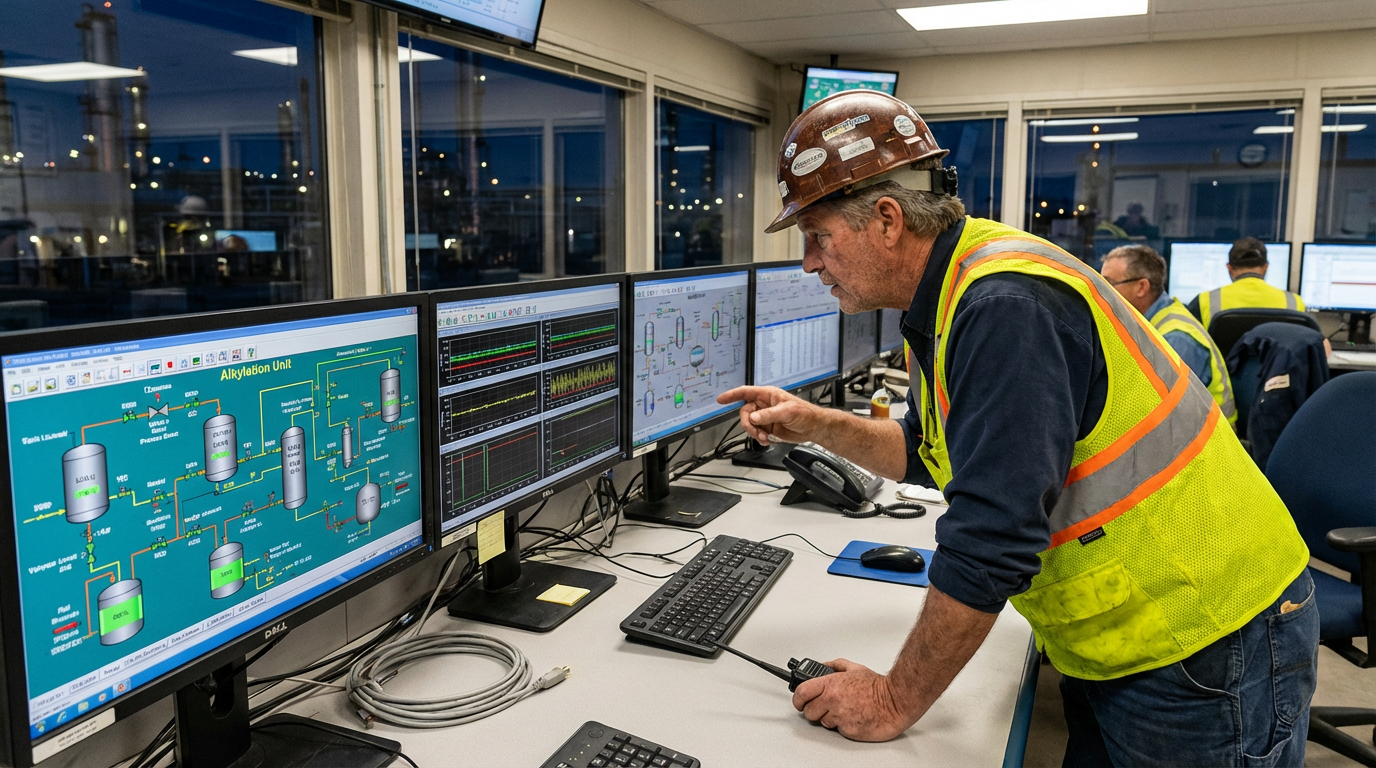
The pattern recognition that comes from years at the board catches problems no controller can see. But the interacting variables in alkylation can exceed what any single operator or linear controller can continuously optimize across a full range of operating states.
AI optimization addresses alkylation's nonlinear behavior by learning from actual plant data instead of relying on a single linearized operating point. The model learns how I/O ratio, acid behavior, temperature, and feed composition move together across a wider operating envelope. As conditions change, the model adapts rather than waiting for a formal re-identification cycle.
That adaptation matters practically. When acid-soluble oil concentrations shift with a change in feed quality, an AI model trained on the unit's operating history can adjust its recommendations to reflect how the unit has responded to similar conditions before.
The model learns from what the plant actually does, so its recommendations stay grounded in real process behavior even as feed quality, acid conditions, and temperatures shift.
Cross-boundary coordination also becomes possible. AI can support broader catalytic cracking optimization alongside the alkylation interface, so that a shift in the C3/C4 olefin balance no longer arrives as a purely reactive disturbance. When the model has visibility across connected units, it can evaluate the margin effect of upstream changes and recommend setpoint adjustments that account for both units.
The impact extends beyond the control layer. A shared model of plant behavior changes how operations, planning, and engineering interact. Planning may set LP targets from assumptions that differ from board reality, while operations compensate in ways the planning model doesn't capture.
Improved value chain coordination starts when a common model built from historical process data makes that gap visible, so teams can align before mismatches compound.
Plants don't start in closed loop. In practice, the AI recommends setpoint changes for variables such as I/O ratio, acid draw-off rate, and temperature targets, and operators decide whether to act. That gives experienced operators a way to test the model's judgment against their own before any automatic moves happen. It also means the model has to prove itself under the unit's actual operating conditions, not just in offline validation.
Advisory mode also gives teams a common reference point across shifts, so the same changing conditions don't have to be interpreted from scratch each time. A shared model doesn't impose a single operating philosophy, but it makes the tradeoffs visible so teams can make more consistent choices.
For newer operators, the advisory phase also shortens the learning curve: they can see what the model recommends under conditions they haven't yet encountered. That kind of operator training builds understanding of unit behavior faster than time at the board alone.
Trust builds gradually. When operators repeatedly confirm that the model identifies margin opportunities under changing conditions, the system becomes easier to rely on.
The model won't capture every instinct behind a veteran's judgment call, but it can preserve the observable relationships between process states and the operating moves that produced better results. Over time, plants can progress from advisory recommendations toward closed loop control as the team's confidence grows.
For refinery operations leaders seeking to capture more of their alkylation unit's margin potential, Imubit's Closed Loop AI Optimization solution learns from actual plant data, writes optimal setpoints in real time through existing control system infrastructure, and manages the nonlinear variable interactions that traditional APC cannot sustain. Plants can start in advisory mode to build operator confidence, then progress toward closed loop control at a pace that matches the organization's readiness.
Get a Plant Assessment to discover how AI optimization can capture recoverable margin from your alkylation unit's interacting variables.
Acid strength drift compounds control problems because many alkylation units depend on an inferential view of acid behavior rather than direct measurement. When that inferential drifts, every control layer above it responds to weaker information. That makes it harder to protect octane, throughput, and acid use simultaneously. Models trained on existing plant data can learn acid behavior from observed relationships across operating states instead of relying on a single fixed inferential.
Initial improvement often appears during advisory mode, before closed loop control is activated. The model recommends setpoint adjustments under current conditions, and operators evaluate those recommendations before acting. Early value comes from making changing unit conditions more visible and consistent across shifts. Over time, AI adoption builds as the model encounters a wider range of operating states.
Yes. Coordination improves when the FCC-to-alkylation olefin balance is treated as a live economic variable rather than as an after-the-fact disturbance. Traditional APC at the alkylation boundary has limited ability to act proactively on upstream changes. A broader AI model gives operations and planning teams visibility into the same feed shift, so they can evaluate its margin effect and support more coordinated production optimization across connected units.