Tubular flow reactors in chemical and petrochemical operations can lose millions annually to yield degradation, quality variations, and capacity constraints. These losses accumulate in every production run, visible in conversion shortfalls and off-spec material, yet rarely recovered through traditional control approaches.
The root cause traces back to control system limitations. McKinsey research notes that, in some cases, less than 10% of implemented advanced process control (APC) systems remain active and maintained over time, indicating that many optimization investments fail to deliver sustained value. For operations leaders in chemical and petrochemical facilities, this translates to production running below optimal capacity across thousands of operating hours.
What has changed is the availability of AI-powered process control capable of addressing tubular reactor dynamics continuously. Rather than relying on fixed control logic that degrades as conditions shift, industrial AI adapts to temperature profiles, flow variations, and composition changes in real time.
Why Traditional Control Struggles with Tubular Reactor Dynamics
Tubular flow reactors present control constraints that stretch the practical limits of conventional distributed control systems (DCS) and PID-based regulatory control. These systems were designed primarily for relatively steady-state operation with predictable disturbances, rather than the strongly interacting, spatially distributed dynamics that characterize continuous flow reactions.
Temperature profile management exposes the first limitation. Exothermic reactions generate heat unevenly along the reactor length, creating localized hot spots that traditional controllers cannot anticipate. In many installations, conservative tubeskin measurement and modeling can lead to overestimated temperatures, driving unnecessarily conservative operating constraints and production loss from running below optimal throughput.
Flow control valve performance compounds the problem. Valve stick-slip behavior and stroke uncertainty create flow rate inconsistencies that propagate through the entire system, affecting residence time distribution and conversion uniformity. Many traditional control deployments provide limited built-in diagnostic capabilities to detect valve degradation before it impacts product quality, particularly where advanced valve diagnostics and asset management tools have not been implemented.
Multi-loop coordination represents perhaps the most fundamental constraint. Temperature, flow, pressure, and composition interact continuously in tubular reactors, but traditional systems manage these as independent loops. When one loop adjusts, it creates disturbances in others, leading to oscillatory behavior and extended settling times after disturbances. These limitations often lead operators in many plants to switch to manual mode during complex transitions.
How AI Optimization Transforms Reactor Performance
AI-powered process control approaches reactor optimization differently than traditional systems. Rather than relying on fixed control logic derived from design conditions, industrial AI learns from actual plant data, capturing the complex relationships between process variables, feed variations, equipment states, and product outcomes that no static model can fully represent.
The capability difference manifests across several dimensions:
- Predictive temperature management: AI models anticipate thermal dynamics based on current conditions and learned patterns, adjusting setpoints proactively rather than reactively. This enables tighter operation near optimal conditions while maintaining safety constraints.
- Multi-variable coordination: Instead of managing independent control loops, AI optimization balances temperature, flow, pressure, and composition simultaneously, accounting for interaction effects that traditional systems cannot address.
- Adaptive response to disturbances: Feed composition changes, ambient temperature shifts, and equipment degradation all affect reactor performance. AI optimization detects these variations and adjusts control strategies continuously, maintaining consistent output despite changing conditions.
- Real-time residence time optimization: By modeling flow dynamics across the reactor length, AI optimization maintains target residence time distributions even as throughput or feed characteristics vary.
In industrial processing plants applying these capabilities, operators have achieved 10–15% increases in production and 4–5% improvements in EBITDA. These improvements translate to higher conversion efficiency, reduced off-spec production, and energy savings from optimized heat management.
Achieving Quality Consistency Through Real-Time Adaptation
Product consistency in tubular reactors depends on maintaining precise conditions across multiple interacting variables. This requirement intensifies during grade transitions, startup sequences, and response to upstream disturbances. Traditional approaches address these scenarios through conservative operating envelopes and manual operator intervention. AI optimization offers a different path.
APC powered by AI enables systems to estimate product properties from available sensor data through hybrid soft sensor models that combine engineering knowledge with machine learning. These models can predict unmeasurable polymer properties, including molecular weight distribution characteristics and fluid properties, by analyzing available process measurements.
When AI-driven optimization detects process conditions trending toward specification limits, the system can provide optimized recommendations to operators or make automated adjustments within defined boundaries. This predictive capability proves particularly valuable during transitions. Grade changes in continuous polymer operations generate off-spec material during each transition, representing economic loss from both wasted material and reduced capacity. AI optimization can predict transition curves and dynamically adjust parameters to compress transition windows and reduce waste.
The Implementation Path from Advisory to Closed Loop
AI optimization deployment follows a progression that builds confidence while delivering value at each stage. Plants do not leap directly from traditional control to autonomous operation. Instead, implementation moves through phases that validate performance, establish operator trust, and demonstrate ROI before advancing toward greater automation.
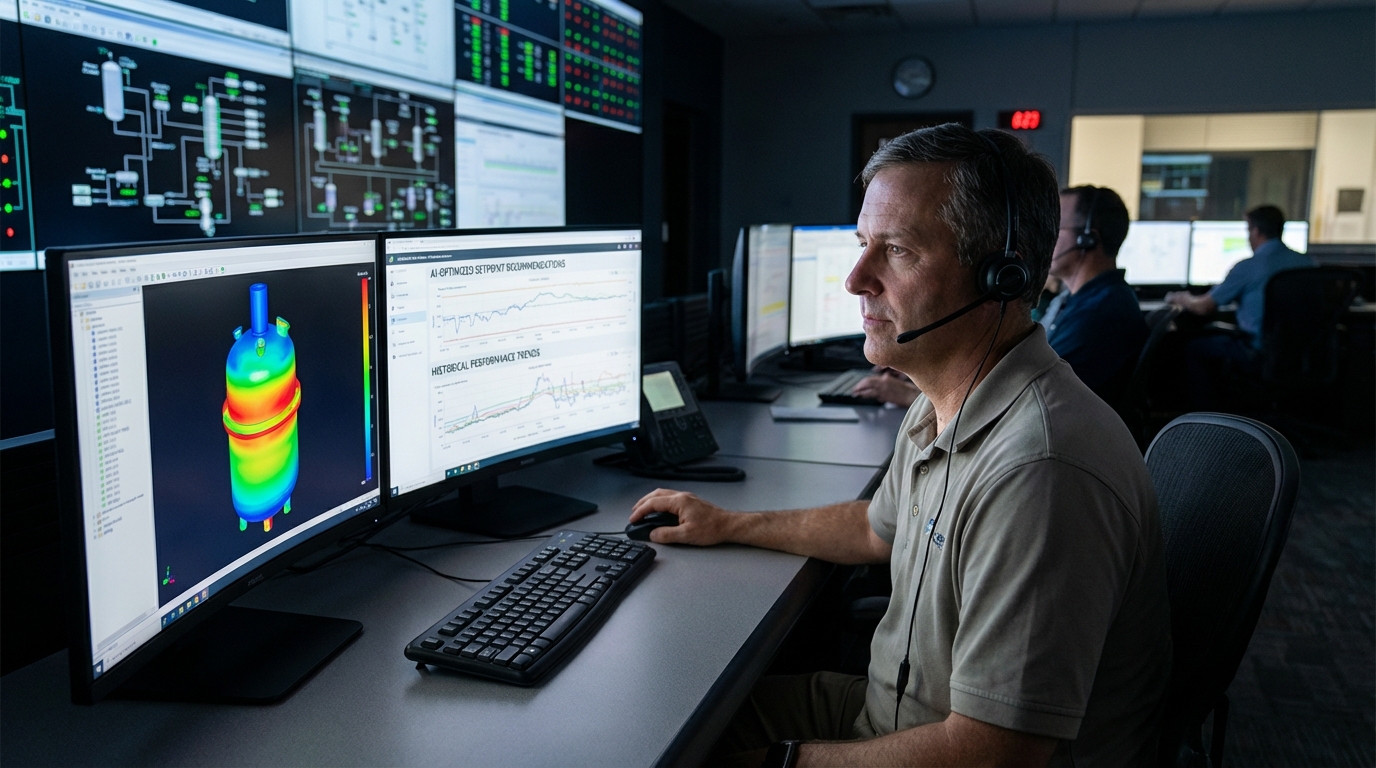
Advisory mode represents the starting point. AI models analyze real-time process data and provide optimized setpoint recommendations that operators review and implement at their discretion. This phase delivers immediate operational value: enhanced visibility into complex reactor dynamics, decision support that improves operational consistency across shifts, and workforce development as teams build expertise with AI-assisted recommendations.
Advisory mode also validates model accuracy against actual plant behavior and demonstrates improvement potential through measurable results. Many plants operate in advisory mode long-term, capturing these benefits while maintaining full operator control. Validation periods extend from several months to over a year depending on process complexity and organizational readiness.
Supervised autonomy follows as demonstrated results earn expanded authority. The AI optimization system begins writing setpoints to the control system within defined boundaries, while operators maintain oversight and override capability. Research on industrial AI solutions describes how AI-enabled automation can be embedded into end-to-end workflows while humans retain oversight. This aligns with the supervised autonomy phase, where AI makes automated adjustments within defined boundaries.
Closed loop operation represents the subsequent phase. The system operates autonomously within validated constraints, continuously adjusting reactor parameters to maintain optimal conditions. Human operators shift from tactical intervention to exception management and strategic optimization, maintaining continuous oversight through automated monitoring systems with validated fallback procedures.
Integration with existing infrastructure follows established patterns validated across major chemical producers. AI optimization typically deploys as a supervisory layer above existing DCS and APC systems, communicating through standard industrial protocols and leveraging existing process historians as data sources. This integration approach reduces the need for wholesale system replacement.
How Imubit Enables Consistent Tubular Reactor Output
For operations leaders in chemical and petrochemical facilities seeking consistent output and margin recovery from tubular reactor operations, Imubit’s Closed Loop AI Optimization solution addresses the fundamental constraints that traditional control cannot resolve. The technology learns from actual plant data and writes optimal setpoints in real time, enabling improvements in yield, energy efficiency, and product consistency.
The platform supports progressive deployment, starting in advisory mode where operators validate recommendations before advancing toward closed loop control as confidence builds. Plants capture value at each stage while building toward full optimization capability.
Get a Plant Assessment to discover how AI optimization can deliver consistent output and margin recovery from your tubular reactor operations.