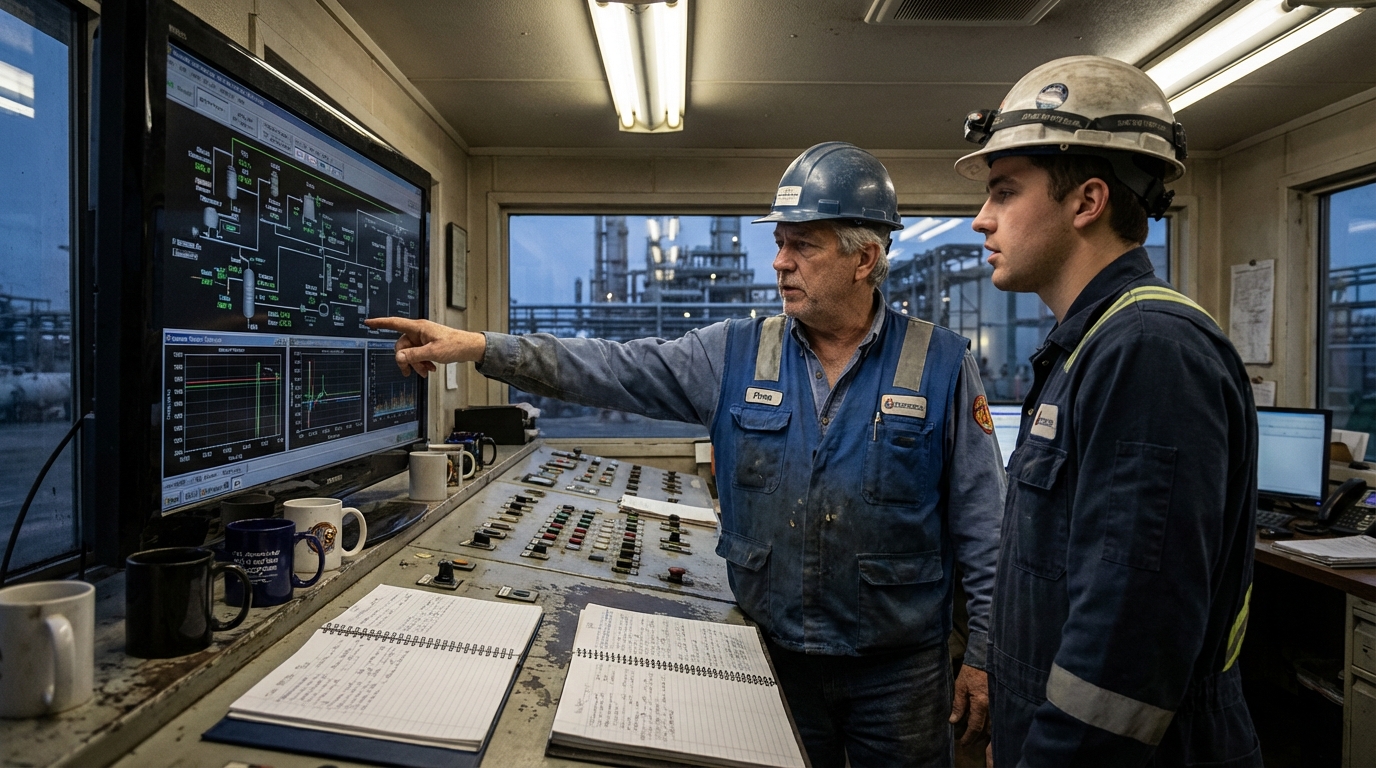
The control room operator who spent thirty years mastering your crude unit’s quirks is planning retirement. The process engineer who instinctively knows when that heat exchanger needs attention is training her replacement, a recent graduate who has never seen a turnaround.
This scenario plays out daily across refineries and petrochemical facilities worldwide. In the United States alone, McKinsey research estimates that as many as 400,000 energy-sector employees may retire within the next decade, with over a quarter of the workforce already at or near retirement age. The talent pipeline has contracted in parallel: the share of employees with less than two years of tenure dropped from 16% in 2012 to under 4% in 2022.
Traditional digital transformation training methods cannot close that gap fast enough. AI optimization offers a different path: rather than attempting to replace experienced operators, it can capture aspects of their decision-making as reflected in historical operating data, accelerate skill development for new hires, and augment human-AI collaboration across experience levels.
TL;DR: Oil and Gas Workforce Skills and Training for the AI Era
Mass retirements and a shrinking talent pipeline are creating workforce gaps that traditional training cannot close at scale.
Why Traditional Training Falls Short
- Too few junior operators are entering the pipeline to absorb knowledge before veterans depart, creating a succession “dead zone”
- The intuitive expertise veterans build over decades does not transfer through standard operating procedures or documentation
How AI Accelerates Knowledge Transfer and Training
- Dynamic process simulators let new operators practice alarm responses and process upsets before live deployment
- Advisory mode turns every shift into a learning opportunity as operators evaluate AI recommendations against real unit conditions
- Historical operating data preserves veteran decision patterns in a form accessible to every operator on every shift
Here’s how to put these strategies into practice.
Why Traditional Oil and Gas Training Cannot Keep Pace
The oil and gas industry faces a workforce transition that conventional training programs were never designed to handle. What makes this moment different from previous generational shifts is the speed and scale of the gap. Too few junior operators are entering the pipeline to absorb knowledge from retiring staff before that expertise disappears, creating a succession “dead zone.” The operational consequences are tangible: wider variability between shifts, slower responses to abnormal conditions, and optimization opportunities that go unrecognized because no one on shift has encountered them before. In many organizations, succession planning begins only once experienced employees announce their departures, meaning refineries often start documenting decades of unit-specific knowledge after the departure countdown has already begun.
Classroom instruction, on-the-job training, and structured mentorship all depend on experienced operators whose time is already divided between production responsibilities and knowledge transfer. All three share a critical limitation: none of them capture tacit knowledge effectively. The intuitive understanding that expert operators develop over decades resists documentation. When a veteran board operator retires, the organization loses more than procedural knowledge. It loses the pattern recognition refined through thousands of operational edge cases. Knowing how a specific crude unit behaves when feed quality shifts, when ambient temperature drops, or when an upstream unit changes throughput does not transfer through standard operating procedures. This is the knowledge that keeps units running smoothly during abnormal conditions, and it disappears fastest when experienced staff leave.
What Changes in the Control Room When Experience Walks Out
The gap left by departing veterans extends beyond process knowledge. The control room increasingly relies on AI-augmented tools that demand capabilities traditional roles never required, and the experienced staff who could mentor that development are the ones leaving. Industry research identifies skills gaps as a primary barrier to industrial transformation, with many companies citing difficulty bridging local skill gaps and attracting new talent at the same time.
The skills that matter most build on each other.
At the foundation, data literacy means interpreting AI-generated insights, reading statistical process control outputs, and using dashboards and trend displays to inform operational decisions beyond experience and intuition alone.
Built on that, AI output interpretation is the ability to evaluate when AI recommendations should be trusted and when domain expertise should override them. This judgment skill distinguishes operators who work effectively with AI from those who either blindly follow or reflexively ignore it.
Running through both, cross-functional collaboration matters as process engineers, operators, and planners increasingly work together on optimization problems that span traditional departmental boundaries.
In practice, effective skill development tends to be layered and progressive. Digital fluency forms the baseline, domain-specific AI interpretation develops as an intermediate skill, and cross-functional collaboration builds through practice, not instruction alone. Most operators reach substantial proficiency over roughly six to twelve months, depending on role complexity and prior digital experience, making it practical to structure training in phases instead of attempting to build all capabilities at once.
How AI Accelerates Knowledge Transfer and Operator Training
The most effective approach to oil and gas workforce training treats AI as a training mechanism in its own right, not merely a tool operators need to learn how to use.
Dynamic process simulators offer one of the most direct mechanisms. New operators can practice responding to alarm patterns, equipment degradation scenarios, and upset conditions in realistic simulated environments before facing them on a live unit. The learning is repeatable, consistent, and available regardless of whether a senior mentor happens to be on shift. For refinery and petrochemical operations where mistakes are measured in lost margin, safety incidents, or environmental releases, risk-free practice accelerates competency in ways that traditional training formats cannot match.
Advisory mode adds a second layer. When AI optimization provides real-time recommendations that operators evaluate before accepting or overriding, every shift becomes a structured learning opportunity. A junior board operator seeing the system recommend a severity adjustment on a reformer can examine the underlying logic, compare it to their own assessment, and learn from the difference. This builds intuition faster than conventional knowledge-transfer methods allow. Because the AI learns from historical operating data that includes veteran operators’ responses to thousands of process conditions, it embeds institutional knowledge into recommendations accessible across every shift and experience level.
What Makes Oil and Gas Training Programs Succeed in Practice
Even well-designed training programs can stall without deliberate attention to trust-building and phased adoption. Deloitte research indicates that more than 60% of the 1.84 million U.S. energy and chemicals workers, around 1.2 million people, are expected to need upskilling in new technologies, process operations, and analytics. The scale of the need, however, does not determine the approach. Rushing operators through AI training without building confidence typically produces resistance, not adoption.
Programs that deliver sustained results share several characteristics. They pair digital skill-building with scenario-based learning that simulates realistic conditions instead of abstract examples. They include cross-disciplinary rotations so operators understand how their decisions affect engineering, maintenance, and planning functions, building the kind of cross-functional transparency that reduces finger-pointing and accelerates response time. And they involve front-line operations staff in design and deployment phases instead of rolling out fully formed programs from the top down. The common thread is that operators learn through doing, and the training environment mirrors actual operating conditions closely enough that skills transfer directly to the control room.
BCG research on AI adoption in oil and gas reinforces the business case for this kind of investment, describing how leading companies that integrate AI into workflows rather than layering it on top are seeing faster returns. PwC’s AI Jobs Barometer quantifies the retention dimension: workers with AI skills command an average wage premium of about 56%. For operations leaders building the case for workforce development budgets, that translates directly into the ability to attract and retain the digitally skilled talent that oil and gas competes for against other industries.
Turning Workforce Constraints into Lasting Performance
For operations leaders navigating workforce transformation while maintaining operational excellence, AI optimization offers a path that augments rather than replaces human expertise. Imubit’s Closed Loop AI Optimization (AIO) solution learns from actual plant data to write optimized setpoints in real time, capturing operational knowledge in a single shared model that every operator, engineer, and planner can reference. The Imubit Industrial AI Platform includes dynamic process simulators for hands-on operator training and performance dashboards that support data-first decisions across functions. Plants can start in advisory mode where operators validate AI recommendations and build proficiency through daily interaction with the model, progressing toward closed loop operation as confidence builds. Value accrues at each stage: from accelerated training and knowledge capture in advisory mode to autonomous optimization in closed loop, turning the workforce transition from a vulnerability into a foundation for sustained performance.
Get a Plant Assessment to discover how AI optimization can accelerate operator training while capturing critical operational expertise.
Frequently Asked Questions
How do oil and gas plants typically phase AI training into existing operator workflows?
Successful implementations layer AI training into daily operations instead of treating it as a separate program. Operators begin by reviewing AI recommendations alongside their normal decision-making process, comparing system suggestions to their own judgment before acting. This integration path avoids disrupting production schedules while building familiarity through daily practice. Most plants find that operators develop meaningful proficiency within a few months, with deeper skills building as they encounter a wider range of operating conditions through subsequent cycles.
What happens to AI-captured knowledge when process conditions change significantly?
AI models built from historical operating data reflect the range of conditions a plant has actually experienced, so their relevance depends on how representative that history is. When new feedstocks, equipment changes, or operating regimes introduce conditions outside the training data, models can be updated to incorporate those new patterns. The key advantage over traditional knowledge transfer methods is that updates propagate to every operator immediately rather than relying on verbal handoffs or revised documentation that may take months to circulate.
How should oil and gas plants measure whether their workforce training programs are working?
Shift-to-shift consistency in key operating parameters provides one of the clearest signals that training is translating into practice. When variability between experienced and newer operators narrows, it suggests the training approach is effective at transferring operational judgment rather than just procedural steps. Other meaningful indicators include alarm response times, the frequency with which operators override AI recommendations as trust develops, and reductions in process variability during grade transitions or feed changes.