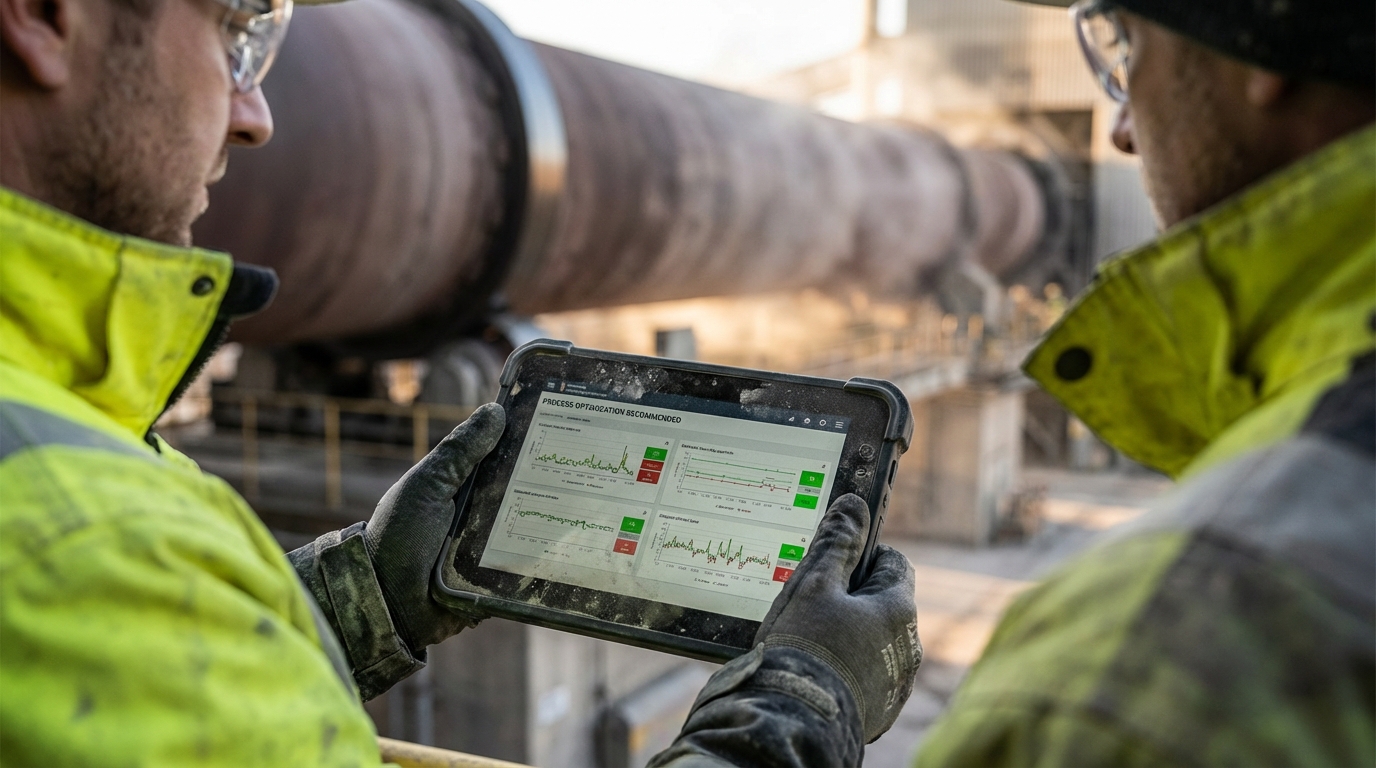
Every shift, process operators face the same paradox: surrounded by more data than ever, yet starving for the insights that matter. Screens display hundreds of variables, historians log millions of data points, and alarms compete for attention. But when something goes wrong, finding the root cause still requires hours of manual investigation and institutional knowledge that fewer people possess each year.
This isn’t just a technology problem. It’s a workforce problem. Senior operators know where to look and what patterns matter, but that expertise lives in their heads, not in systems. When they retire or change shifts, less experienced team members face the same data flood without the same intuition. The result is inconsistent decisions, slower troubleshooting, and a growing gap between what plants could achieve and what they actually deliver.
McKinsey research indicates that most manufacturing data is never used in decision-making. The vast majority of collected data remains unused, representing significant untapped potential for improving operational consistency, accelerating troubleshooting, and preserving the institutional knowledge that experienced operators carry.
Industrial AI offers a fundamentally different approach: one that transforms raw data into real-time visibility while keeping operator expertise at the center of decision-making.
TL;DR: How to Improve Manufacturing Visibility with Industrial AI
Real-time manufacturing visibility means more than dashboards and data access. It means operators and plant leaders having the insights they need to make confident decisions, exactly when those decisions matter.
From Data Overload to Decision Confidence
- AI serves as an augmentation layer between raw data and human judgment, surfacing insights while preserving operator authority
- Pattern recognition at scale highlights opportunities and anomalies hidden in thousands of variables, improving throughput and reducing unplanned downtime
- Less experienced operators gain access to expert-level insights, reducing shift-to-shift variability and accelerating competency development
Preserving Institutional Knowledge as Workforces Transition
- AI models can help capture recurring operational patterns and best practices, creating a knowledge transfer mechanism that remains available regardless of staffing changes
- Dynamic process models serve as training tools, enabling new staff to practice decision-making before real-time deployment
- Organizations can embed operational expertise into systems rather than losing it when senior operators retire
Here’s how to put these principles into practice.
What Does True Manufacturing Visibility Require?
Manufacturing visibility in process industries means more than collecting data or displaying metrics on dashboards. True visibility requires the ability to understand what’s happening across operations in real time, why it’s happening, and what to do about it. For operators, engineers, and plant leaders, visibility is the foundation of confident decision-making.
Process plants generate thousands of operational data points: sensors measuring temperature, pressure, flow rates, and composition; historians archiving millions of records. Yet for most operations teams, this wealth creates noise rather than clarity.
In many mature process plants, the primary constraint has shifted from data collection to data comprehension and effective use. Operators monitor dozens of displays simultaneously, each showing variables that interact in complex, nonlinear ways. When performance drifts, identifying whether the cause lies in feed quality, equipment fouling, ambient conditions, or control system behavior requires correlating information across multiple systems. During this investigation, production continues under suboptimal conditions.
Traditional monitoring compounds the problem through fragmentation. Process data resides in historians, quality data lives in laboratory information systems, and enterprise data sits in separate platforms. Each system serves its purpose, but the connections between them require manual effort to establish. When operators need to understand why yield dropped last shift, they must navigate multiple interfaces and mentally correlate information that technology cannot integrate automatically.
The burden falls heaviest on less experienced operators. Senior team members have built mental models over decades that help them know where to look first. They recognize patterns that indicate specific failure modes and can quickly narrow diagnostic searches. But this expertise is difficult to transfer. When experienced operators retire or move to different shifts, the visibility gap widens for those who remain.
How Can AI Improve Manufacturing Visibility for Operators?
Industrial AI approaches manufacturing visibility fundamentally differently than traditional monitoring. Rather than waiting for threshold violations, AI continuously analyzes relationships across all available process variables, identifying patterns that indicate emerging issues before they manifest as alarms.
This shift from reactive to predictive visibility changes what operators can see and when they can act. AI processes thousands of variables simultaneously, detecting correlations and patterns that would be impossible for humans to identify manually. When feed composition shifts subtly, AI can recognize the downstream implications across multiple unit operations and surface the insight before quality or efficiency degrades.
IEA research indicates that AI-driven systems can reduce equipment downtime and improve operational efficiency across process industries. The more immediate benefit for operators is reduced alarm fatigue. By identifying genuine anomalies rather than threshold violations, AI helps operators focus attention on issues that actually require intervention.
Initial deployments typically operate in advisory mode, where AI analyzes process data and provides recommendations while operators evaluate and validate suggestions based on their contextual knowledge. This approach builds trust incrementally. Operators learn how the AI reasons about process behavior, and the AI benefits from operator feedback that improves its recommendations over time.
How Does Better Visibility Drive Business Results?
The true measure of manufacturing visibility is not how much data operators can access, but how confidently they can make decisions. Industrial AI transforms this equation by serving as an augmentation layer between raw data and human judgment, surfacing insights while preserving operator authority.
This augmentation model addresses a critical concern in process industries. Experienced operators possess decades of institutional knowledge that no technology can fully replicate. Rather than attempting replacement, AI optimization captures and extends this expertise, enabling operators at various skill levels to access expert-level insights and make data-first decisions.
Operators and plant leaders gain specific capabilities that compound their effectiveness:
Pattern recognition at scale. AI surfaces relationships across thousands of variables, highlighting opportunities and anomalies that would otherwise remain hidden in data volume. An operator might notice a single trend line drifting; AI can identify how that drift correlates with dozens of other variables and predict where it leads.
Guided diagnostics. Rather than manual investigation across multiple platforms, operators receive directed pathways to root causes with supporting evidence. Investigation time that previously required hours can be compressed significantly, reducing the production losses that accumulate during diagnostic periods.
Predictive context. Understanding not just current state but likely trajectories enables proactive intervention before issues escalate. Operators can address emerging problems during convenient windows rather than responding to crises.
Standardized best practices. Expert decision patterns become accessible to less experienced operators, accelerating competency development and reducing shift-to-shift variability. The insights that senior operators developed over decades become available to the entire team.
These capabilities translate directly into business metrics that matter: improved throughput, higher overall equipment effectiveness (OEE), reduced unplanned downtime, and fewer quality escapes. BCG research shows that successful AI implementations in industrial settings can deliver 10–15% improvements in production and 4–5% improvements in EBITA. Critically, these improvements come from empowering existing operators rather than replacing them, demonstrating that workforce augmentation delivers business results.
How Can Plants Preserve Institutional Knowledge Before Experienced Operators Retire?
The workforce implications of manufacturing visibility matter enormously given industry demographics. Deloitte projects that U.S. manufacturing could face a shortage of millions of workers over the next decade. Each departure of experienced staff represents accumulated process knowledge that traditional systems cannot preserve.
This workforce transition threatens operational continuity in ways that go beyond headcount. Senior operators carry mental models of process behavior built over decades of experience. They know which alarms matter and which can be safely deprioritized. They recognize early warning signs that don’t trigger any threshold but indicate trouble ahead. They understand how different process units interact in ways that documentation rarely captures.
When this knowledge walks out the door, plants face a choice: accept increased variability and slower troubleshooting, or find ways to capture and transfer expertise systematically.
AI-powered visibility tools offer a third path. The models that learn process behavior from plant data can help capture recurring operational patterns and best practices. When AI learns that certain parameter combinations indicate specific failure modes, that knowledge becomes embedded in the system, available to every operator regardless of their experience level. The extent of this captured expertise depends on the breadth and quality of available data and cannot fully substitute for expert judgment in novel or poorly instrumented scenarios.
Dynamic process models can serve as training tools, enabling new staff to practice decision-making in simulated environments before handling real-time operations. New hires can experience scenarios that might occur only a few times per year in actual operations, accelerating pattern recognition that would otherwise require extended on-the-job exposure to develop.
The result is a knowledge transfer mechanism that scales. Rather than one-on-one mentoring that depends on senior operator availability, organizations can embed institutional knowledge into systems that support the entire workforce. Shift-to-shift variability decreases as all operators gain access to consistent, expert-level guidance.
What Does Successful Implementation Look Like?
Technology alone does not create lasting visibility improvements. Industry research indicates that in some plants, fewer than 10% of implemented advanced process control (APC) applications remain active and maintained over time. This low persistence rate demonstrates that operators need more than sophisticated tools: they need solutions designed around their workflows and implemented through approaches that build genuine confidence.
Successful AI visibility initiatives share common characteristics:
- They begin with focused applications that address specific operational pain points rather than attempting plant-wide transformation simultaneously
- They provide transparent reasoning so operators understand why the AI recommends particular actions
- They maintain clear boundaries between automated insight and human decision-making authority
- They integrate with existing data infrastructure rather than requiring wholesale replacement
In plants with reasonably mature historian data and basic IT/OT foundations, industrial AI can often begin learning from existing data while targeted infrastructure and data-quality improvements proceed in parallel. This removes a common barrier to adoption: unlike traditional approaches requiring extensive data preparation, modern AI can work with existing operational data while helping identify opportunities to enhance data quality over time.
The implementation journey matters as much as the technology selection. Initial deployments operate in advisory mode, where AI analyzes process data and provides recommendations while operators evaluate and validate suggestions based on their contextual knowledge. This period builds trust and allows operators to understand system behavior before expanding reliance.
As confidence develops, organizations can choose to progress toward supervised modes where AI takes more active roles in routine optimization while operators maintain oversight and intervention capability. Some organizations may find that advisory mode delivers sufficient value for their needs; others may progress toward greater automation. Both paths represent successful outcomes.
From Visibility Constraints to Operational Clarity
For operations leaders and plant managers seeking to transform how their teams see and respond to plant performance while preserving institutional knowledge, industrial AI offers a proven pathway from data overload to decision confidence. The technology has matured beyond pilot applications into production-ready solutions that deliver measurable improvements in throughput, OEE, and operational consistency while respecting operator expertise.
Imubit’s Closed Loop AI Optimization solution addresses manufacturing visibility constraints by learning directly from plant data to identify patterns, predict behavior, and recommend optimal setpoints in real time. Plants can begin in advisory mode, gaining immediate value from AI-surfaced insights while operators retain full decision authority, then progress toward closed loop operation as confidence builds. This phased approach preserves institutional knowledge while systematically expanding visibility and optimization capabilities.
Get a Plant Assessment to discover how AI optimization can close the visibility gap, preserve institutional knowledge, and empower your workforce with decision-ready insights.
Frequently Asked Questions
How long does it typically take for operators to trust AI visibility recommendations?
Trust develops progressively rather than all at once. Most implementations begin in advisory mode where operators evaluate AI recommendations against their own judgment over an initial evaluation period. During this time, operators learn how the AI reasons about process behavior and can verify its accuracy against outcomes. Organizations that invest in transparent explanations of AI reasoning and provide operators authority to override recommendations typically see faster trust development than those that present AI as a black box.
Can AI visibility tools integrate with existing plant data infrastructure?
In plants with reasonably mature data foundations, AI visibility solutions can begin learning from existing historian data without requiring extensive infrastructure upgrades first. While richer, cleaner datasets sharpen results over time, plants can start with current data quality and improve infrastructure in parallel as benefits accrue. The AI can also help identify data quality issues and instrumentation gaps that were previously invisible, creating a roadmap for targeted improvements that deliver the highest return.
How does improved visibility help preserve institutional knowledge as experienced operators retire?
AI models learn process behavior patterns from plant data, helping capture recurring operational patterns that experienced operators have developed over decades. When senior operators respond to specific situations, those response patterns can be embedded in systems that remain available after they retire. Dynamic process simulators also enable accelerated training for new hires, allowing them to build familiarity with process behavior more quickly than relying solely on infrequent real-world events.