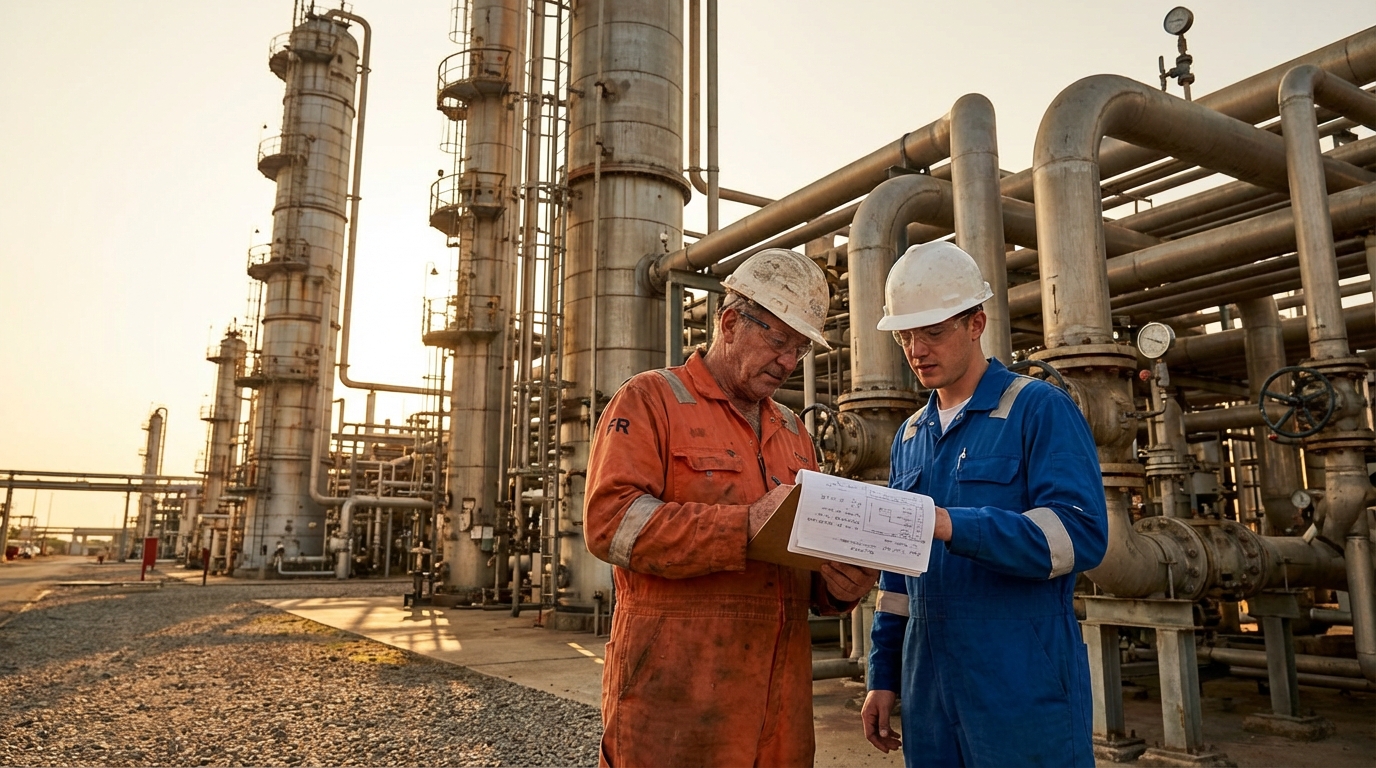
The operations manager who spent thirty years learning every quirk of a fluid catalytic cracker is retiring next quarter. The knowledge that prevents costly upsets, the intuition that catches problems before alarms fire, the judgment that separates routine adjustments from critical interventions: all of it walks out the door. The knowledge gap is widening now, on every shift, at facilities worldwide.
According to Deloitte research, more than 60% of the US energy and chemicals workforce, roughly 1.2 million workers, will need upskilling in new technologies, process operations, and analytics over the next decade. The IEA’s World Energy Employment 2025 report puts the scale in sharper focus: 2.4 workers nearing retirement for every new entrant under 25 in advanced economy energy workforces. Yet the same technologies driving Industry 4.0 offer a practical path forward.
AI optimization captures operational expertise, extends decision support to every shift, and accelerates the development of newer operators. Not by replacing experienced judgment, but by preserving and building on it. The question for oil and gas leaders isn’t whether to adopt these technologies. It’s how to implement them in ways that people across the plant will actually use.
TL;DR: How to Implement Industry 4.0 in Oil and Gas Operations
Industry 4.0 succeeds when organizations treat deployment as workforce transformation, not just automation.
What Industry 4.0 Changes in Oil and Gas Operations
- AI optimization analyzes thousands of process variables simultaneously to identify margin, energy, and yield opportunities across refining, gas processing, and midstream operations
- A single shared AI model breaks down decision silos between maintenance, operations, engineering, and planning
- AI models trained on historical operating data help preserve process knowledge that would otherwise leave with retiring staff
How Phased Deployment Builds Operator Trust
- Advisory mode lets operators validate AI recommendations against their own experience while delivering improvements from the start
- Progression toward closed loop operation happens as trust develops, not on a fixed timeline
- Organizations with stronger change management achieve significantly better AI outcomes
Here’s how these principles work in practice.
What Does Industry 4.0 Look Like in Oil and Gas Operations?
Industry 4.0 in oil and gas isn’t a single technology. It’s what happens when AI optimization, advanced analytics, real-time process control, and connected data infrastructure work together to change how plants operate and how teams make decisions.
In daily operations, AI optimization trained on actual plant data continuously analyzes thousands of process variables at once, surfacing opportunities that manual monitoring cannot detect. In crude distillation, for example, operators traditionally adjust column parameters based on periodic lab results and experience. AI-driven process optimization can analyze feed quality, column behavior, and downstream constraints together. The result is setpoint recommendations that improve yield or energy efficiency while operators evaluate each change alongside their own judgment. Similar capabilities apply across refining units, gas processing facilities, and midstream operations where process complexity and variable feedstocks create persistent optimization gaps.
Industry 4.0 also creates cross-functional visibility that breaks down decision silos. When maintenance, operations, engineering, and planning teams all reference the same AI model built from the same plant data, they share a common view of how their decisions affect one another. A maintenance scheduling choice that looks optimal for equipment uptime might constrain throughput during a high-margin window. Shared visibility into these trade-offs allows teams to coordinate rather than optimize in isolation.
The AI model also captures a meaningful share of what experienced operators know. As it learns from years of historical operating data shaped by seasoned staff, the patterns they recognized intuitively become embedded in the model and accessible to every shift. Not all tacit expertise transfers this way, particularly knowledge of rare events or unmeasured context, but institutional knowledge that once lived in individuals’ heads becomes part of the plant’s permanent operating intelligence.
Why Do Most Industry 4.0 Initiatives Stall in Oil and Gas?
McKinsey research on industrial AI adoption indicates that leading adopters can generate several times more impact from AI than peers and often achieve double-digit production or efficiency improvements in selected processes. Most organizations never reach that level. The gap usually traces back to how the technology was deployed, not whether it worked.
The most common failure pattern is treating Industry 4.0 as a pure technology deployment. Leadership approves a platform, IT installs it, and operators are expected to adopt it. Without meaningful change management, operator training, or organizational alignment, the technology sits underused while the team continues operating as before. BCG research indicates that companies with more mature AI operating models and supporting capabilities, including change management, achieve significantly higher financial performance from AI initiatives than peers. The technology itself rarely fails. The organizational readiness around it does.
The second failure pattern is moving too fast toward automation. When organizations jump directly to closed loop control without building operator trust, they trigger the resistance that stalls the entire initiative. Operators who feel their expertise is being bypassed will find ways to work around the system, disable recommendations, or revert to manual control at the first sign of an unexpected situation.
Successful implementations recognize that Industry 4.0 in oil and gas is fundamentally a workforce transformation that happens to involve technology. The organizations getting the most from AI are the ones that invest in people and process first, then let the technology extend what their teams can do.
How Does Phased Industry 4.0 Deployment Build Operator Trust?
The stall patterns above share a common thread: organizations that skip trust-building pay for it later. Effective implementation follows a progressive path that builds operator confidence at each stage, and each stage delivers its own returns.
Advisory mode represents the starting point. AI optimization analyzes process data and provides recommendations, but operators retain full decision authority. Every suggested setpoint change requires explicit approval. This stage delivers meaningful improvements in consistency and energy use while serving a deeper purpose: operators observe AI recommendations alongside their own judgments and develop intuition about when AI insights add value and when operational context should take precedence.
Supervised autonomy expands AI execution within defined operational boundaries. AI optimization handles routine adjustments automatically, from maintaining target temperatures to optimizing feed blend ratios, while operators maintain supervisory oversight. The transition to this stage typically occurs when recommendation acceptance rates are consistently high, meaning the AI’s suggestions and operators’ independent judgments are converging. Operators can return systems to manual mode at any time.
Closed loop optimization achieves full operational value while maintaining permanent human oversight. Operators set strategic objectives and constraints; AI handles tactical optimization within those boundaries, continuously adjusting setpoints for throughput, energy, and product quality in real time.
Organizations choose their own pace through these stages. Some may operate in advisory mode for extended periods and still see significant improvements in energy optimization and shift-to-shift consistency. The progression is driven by demonstrated trust, not a predetermined timeline.
What Makes Industry 4.0 Training Effective in Oil and Gas?
Effective training in an Industry 4.0 context looks different from what most organizations default to. Classroom seminars and reference binders don’t prepare operators for the day-to-day experience of working alongside AI tools on a live unit.
Dynamic process simulation plays a particularly important role in oil and gas operations. Operators can practice with AI optimization in safe, simulated environments that reflect their actual unit’s behavior, and build confidence before managing live systems. This approach compresses learning curves significantly compared to traditional shadowing models, where new operators might wait months before encountering the specific scenarios they need to learn from.
Placing data scientists alongside operations teams also accelerates adoption. When operators see analytics applied to the unit they’re running, the connection between data and operational decisions becomes concrete rather than abstract. Layered upskilling targets multiple levels simultaneously: experienced operators developing supervisory capabilities for AI-augmented operations while newer team members build foundational digital skills. This prevents the common failure where only a handful of specialists adopt the technology while the broader workforce continues operating as before.
Training in digital tools tends to produce broader productivity improvements than mechanical training alone, which suggests workforce development budgets should reflect this shift. But training alone doesn’t sustain adoption. Leadership alignment, transparent communication about AI’s role, and visible respect for operator expertise determine whether the technology becomes part of daily operations or sits unused after the initial rollout.
How Should Operations Leaders Measure Industry 4.0 Success?
Implementation success requires metrics spanning both technology performance and workforce outcomes. Tracking only operational numbers misses whether the technology is actually making operators more effective or simply running around them.
Capability metrics track whether operators can effectively use AI tools: training completion rates by role, skills assessment improvements over time, and digital tool usage frequency across shifts. If usage drops off after the first month, the problem is adoption, not technology.
Confidence metrics reveal whether operators trust the technology: AI recommendation acceptance rates serve as a key indicator, alongside user satisfaction scores and willingness to rely on AI for progressively more complex decisions. Rising acceptance rates signal that operators are developing genuine confidence, which is the prerequisite for advancing through deployment stages.
Operational metrics validate the business case: production improvements, overall equipment effectiveness, error rate reductions, and cost efficiency improvements across operations.
When all three metric categories trend positively, the implementation is building something sustainable. When operational metrics improve but confidence metrics stagnate, the organization may be capturing short-term value while setting up longer-term adoption problems.
From Implementation Guide to Implementation Partner
For operations leaders seeking to build AI-capable teams while capturing Industry 4.0 value, Imubit’s Closed Loop AI Optimization solution provides a practical path forward. The technology learns from plant-specific operating data to write optimal setpoints in real time, starting in advisory mode where operators validate recommendations before progressing toward closed loop operation as confidence builds. Operators retain authority throughout the journey while gaining AI-powered decision support that preserves process knowledge and accelerates workforce readiness.
Get a Plant Assessment to discover how AI optimization can strengthen your operations team while capturing the full value of Industry 4.0 implementation.
Frequently Asked Questions
How long does Industry 4.0 implementation typically take to show results in oil and gas?
Plants implementing AI-driven optimization can often observe measurable improvements within the first several months during advisory mode deployment. Initial improvements come from standardized recommendations and reduced shift-to-shift variability, while deeper operational benefits develop as operators build trust and systems progress toward supervised autonomy and closed loop operation over subsequent quarters.
Can AI optimization integrate with existing control infrastructure in oil and gas facilities?
AI optimization integrates with existing distributed control systems and advanced process control (APC) layers rather than replacing them. The technology operates as an optimization layer above current infrastructure and sends setpoint recommendations through established communication pathways. All existing safety interlocks and operator override capabilities remain fully operational.
What data does an oil and gas plant need to start with AI optimization?
Plants can begin with existing process data from their plant data systems covering temperature, pressure, flow, and quality measurements. While richer, cleaner datasets sharpen results over time, perfectly structured data is not a prerequisite. Most implementations start with available plant data and lab results, then improve data quality iteratively as the system identifies gaps and calibration opportunities.