Every experienced operator who retires takes decades of hard-won knowledge out the door. That intuition for when a process is drifting toward trouble, the subtle adjustments that keep quality consistent, the quick decisions during upsets: none of it lives in a manual.
With 2.1 million manufacturing jobs projected to remain unfilled by 2030 according to a Deloitte and Manufacturing Institute study, the question facing operations leaders in refineries, chemical plants, and mineral processing facilities is no longer whether productivity will suffer from workforce constraints, but how severely.
Process industries need ways to amplify the capabilities of existing teams, accelerate time-to-competency for new operators, and preserve institutional knowledge before it disappears. AI-powered decision support offers a path forward, but this is not the robotics and machine vision automation common in discrete manufacturing. In continuous and batch process environments, AI addresses multivariable optimization, institutional knowledge capture, and real-time decision support across complex, interconnected unit operations.
TL;DR: Improving manufacturing productivity with AI in process industries
AI-powered decision support helps refineries, chemical plants, and mineral processing operations address productivity constraints by capturing institutional expertise and making it accessible across the workforce. Unlike robotics or vision systems used in discrete manufacturing, process industry AI focuses on multivariable optimization across interconnected units, real-time quality prediction, and preserving the tacit knowledge that experienced operators carry. Implementations typically begin in advisory mode before progressing toward automation, with documented deployments reporting 10–15% throughput improvements, 20–30% reductions in unplanned downtime, and 4–5% EBIT uplift.
Why Institutional Knowledge Keeps Walking Out the Door
Process operations depend on tacit expertise that accumulates over years. Experienced operators recognize patterns in plant behavior and context that generic algorithms may miss, while advanced AI can also detect complex patterns beyond unaided human analysis. Operators understand how equipment behaves under different conditions, how processes interact, and when standard procedures need situational adaptation. This knowledge rarely exists in documented form.
The business impact is quantifiable. Unplanned downtime has been estimated to cost industrial operations as much as $50 billion annually according to industry analyses. A portion of this can be linked to human and procedural factors, including decisions by less experienced personnel, alongside equipment, maintenance, and process issues.
Traditional knowledge transfer approaches face structural constraints:
- Extended apprenticeship timelines: Many registered apprenticeship programs run several years, often in the three-to-four-year range, with some lasting longer depending on the trade and jurisdiction
- Classroom-reality disconnect: Written procedures often miss the gap between training and actual operator practices in dynamic environments
- Undocumented expertise: Tacit knowledge is difficult to capture fully in standard operating procedures
- Shift inconsistency: Decisions depend on individual experience rather than shared, data-driven insights
How AI Preserves Institutional Knowledge During Workforce Transitions
The workforce constraint creates urgency that traditional knowledge management cannot address. When experienced operators retire, organizations face a narrow window to capture decision patterns developed over decades. AI-powered decision support offers a mechanism to preserve this expertise before it disappears.
The preservation mechanism works through continuous learning from operational data. As experienced operators make decisions, AI models learn the patterns connecting process conditions to optimal responses. These patterns become embedded in the system, accessible to every operator regardless of tenure. When a less experienced operator encounters an unfamiliar situation, the AI surfaces recommendations based on how veteran operators handled similar conditions historically.
This approach transforms workforce development from a race against retirements into a sustainable knowledge accumulation process. Each decision, each adjustment, each response to an upset contributes to an expanding base of institutional expertise that persists through workforce transitions.
Emerging capabilities are extending this further. Some organizations are exploring how AI can assist with generating updated standard operating procedures, creating training scenarios based on historical incidents, and helping new operators understand the reasoning behind expert decisions. These applications remain early-stage but signal where industrial AI is heading as a workforce solution.
How AI Augments Operator Expertise Without Replacing It
Many effective industrial AI implementations frame artificial intelligence as augmentation rather than full automation. Rather than attempting to replace human judgment, AI-powered decision support enhances operator decision-making by identifying opportunities and insights that would otherwise remain hidden in complex operational data. Operators retain full decision authority and the ability to override recommendations.
This augmentation model delivers value through several mechanisms.
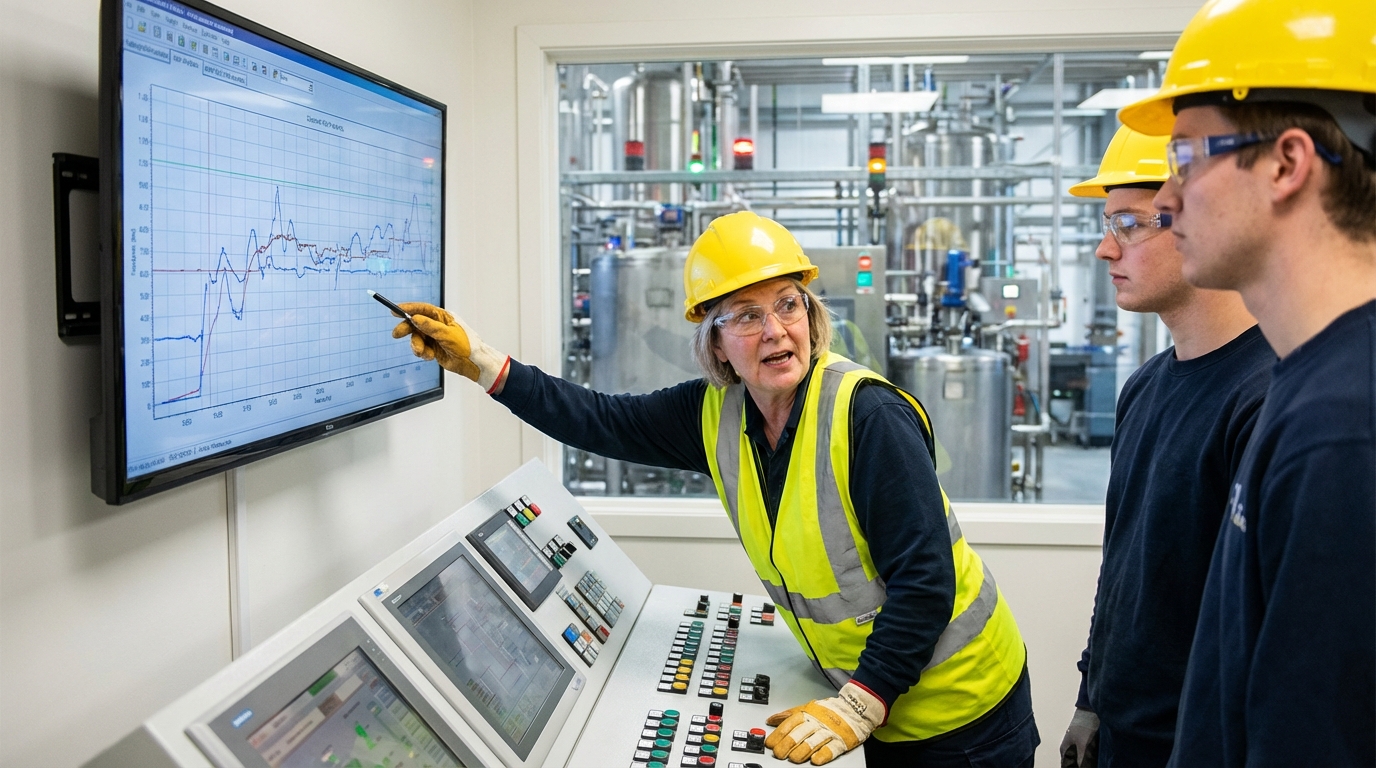
Decision support in complex environments: Modern process operations generate thousands of measurements that no human can simultaneously monitor. Advanced optimization platforms identify patterns across these variables, highlighting opportunities and anomalies that experienced operators would recognize, and making that recognition available to every team member.
Expertise democratization: When industrial AI learns from historical operational data spanning decades of accumulated decision-making, it democratizes expertise by making it accessible across the workforce. Subject matter experts can use AI assistance to analyze multiyear operational data across thousands of process parameters without manually reviewing every data point.
Real-time quality and yield optimization: AI can predict product quality before laboratory results return, enabling proactive adjustments that reduce off-spec production. Documented implementations have reported 10–20% reductions in off-spec material through earlier intervention.
The key distinction is authority. In effective implementations, operators retain decision-making control while AI provides recommendations. The system surfaces optimal setpoints; the operator validates and implements them. This preserves human accountability for safety-critical decisions while accelerating the learning curve for less experienced personnel.
Building Operator Trust Through Phased Implementation
The most successful deployments build trust through phased capability demonstration. AI begins in advisory mode, providing recommendations while operators maintain full control. As confidence builds through validated suggestions, deployment can progress toward supervised operation where AI executes decisions with operator approval. Only after sustained demonstration of value does closed loop operation become appropriate.
This progression serves multiple purposes:
- Risk mitigation: AI proves its value at each phase before assuming operational authority
- Trust development: Transparency and explainability allow operators to verify that recommendations align with their experience
- Capability calibration: Phased advancement provides time to identify and address edge cases before they affect production
- Organizational adaptation: Teams develop new workflows and responsibilities at a sustainable pace
Operators often approach AI with legitimate concerns that effective implementations must address. Job security anxiety requires clear positioning of AI as augmentation, not replacement, with operators retaining override authority. Black-box skepticism demands explainable recommendations that show which variables influenced each suggestion. Safety accountability means human operators remain responsible for safety-critical decisions while AI operates within defined boundaries.
Training investment matters for adoption. McKinsey analysis indicates that organizations providing several hours of hands-on AI training per employee report higher adoption rates, with front-line workers often requiring more extensive preparation than knowledge workers.
Change Management Practices That Sustain Results
Technology deployment without adequate change management creates adoption barriers that delay value capture. Organizations that achieve sustained productivity improvements typically implement several practices alongside the technology.
Cross-functional implementation teams bring together operations, engineering, maintenance, and planning perspectives from the start. This prevents optimization in one area from creating problems in another and builds broader organizational ownership of results.
Pilot unit selection focuses initial deployment on processes where variability is high and potential value is clear. Success in a well-chosen pilot builds credibility for broader rollout while limiting risk during the learning phase.
Standard work integration embeds AI recommendations into existing workflows rather than creating parallel systems. When operators see AI guidance as part of their normal routine rather than an additional task, adoption accelerates.
Regular review cadences incorporate AI performance into daily and weekly operational meetings. Teams review recommendation accuracy, identify edge cases, and provide feedback that improves model performance over time. This creates a continuous improvement cycle where AI becomes more valuable as operational experience accumulates.
These practices connect AI deployment to the disciplined improvement routines that process industries already maintain. AI becomes an enabler of existing operational excellence efforts rather than a separate initiative competing for attention.
What Productivity Improvements Can Process Operations Expect?
Process industries implementing AI-powered optimization have reported significant productivity improvements across multiple metrics in documented case studies. McKinsey analysis of AI deployments across industrial processing plants found that operators reported 10–15% production increases and 4–5% EBIT/EBITA improvements.
Beyond throughput and profitability, documented implementations have reported:
- 20–30% reduction in unplanned downtime through earlier detection of process drift and equipment stress patterns
- 10–20% reduction in off-spec production through real-time quality prediction and proactive adjustments
- Faster time-to-competency for new operators who can access AI-guided decision support from day one
To illustrate the cumulative impact: consider a mid-size processing facility with $200 million in annual throughput operating at 85% capacity utilization. A 10% production increase represents $20 million in additional capacity from existing assets. A 25% reduction in unplanned downtime at an average cost of $500,000 per incident across 20 annual events saves $2.5 million. A 4% EBIT improvement on the expanded revenue base adds further margin. Combined, these improvements can generate $25–30 million in annual value without capital expansion, with payback periods often measured in months rather than years.
Time-to-competency reduction addresses the workforce constraint directly. When industrial AI provides real-time guidance based on expert decision patterns, new operators can achieve independent competency faster. This reduces the vulnerability window during workforce transitions and decreases elevated error rates that occur during traditional apprenticeship timelines.
These outcomes compound over time. As industrial AI learns from additional operational data, recommendation quality improves. As operators develop trust in AI suggestions, they engage more fully with the technology. As institutional knowledge becomes embedded in decision-support systems, it persists through workforce transitions.
Building Sustainable Workforce Productivity
For process industry leaders facing retirements, skills gaps, and throughput constraints, the path forward requires more than technology investment. It demands organizational commitment to workforce development, phased implementation that builds trust, and systems designed to augment rather than replace human expertise.
Imubit’s Closed Loop AI Optimization solution supports this progression by learning from plant data and providing recommendations that operators can validate before the system writes optimal setpoints in real time. Plants can begin in advisory mode, capturing value through enhanced visibility and decision support, then progress toward closed loop operation as trust develops through demonstrated results.
Get a Plant Assessment to quantify where AI-driven optimization can unlock hidden capacity in your existing assets while preserving the operational expertise your plant depends on.