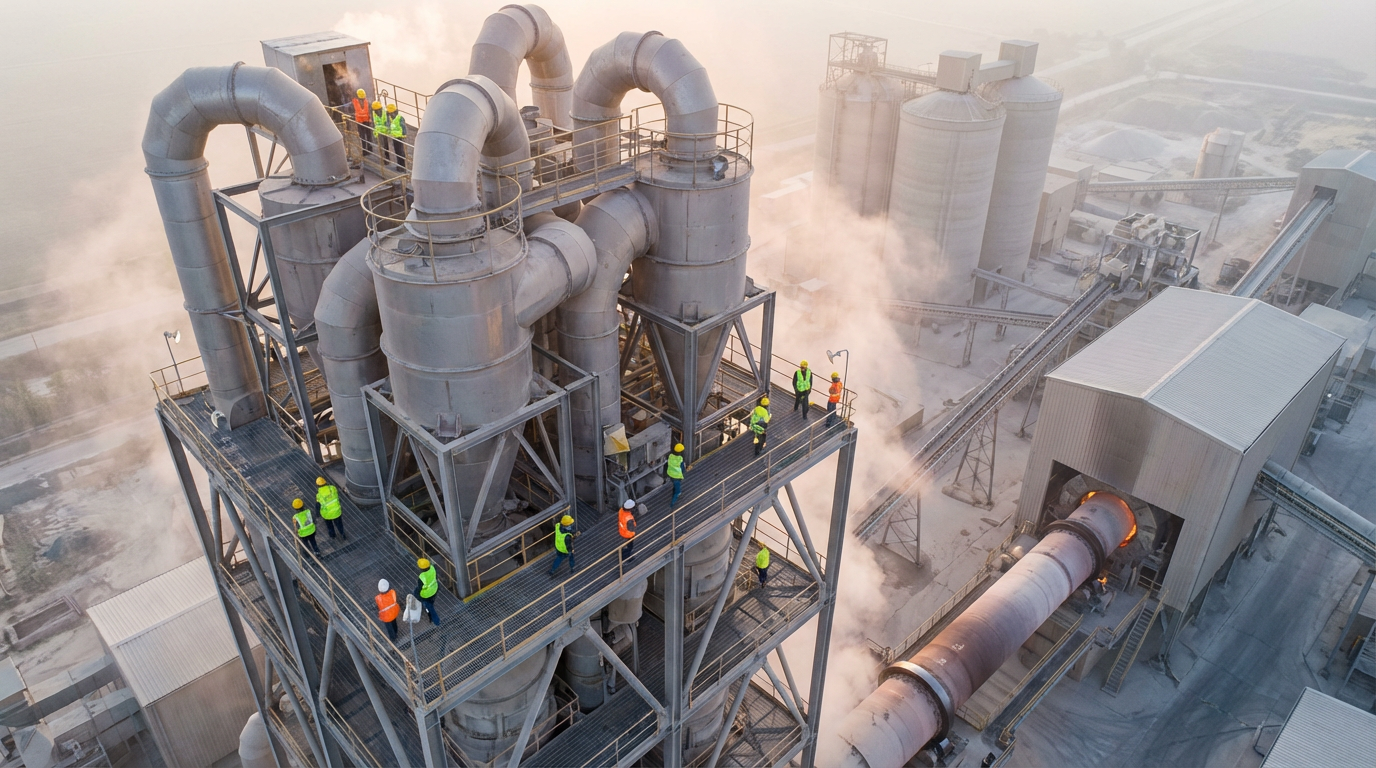
Every cement plant’s margin story runs through its preheater tower. The preheater-kiln system consumes the majority of plant energy, so small control losses show up quickly in the fuel and power bill.
Most plants operate well below the thermal efficiency their equipment can deliver, a gap driven less by the hardware itself than by how the process is controlled. For operations leaders tracking energy costs per tonne of clinker, that gap translates directly into recoverable margin. Blockages develop between inspections, and thermal profiles drift as raw meal chemistry shifts. Operators compensate with conservative setpoints that sacrifice fuel efficiency for stability.
TL;DR: Cyclone Preheater Optimization for Cement Operations
Cyclone preheater efficiency is usually lost in small coordination failures: draft swings, false air, and buildup that flatten the temperature profile. AI-enabled optimization recovers margin by coordinating fuel, air, and feed moves across the tower instead of relying on isolated loops.
Where Thermal Efficiency Breaks Down in Operations
- Blockages, coating buildup, and false air infiltration degrade heat transfer and force conservative operating strategies.
- Measurement drift over months compounds instability and masks developing problems.
Why Traditional Control Systems Leave Efficiency on the Table
- Single-loop DCS architectures cannot coordinate tightly coupled variables across 4–6 cyclone stages.
- APC models degrade to baseline performance within months without continuous maintenance.
Most efficiency losses trace back to how tightly the tower’s constraints are coordinated. The sections below break down what that looks like and how plants close the gap.
What Makes Preheater Towers Difficult to Optimize
In day-to-day operations, a preheater tower operates as a single coupled exchanger network. A small shift in gas-to-solids ratio at the calciner, a change in kiln ID fan response, or a dust surge after a kiln upset can distort multiple stage temperatures at once. Hardware wear compounds this: dip tube erosion, vortex finder damage, or inlet geometry changes increase internal recirculation, which raises dust loading and shifts where heat transfer actually happens.
That coupling is what makes the tower so resistant to isolated control strategies. Stage-to-stage temperature gradients and system pressure drop serve as the primary diagnostic signals for pyroprocessing optimization, but reading these signals is only half the problem.
Acting on them requires coordinating fuel, draft, and feed moves that traditional control architectures treat as separate loops, and distinguishing whether a developing deviation calls for cleaning, air sealing, or a feed strategy change.
Where Thermal Efficiency Breaks Down in Operations
The gap between design efficiency and actual performance rarely comes from one cause. It builds through problems that feed each other. Coating buildup on cyclone walls and riser ducts, sometimes called “snowmen” formations, insulates surfaces and restricts flow. As coatings grow, gas velocities change, separation efficiency drops, and material recirculation increases dust loading throughout the system.
False air infiltration through worn seals at cyclone doors, expansion joints, and raw meal pipe connections disrupts the designed thermal profile. Cold air dilutes hot gas streams, forcing higher fuel rates to maintain target temperatures. The effect compounds: higher fuel rates increase gas volumes, which increase pressure drop, which increases fan power.
Many plants can spot false air before it shows up as a major temperature problem. A drifting oxygen reading at the preheater exit, or an increase in ID fan demand to hold the same draft setpoint, often appears weeks before a blockage event.
When operators dismiss those signals as “normal seasonal variation,” the tower gradually ends up operating with more dilution, higher gas volumes, and less stable separation conditions.
When Feed Chemistry and Instruments Add Uncertainty
Raw material variability adds another layer. Changes in limestone and raw mix composition shift heat requirements enough to change the operating strategy between feedstock batches. When those shifts hit mid-campaign, the safest response is wider margins on fuel input and inlet temperatures, which keeps the kiln stable but widens the efficiency gap with every conservative decision.
Measurement infrastructure compounds the problem. Thermocouples exposed to 800–1,000°C drift over months of service, sometimes by enough to change where operators think the process is running. Pressure transmitter sensing lines clog in dust-laden gas streams. When operators lose confidence in their instruments, they rely more heavily on experience and intuition, and every decision carries a wider safety margin than the tower actually requires.
Why Traditional Control Systems Leave Efficiency on the Table
Conventional distributed control systems (DCS) manage preheater operations through independent single-loop controllers. Temperature control in one cyclone stage operates without awareness of adjacent stages, so fuel input adjustments miss the downstream thermal cascading effects that define preheater behavior.
Advanced process control (APC) systems attempt to address this through multivariable models, but their linear dynamic models weren’t designed for the nonlinear heat transfer relationships in a preheater tower. The result is familiar to most cement engineers: APC delivers solid efficiency improvements initially, then degrades toward baseline performance within months as raw material properties shift and equipment conditions change.
The Coordination Burden Operators Carry
In a control room, this limitation shows up as constant “babysitting” across interacting loops. Draft, calciner fuel, tertiary air, and cyclone temperatures all move together, but the control architecture treats them as separate problems. Operators end up carrying the coordination burden manually, especially during disturbances like raw mill stops, fuel changes, or a slow-developing restriction.
When multiple constraints become active simultaneously and material transport delays stretch over tens of minutes, traditional systems have no systematic method to balance process control trade-offs between throughput, fuel efficiency, and emissions limits. Over time, setpoints drift upward because every shift is trying to protect against the last upset.
The maintenance burden explains why many APC installations end up running in advisory mode or get abandoned entirely. Retuning models for new conditions requires specialized expertise that plants struggle to retain. Without continuous model updates, controllers either oscillate or default to conservative action that operators could replicate manually.
No APC system replaces the pattern recognition that comes from decades at the board. But the operators who built that intuition are retiring, and their successors need systems that can handle the complexity these veterans managed instinctively.
How AI Optimization Closes the Preheater Performance Gap
AI optimization treats the preheater-kiln system as a coupled heat-and-flow problem. Machine learning models train on a plant’s own operating history, not on idealized physics, so they capture the nonlinear relationships between gas temperatures, material flow, pressure profiles, and clinker quality outcomes that linear APC models miss. The integration connects to existing sensors and the control system through standard protocols, without major equipment changes.
Coordinated optimization adjusts fuel flow, air-to-fuel ratio, draft pressure, and feed rate together instead of fighting stage-by-stage interactions. In one documented implementation, this approach delivered up to 10% improvement in throughput and energy efficiency, with additional benefits from fewer temperature excursions and reduced process variability.
From Recommendations to Repeatable Strategy
In the tower, constraints are specific and measurable. ID fan amperage limits define the ceiling on draft, minimum cyclone outlet temperatures guard against sticking, and oxygen readings flag false air. When a disturbance hits, holding every temperature is rarely possible, so the question becomes which variable can move without triggering a restriction or an emissions excursion. Coordinated optimization makes those trade-offs explicit by weighing draft, fuel, and feed moves together.
That consistency reduces the slow creep toward higher setpoints that usually follows a few bad upsets.
Most successes start in advisory mode. The model recommends setpoint moves, and operators accept, modify, or reject them. In practice, this looks like a short list of recommended changes tied to the constraints operators already manage, from draft stability and cyclone outlet temperatures to kiln inlet targets.
Over time, the recommendation history becomes its own kind of operating log. It captures which moves worked during dust surges, which increased variability, and which conditions called for a slower response.
Advisory mode also changes shift-to-shift consistency. Instead of each shift learning the same tower behavior the hard way, newer operators can see the same cause-and-effect relationships experienced operators rely on, expressed as repeatable setpoint strategies. As confidence builds, plants typically tighten the acceptance criteria, expand the operating envelope, and progress toward closed loop control at their own pace.
Aligning Operations, Maintenance, and Engineering
When process engineers, kiln operators, and energy managers share a single model of preheater behavior, decisions about maintenance timing, feed targets, and fuel sourcing align around the same cause-and-effect. One common scenario involves seal and ductwork maintenance: operations may tolerate a gradual rise in oxygen and fan load, while maintenance sees only “minor leaks.” A shared model can quantify how that false air increases specific fuel and fan power, making the repair priority clearer.
Some plants also use the recommendation log as an early-warning tool. If the model repeatedly calls for higher draft or higher calciner fuel to hold the same kiln inlet temperature, that pattern often aligns with developing buildup, seal leakage, or a drifting thermocouple. Instead of waiting for a hard alarm, teams can schedule inspections during the next available window.
The model won’t capture every instinct behind a thirty-year veteran’s judgment call, but it preserves the observable relationships between process states and the actions that produced good outcomes.
Recovering Preheater Efficiency with AI Optimization
For cement operations leaders seeking to close the efficiency gap in their preheater-kiln systems, Imubit’s Closed Loop AI Optimization solution learns from actual plant data and writes optimal setpoints in real time across the entire pyroprocessing chain. Plants can start in advisory mode to build operator trust and progress toward closed loop control as confidence grows. Every stage of the journey recovers additional margin.
Get a Plant Assessment to discover how AI optimization can reduce thermal energy consumption and recover preheater efficiency in your cement operations.
Frequently Asked Questions
How does raw material variability affect cyclone preheater efficiency over time?
Raw material variability is one of the most persistent efficiency drains in preheater operations. Shifts in limestone composition change heat requirements from batch to batch, and operators respond by running higher safety margins on fuel input and inlet temperatures. Traditional control systems react slowly and often over-correct because of variable time delays. AI optimization trained on a plant’s own feed and process history learns how specific chemistry changes affect kiln behavior and adjusts proactively rather than chasing temperature excursions.
Can AI optimization work with aging sensor infrastructure in cement preheater towers?
Yes. AI optimization integrates with existing sensor networks through standard DCS protocols without requiring wholesale instrumentation upgrades. Machine learning models can learn to identify and compensate for sensor degradation patterns, such as thermocouple drift or pressure transmitter clogging, that cause traditional controllers to oscillate or default to cautious setpoints. The combination of cement data readiness and adaptive modeling extracts reliable control signals even from imperfect measurement infrastructure.
What operational metrics should cement plants track to benchmark preheater performance?
Total system pressure drop, stage-to-stage temperature gradients, and specific thermal energy consumption per tonne of clinker together give the clearest picture of preheater health. Weekly pressure-drop trending against the tower’s design benchmark reveals developing blockages before they force shutdowns, and temperature gradient shifts reveal whether the cause is buildup, false air, or feed composition change. Plants that correlate these signals with energy management targets can prioritize interventions by actual margin impact rather than responding to each symptom independently.