
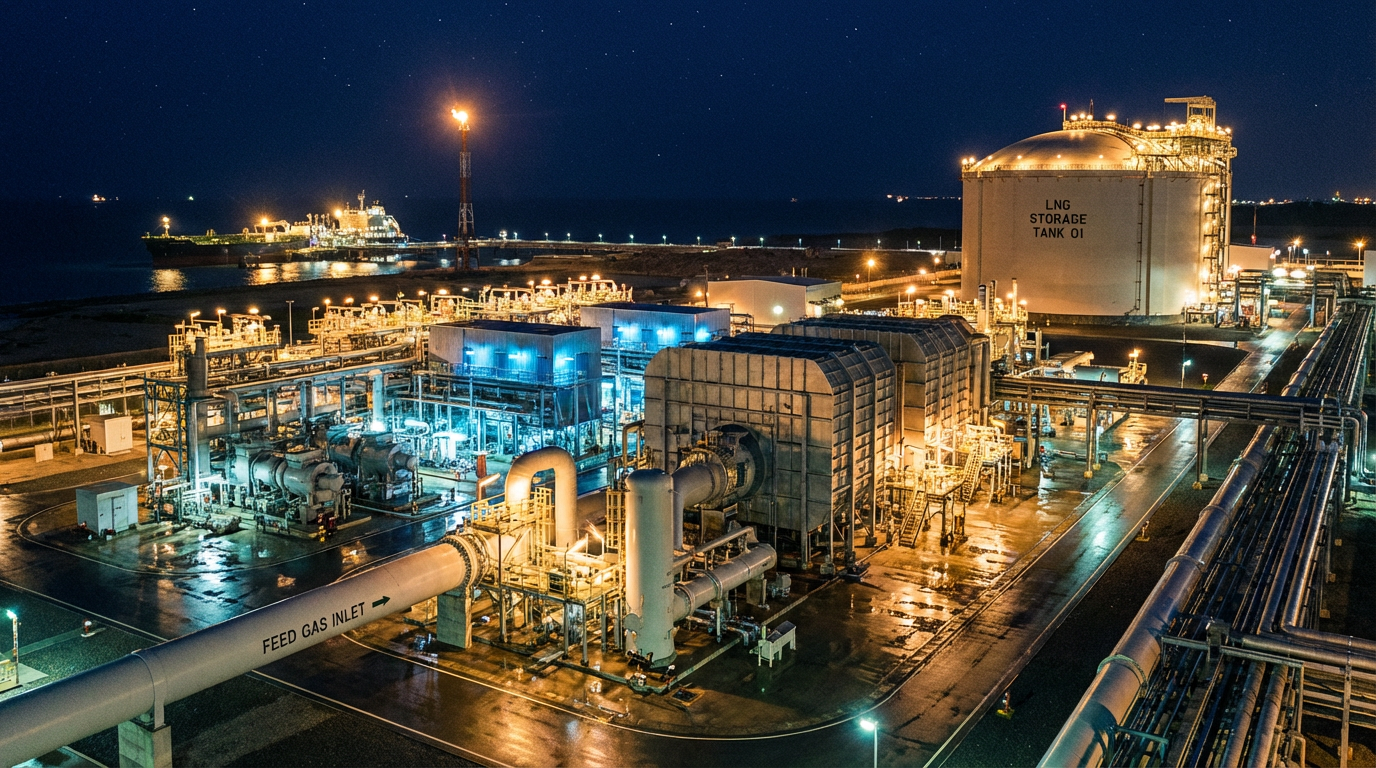
Operations teams that benchmark C3MR trains against peers consistently find a wide spread in specific energy consumption, even between plants running the same licensor technology. That gap translates to millions in annual operating cost, and it’s widening as global LNG export capacity is projected to increase by nearly 50% by 2030. More trains competing on margin means the spread between good and great operations matters more than it used to.
Every LNG operations leader knows the C3MR flowsheet. Most can sketch the propane loop and mixed refrigerant cycle from memory. But the gap between understanding the process flow diagram and extracting maximum performance traces back to how plants manage their LNG plant operational challenges differently, not which process they chose. Where performance actually diverges is in how the refrigerant system, compressors, and heat exchangers are managed as conditions change.
TL;DR: C3MR Process Performance and Optimization Opportunities
C3MR remains the dominant LNG liquefaction scheme, but plants on the same flowsheet still show large efficiency spreads. That gap traces to how three operational drivers are managed across the train.
Where Refrigerant Management Sets the Performance Ceiling
- Mixed refrigerant composition drifts continuously, and control strategies that reconcile inferred and lab-confirmed composition can reduce corrective instability.
- MCHE fouling degrades approach temperatures gradually; operator compensation for fouling often costs more power than the fouling itself.
How Compressor Operations Drive Power Consumption
- Load distribution based on individual performance curves, not equal sharing, reduces total power on multi-compressor trains.
- Anti-surge recycle is the most common hidden loss, increasing mass flow without increasing useful refrigeration.
The sections below break down how each driver plays out across the train, including how ambient conditions and cross-functional coordination compound or contain these losses.
Where Refrigerant Management Sets the Performance Ceiling
Mixed refrigerant composition drifts continuously rather than degrading in discrete events, and operational data from large-scale LNG facilities shows that tighter composition control can recover meaningful efficiency. The takeaway is staying ahead of drift that moves the system away from the best match to current feed gas conditions, not chasing a single “optimal recipe.”
In practice, drift comes from small leaks, fractionation effects across separators, and the reality that refrigerant makeup decisions are often made with partial information. A lab sample might confirm composition hours later, after multiple operator shifts have already adjusted pressure levels and flows to protect constraints. Most LNG operations teams recognize the pattern: a series of corrective adjustments that each address the most visible symptom without fully resolving the underlying compositional mismatch. Control strategies that continuously reconcile inferred composition, derived from temperatures, pressures, and duties, with lab confirmation can reduce the frequency of these large corrective actions and the instability that follows.
How Fouling Compounds the Problem
The interaction between refrigerant state and MCHE condition is where production efficiency compounds or erodes. Fouling from heavy hydrocarbons, moisture, or particulate solids degrades approach temperature differences gradually, and the resulting throughput reduction often goes unnoticed until cumulative degradation visibly affects production rates. Monitoring approach temperature trends, heat duty reduction, and pressure drop increase can identify cleaning interventions that recover the throughput that fouling silently erodes.
The more consequential loss is often the compensation, not the fouling itself. When warm-end pinch starts to tighten and subcooling margin shrinks, operators compensate by pushing refrigerant conditions harder. Warm-end temperatures get held down by adding mixed refrigerant flow rather than addressing the underlying heat transfer limitation. Compressor power increases first, then LNG rate starts to fall as drivers hit limits. And that sequence can persist for weeks before anyone connects the hidden cost of throughput rate to exchanger condition rather than normal process variability.
How Compressor Operations Drive Power Consumption
Refrigerant compressors consume the majority of a C3MR train’s power. Well-maintained centrifugal compressors achieve high isentropic efficiency at design point, but off-design operation and progressive fouling can erode performance annually without proactive intervention.
The most common hidden loss is anti-surge recycle: when valves crack open, mass flow through the compressor increases without producing useful refrigeration. On the board, operators see stable suction pressure and steady cold-end temperatures. But the train is effectively paying for internal circulation. The effect can be self-reinforcing: higher recycle heats suction gas, reducing available head, and the control system pushes speed or guide vanes harder to compensate. Across a full operating year, recycle losses alone can account for more of the SEC gap than most operators would expect.
Where Load Distribution Creates Opportunity
Load distribution across parallel compressors represents one of the largest power reduction opportunities on multi-compressor trains. When machines share load evenly regardless of individual performance curves, power is wasted. Optimizing distribution so each compressor operates closer to its best efficiency region reduces total power while improving stability around surge boundaries.
The plants that do this well treat load distribution and maintenance as connected decisions: a compressor with clean internals and healthy seals doesn’t have the same optimal operating point as the same machine after months of fouling. This type of plantwide process control, where compressor scheduling reflects real-time equipment condition rather than fixed rules, is what separates top-quartile trains from the average.
Why Turndown Makes These Losses Worse
The efficiency spread between C3MR plants is often widest during reduced-rate operation, not at stable full throughput. Turndown scenarios are common: a driver under maintenance, feed gas shortfalls, downstream tank management constraints, or partial derates during hot weather.
Fixed control strategies that work acceptably at nameplate can become actively wasteful at reduced rates because the relationship between refrigerant circulation and useful cooling changes nonlinearly with throughput. At reduced rates, refrigerant circulation stays disproportionately high relative to LNG production, and anti-surge recycle tends to increase. Both effects compound the SEC penalty.
The plants that maintain efficiency through rate changes treat turndown as a distinct operating regime with its own energy optimization targets: adjusted circulation targets, rebalanced compressor load splits, and revised constraint boundaries that reflect actual equipment availability rather than full-train assumptions.
Why Ambient Conditions Compound Across the Train
Ambient temperature changes how easily the refrigeration system can reject heat, and the effect reaches both loops simultaneously.
Cooler ambient generally helps: condenser performance improves, required compression ratios drop, and driver margin opens up for additional throughput or efficiency.
Hot conditions push the opposite direction. Propane condensing pressure rises, mixed refrigerant compressor suction conditions drift, and cold box approach temperatures tighten.
The constraint is that effective responses in one loop often create trade-offs in the other. Increasing propane circulation can stabilize pre-cool when condensation is marginal, but it steals power from the mixed refrigerant side where the marginal refrigeration may be more valuable. And shifting mixed refrigerant to slightly heavier composition can protect cold-end temperatures, but it also increases required head and worsens compressor surge margin.
When Seasonal Adjustments Help and When They Backfire
Seasonal composition adjustments can make a real difference when managed systematically: increasing lighter MR components during colder periods and heavier components during hot weather, paired with broader industrial energy efficiency strategies that address refrigerant management alongside compressor loading and exchanger condition.
The net effect of uncoordinated responses to ambient swings, where each adjustment addresses one constraint while inadvertently worsening another, can cost more in SEC than the ambient change itself. That’s why managing the full set of trade-offs benefits from proactive coordination that treats refrigerant adjustments, compressor operating points, and inlet air cooling strategies as parts of the same operating decision.
Coordinating Decisions Across the Train
When maintenance, operations, and planning teams each optimize their own slice of the C3MR train independently, the interactions between refrigerant composition state, compressor scheduling, and MCHE fouling trends go unmanaged. A shared process model that tracks these interactions simultaneously gives each team visibility into how their decisions affect the others. Maintenance timing can account for current refrigerant inventory. Production targets can reflect actual equipment condition rather than design-basis assumptions, which often persist months after conditions have changed.
The seasonal planning scenario illustrates the stakes: planning pushes for peak summer throughput based on nameplate capacity, while operations already see propane condenser approach tightening and mixed refrigerant recycle increasing. Maintenance defers a compressor wash because the train is “still meeting rate,” even though the cost is showing up as higher SEC.
A shared model makes the trade-off explicit, so teams can agree on whether to spend the margin on power, maintenance time, or reduced rate. That kind of human AI collaboration gives each function the full picture rather than isolated slices.
How Data-First Models Close the Gap
These interacting variables exceed what any operator can continuously optimize across a full shift, even with decades of board experience. The plants closing that performance gap supplement experienced operator judgment with real-time adaptive control built from the plant’s own operating data, not idealized physics or generic models. That distinction matters: a model trained on how a specific train actually behaves, including its fouled exchangers, aging compressors, and real feed composition variability, captures process dynamics that first-principles simulators typically don’t.
These systems typically operate in advisory mode first, recommending setpoint optimization changes that operators evaluate against their own process knowledge before any automated execution begins. The advisory phase delivers standalone value well before any closed loop execution begins: operators can run what-if scenarios against competing constraints, and the same recommendations go to every shift, reducing the variability that comes from different crews managing the same trade-offs differently.
Trust builds through demonstrated accuracy on the specific train, especially the difficult cases like hot afternoons, feed composition swings, and partial equipment derates. Operators retain full authority to accept, modify, or reject each recommendation, and constraint boundary management layers ensure the system respects safe operating limits at all times.
Closing the C3MR Performance Gap
For operations leaders managing C3MR trains where the gap between current performance and top-quartile benchmarks translates to millions in annual value, Imubit’s Closed Loop AI Optimization solution (Closed Loop AI Optimization) addresses exactly these interacting constraints: refrigerant drift, fouling compensation, compressor recycle losses, ambient trade-offs, and the coordination gaps between teams.
The system learns from a plant’s own historical operating data to build a dynamic model of the liquefaction process, then writes optimal setpoints in real time across compressor loading, refrigerant management, and heat exchanger operation. Plants typically begin in advisory mode before progressing to closed loop optimization as operator confidence builds, continuously capturing efficiency that manual adjustments miss.
Get a Plant Assessment to discover how AI optimization can close the performance gap on your C3MR liquefaction trains.
Frequently Asked Questions
Why is mixed refrigerant composition so difficult to optimize manually in C3MR plants?
Mixed refrigerant composition drifts continuously rather than changing in discrete steps, so periodic rebalancing is always playing catch-up. The optimal blend depends on current ambient temperature, feed gas composition, compressor performance state, and MCHE fouling condition, all of which can shift throughout a single operating day. Adjusting one component ratio affects thermodynamic performance across the entire cryogenic range, creating interactions that are difficult to track manually. AI optimization can manage that complexity with continuous process control and adjustment.
Can AI optimization work alongside existing advanced process control on LNG liquefaction trains?
Yes. Many sites layer AI optimization on top of existing advanced process control and distributed control system infrastructure rather than replacing it. APC handles fast-acting regulatory control while AI optimization addresses slower, higher-level decisions like refrigerant composition targets, compressor load distribution, and constraint boundary management. This separation of roles can reduce operator workload during upsets while keeping operators in control of whether recommendations get applied.
What metrics should operations leaders track to benchmark C3MR train performance?
Specific energy consumption (SEC), measured in GJ per ton of LNG produced, is the primary benchmark because it captures the combined effect of compressor efficiency, exchanger condition, and operating decisions. Beyond SEC, track seasonal derating patterns to understand ambient temperature effects, compressor isentropic efficiency to catch degradation early, and MCHE approach temperatures to detect fouling trends before they visibly affect production. These operational efficiency metrics together provide the clearest picture of train health.