Energy costs represent up to 50% of production costs in energy-intensive process industries, according to the International Energy Agency. For plant managers navigating tightening regulatory requirements, that ratio creates a daily tension: compliance is non-negotiable, yet every dollar spent on regulatory reporting and monitoring infrastructure is a dollar not spent improving operations. Converging federal deadlines, state-level carbon pricing, and an escalating EU Carbon Border Adjustment Mechanism are turning energy compliance from a periodic audit exercise into a continuous operational constraint.
The real question is how to build compliance infrastructure so it strengthens operations rather than draining them.
TL;DR: Energy Compliance Essentials for Process Industry Plant Managers
Tightening regulations demand continuous monitoring, automated reporting, and audit-ready data. AI optimization addresses these requirements while improving performance.
Where Conventional Compliance Falls Short
- Less than 10% of installed advanced process controls remain active over time, leaving gaps as scrutiny intensifies
- Fragmented data systems and manual workflows compound costs; siloed approaches cost 20–25% more than integrated alternatives
- Compliance spans operations, EH&S, and finance, yet few plants have visibility to manage it as one function
How AI Optimization Aligns Compliance with Performance
- Continuous sensor analysis detects compliance risks before violations occur, so reactive audits give way to proactive intervention
- Automated data collection produces audit-ready records without manual compilation
- Efficiency improvements reduce emissions intensity proportionally; every optimization investment serves dual purposes
Here’s what compliance demands today and how to meet those demands without losing margin.
The Control Gap Behind Most Compliance Exposure
The most overlooked compliance risk in process operations is degraded control systems. In some industrial settings, less than 10% of installed advanced process control (APC) systems remain active and properly maintained over time. Control systems degrade as process conditions change, tuning parameters drift, and the engineers who configured them move on. That decay creates compliance exposure precisely when regulatory scrutiny intensifies: facilities that cannot demonstrate active, optimized controls face increasingly difficult audit conversations.
This degradation compounds the already substantial overhead of modern compliance. Carbon pricing mechanisms now span multiple jurisdictions, each with distinct monitoring, reporting, and verification requirements. A large facility can face allowance costs reaching into the millions of dollars at prevailing carbon prices, before accounting for the infrastructure required to demonstrate compliance. And those costs trend in one direction as regulatory ambition tightens.
Compliance readiness in this environment rests on continuous monitoring of energy consumption and emissions-related parameters across all reportable units, not periodic sampling. It requires automated data collection and validation that produces audit-ready records without weeks of manual compilation. And it demands the ability to demonstrate that process controls are actively maintained and optimized, not just installed. That last requirement is where most plants face their biggest gap, and where compliance and operational performance connect most directly.
Why Fragmented Systems Compound the Cost
When compliance data lives in spreadsheets, plant data systems, and lab records that don’t communicate, assembling a complete picture of emissions performance for any given period requires significant manual effort. The problem compounds across multi-unit facilities where different systems track different parameters on different timelines.
Industry analyses of digital transformations suggest that integrated, digitally enabled operations can lower operational costs by roughly 20–25% compared with more manual, siloed approaches. That figure reflects more than efficiency; it captures the hidden cost of reconciling inconsistent data during audits, correcting reporting errors after submission, and maintaining parallel systems that each tell a slightly different story about the same process. Automation and advanced analytics can reduce these costs while improving the accuracy and consistency that regulators require.
Manual workflows also introduce timing risk. When reporting depends on quarterly compilation rather than continuous collection, facilities discover compliance gaps weeks or months after they occur, with limited ability to correct course. By the time a deviation surfaces in a compiled report, the operating conditions that caused it may have changed entirely, making root cause analysis harder and corrective action less targeted. The shift from periodic to continuous compliance monitoring addresses this gap, but it requires data infrastructure that most fragmented systems cannot support without significant integration work.
How AI Optimization Aligns Compliance with Performance
AI-driven process control addresses these constraints by integrating with existing infrastructure to improve both compliance performance and operational efficiency simultaneously.
Predictive Monitoring and Continuous Compliance Assurance
Rather than identifying violations after they occur, AI optimization continuously analyzes sensor data to flag potential compliance risks before they materialize. This shifts compliance from a reactive model, where teams scramble to explain exceedances after the fact, to a proactive one where potential issues surface with enough lead time to adjust operations. According to Deloitte’s AI analysis, many process industry companies are increasing AI investments specifically in predictive monitoring and real-time emissions tracking. That trend signals broad recognition that reactive approaches no longer meet the pace of regulatory change.
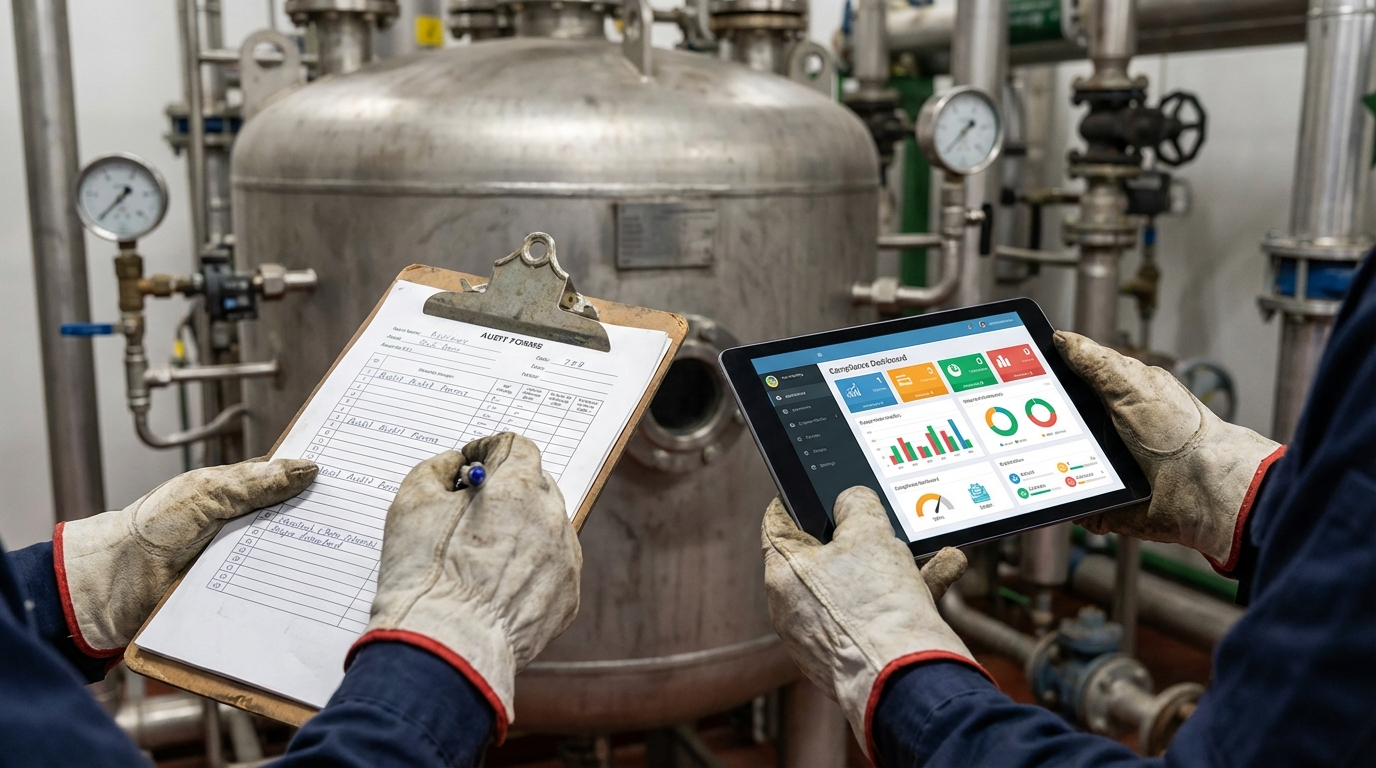
This continuous monitoring also replaces periodic manual audits with ongoing compliance assurance. Rather than spending weeks compiling quarterly reports from disparate data sources across shifts, units, and time periods, AI-powered solutions automate data collection, validation, and documentation. Audit readiness becomes a default state of operations, with compliance dashboards and automated alerts integrated into existing distributed control system (DCS) and SCADA platforms.
Efficiency Improvements That Reduce Emissions Proportionally
The relationship between operational efficiency and emissions performance is direct. Process optimization that reduces energy consumption per unit of output simultaneously reduces emissions intensity. A facility that cuts fuel consumption per unit of throughput improves margins and strengthens its compliance position in the same operational improvement. This reinforcing cycle means efficiency investments serve dual purposes rather than competing for budget, and it holds across energy-intensive operations regardless of the specific process involved.
Who Owns Compliance Performance
One of the less visible constraints in energy compliance is organizational. Compliance performance sits at the intersection of operations, environmental health and safety (EH&S), and finance, but few plants have structures that reflect this reality. The result is that reasonable decisions made by one function can quietly create compliance exposure for another.
Consider a common scenario: operations pushes throughput to meet production targets, which increases energy intensity per unit. EH&S flags the resulting emissions increase during the next reporting cycle. Finance, evaluating allowance costs after the fact, questions why energy spend exceeded forecasts. Each function made a reasonable decision within its own frame, but the combined result created compliance exposure that none of them saw coming. Similar patterns emerge during maintenance scheduling, when delaying equipment service to protect uptime increases energy consumption in ways that only become visible during emissions reporting. Or during feedstock changes, when operations optimize for yield while the resulting emissions profile creates reporting complications that EH&S discovers weeks later.
Effective compliance management requires cross-functional visibility into how operational decisions affect emissions performance and regulatory costs. When a single shared model connects energy consumption, process performance, and emissions output, teams can evaluate trade-offs together rather than discovering conflicts during audit preparation. A maintenance team can see how deferring a turnaround affects both equipment reliability and emissions trajectory. Operations can weigh throughput targets against their compliance implications in real time rather than after the reporting period closes. This coordination doesn’t require reorganization. It requires transparency into how operational variables connect to compliance outcomes, and a common reference point for evaluating decisions that cut across functions.
Building the Business Case for Compliance Technology
For plant managers evaluating compliance technology investments, the economics have shifted. BCG-WEF climate research found that 82% of surveyed companies reported economic benefits from decarbonization, with some reporting net value exceeding 10% of annual revenue. Energy efficiency improvements that cost less than current carbon allowance prices represent the economically rational path. That means compliance-driven efficiency upgrades can often be justified on operational performance alone, with regulatory adherence as an additional benefit rather than the sole justification.
The implementation path matters as much as the investment case. Plants that start in advisory mode, where AI flags compliance risks and recommends operating adjustments that operators evaluate before acting, build the organizational confidence required for broader deployment. This stage alone typically delivers measurable efficiency improvements while establishing the data infrastructure and governance practices that compliance demands. For many plant managers, advisory-mode deployment addresses the most acute pain point first: reducing the manual burden of monitoring and reporting.
As trust develops, industrial AI can begin executing approved adjustments within defined parameters, then progress toward continuous optimization within compliance boundaries. Each stage delivers compliance value independently. Advisory mode provides monitoring and decision support. Supervised automation adds predictive energy optimization while preserving operator control. Full closed loop operation represents the culmination of this progression, not a prerequisite for meaningful improvements. Organizations move at their own pace based on their operational comfort, internal capabilities, and strategic objectives.
Turning Compliance into Operational Advantage
For process industry leaders seeking to meet energy compliance requirements while protecting operational margins, Imubit’s Closed Loop AI Optimization solution learns from actual plant data to write optimal setpoints in real time. The technology addresses the compliance-profitability constraint by reducing energy consumption and emissions while improving throughput, with measurable results across refining, petrochemical, cement, mining, and broader process operations. Plants can start in advisory mode, where operators evaluate AI recommendations and build confidence in the system’s compliance capabilities, then progress toward closed loop optimization as organizational trust develops.
Get a Plant Assessment to discover how AI optimization can help achieve regulatory compliance while reducing energy costs and protecting margins.
Frequently Asked Questions
How does AI optimization handle compliance across multiple regulatory jurisdictions?
AI optimization integrates data from all reportable units into a unified monitoring framework, regardless of which jurisdictions apply. The technology continuously tracks jurisdiction-specific parameters and thresholds, automating documentation for programs with different reporting requirements, timelines, and verification standards. This replaces the manual effort of maintaining separate compliance workflows for each program with a single system that adapts outputs to each jurisdiction’s requirements.
What happens to compliance monitoring when process conditions change unexpectedly?
AI optimization continuously recalibrates its models as operating conditions shift, maintaining accurate emissions and energy tracking even during feedstock changes, equipment degradation, or seasonal adjustments. Unlike fixed-parameter traditional control systems that lose accuracy when conditions drift from their tuning baseline, AI models learn from ongoing plant data and flag compliance risks before deviations become reportable events.
How long does it take to see compliance improvements after deploying AI optimization?
Plants implementing AI-driven process control typically observe measurable compliance improvements within the first few months of deployment. Initial benefits emerge from automated monitoring and reporting capabilities that reduce manual burden immediately. Deeper improvements in emissions reduction and energy efficiency develop as the system learns plant-specific operating patterns and identifies optimization opportunities that manual analysis would miss.