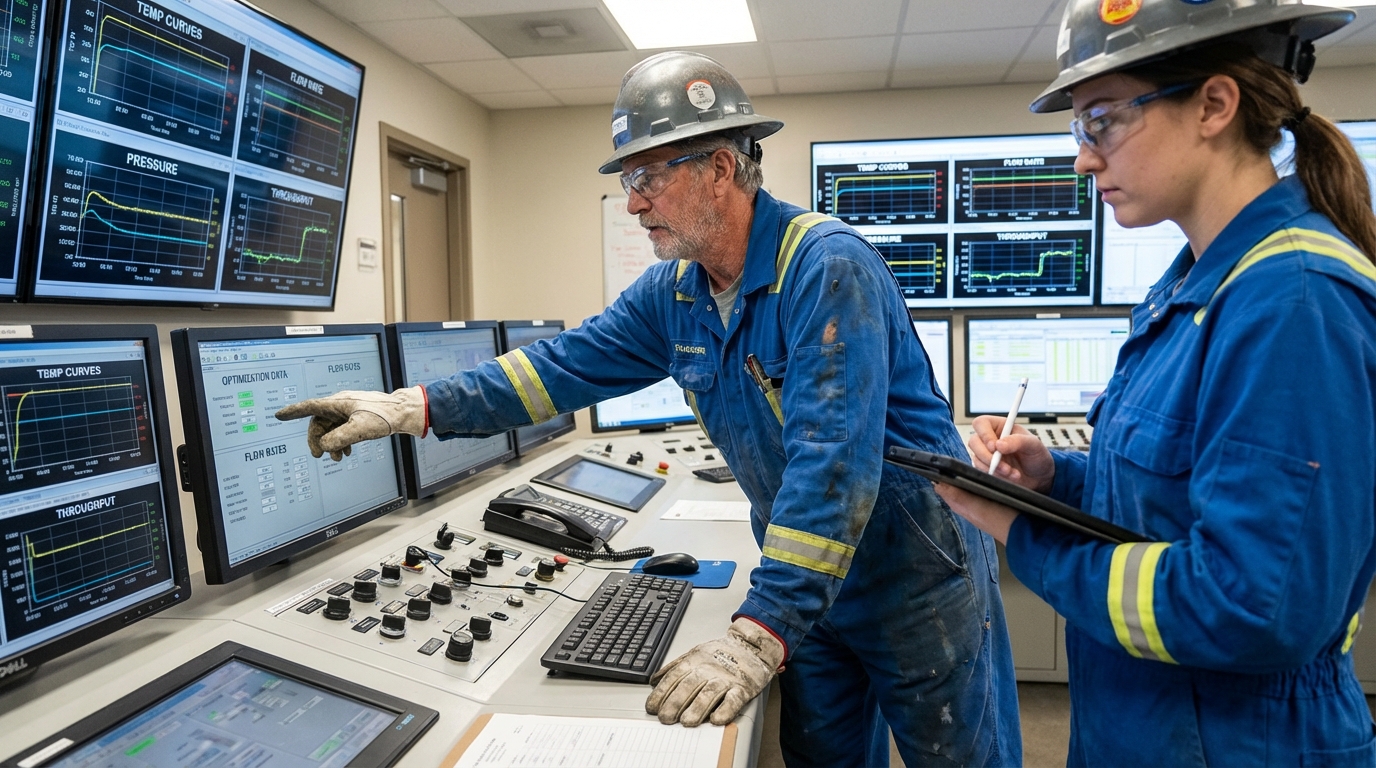
Every shift, experienced operators make hundreds of judgment calls that keep units running safely and efficiently. They adjust for equipment quirks that never made it into the operating manual. They recognize subtle pattern changes that precede upsets. They carry decades of institutional knowledge that determines whether a facility runs at 85% efficiency or 95%.
Now consider this: McKinsey estimates that as many as 400,000 energy-sector employees in the United States, including oil and gas, are approaching retirement in the next ten years, roughly one in four workers in the sector. At the same time, the share of employees with less than two years of tenure has declined over the past decade, indicating a reduced inflow of new talent during a period when operational complexity continues to increase.
The question facing operations leaders is no longer whether to adopt AI, but how to deploy it in ways that capture expert knowledge before it walks out the door while empowering the next generation of operators to perform at levels that took their predecessors decades to achieve.
TL;DR: How to Adopt AI in Oil and Gas by Empowering Your Workforce
AI adoption in oil and gas succeeds when it is implemented as a workforce initiative, not only a technology deployment.
Why Workforce Readiness Determines Success
- The biggest adoption constraint is often organizational readiness rather than technology, spanning workforce skills, data infrastructure, and change management
- When experienced operators retire, the organization loses pattern recognition refined across thousands of upsets and transitions
- AI trained on plant data can preserve those operating patterns and accelerate new-hire competency
How to Build a Sustainable Implementation Path
- Operator co-development from the design phase creates ownership rather than resistance
- Phased deployment starting in advisory mode lets operators validate recommendations before granting control
- Cross-functional teams combining operations, engineering, and planning align around a shared model
Here’s how these strategies work in practice across oil and gas operations.
Where AI Adoption Is Gaining Traction in Oil and Gas
AI adoption in oil and gas is concentrating in operations where process complexity outpaces what traditional control approaches can handle. Refining, gas processing, and LNG production involve hundreds of interacting variables that shift with feedstock quality, ambient conditions, and equipment state. These nonlinear, tightly coupled systems are where AI optimization can extend beyond the scope of traditional advanced process control (APC) by learning relationships from actual plant data that physics-based models and linear approaches miss.
According to McKinsey research, operators that have applied AI in industrial processing plants have reported 10–15% production increases and 4–5 percentage point EBITA improvements. But those numbers tell only part of the story. Deloitte research found that only 25% of organizations have moved 40% or more of their AI pilots into production, with both organizational readiness and technical factors limiting scaling. Most AI initiatives in oil and gas stall not because the technology fails, but because the workforce surrounding it was not prepared.
Why Workforce Readiness Determines Adoption Success
The demographic constraint facing oil and gas is well documented, but its implications for AI adoption are less understood. When a 30-year veteran retires, the organization loses pattern recognition abilities refined across thousands of process upsets, equipment failures, and optimization opportunities. This knowledge rarely exists in documented form, and a large share of the workforce occupies physically and mechanically intensive roles where hands-on experience compounds over years in ways that manuals and classroom training cannot replicate.
That gap compounds the AI adoption constraint. New operators lack the experience to evaluate AI recommendations critically, while the experienced operators who could validate and improve AI models are the same ones approaching retirement. Traditional training approaches cannot bridge this gap at the required pace; new operators need years of mentorship to develop the intuition that AI-assisted decision-making can accelerate.
The constraints to adoption are predictable. The “black box” problem leads operators to default to their own judgment when they cannot understand why AI recommends a particular action. Misaligned expectations between leadership and front-line operations create friction: executives evaluate AI on ROI projections, while operators evaluate it on whether it helps them run the unit safely. And insufficient change management causes adoption to stall even when the technology performs well.
According to BCG research, oil and gas companies that pair technology deployment with workforce upskilling and structured change management are better positioned to capture AI value than those treating AI as a purely technical initiative. AI deployed without workforce readiness consistently underperforms relative to its potential.
How AI Preserves Knowledge and Accelerates Competency
The workforce case for AI adoption goes beyond automation. When AI models are trained on historical plant data, they capture the operating patterns that experienced operators have refined over decades. Those patterns, which would otherwise leave with each retirement, become embedded in the model and accessible to every operator on every shift.
For new hires, this changes the learning curve entirely. Instead of requiring years of mentorship before developing reliable process intuition, operators can interact with dynamic process simulators and AI recommendations from day one. They learn why certain setpoints are optimal under specific conditions and build judgment through guided experience rather than trial and error. The AI functions less like an autopilot and more like a mentor that never retires.
The practical benefits extend across daily operations:
- Real-time decision support. AI surfaces process relationships that would take hours to identify manually. This gives operators better energy management visibility and faster troubleshooting during complex operating conditions.
- Shift-to-shift consistency. Rather than performance varying based on who is on the console, data-first recommendations provide a common baseline that raises the floor across all experience levels.
- Faster response during critical events. During upsets or transitions, AI handles data synthesis while operators focus on judgment calls. Response quality improves precisely when stakes are highest.
Operator authority is preserved throughout. AI provides recommendations; operators maintain decision rights and override capabilities. When operators feel their expertise is valued rather than threatened, trust builds naturally. Operators at facilities using AI optimization have described the experience as engaging, even enjoyable, because the technology gives them a deeper window into process behavior while respecting their role as final decision-makers.
Building the Workforce-Specific Business Case
The traditional business case for AI in oil and gas focuses on throughput, energy, and quality improvements. Those returns are real, but they understate the value for organizations facing workforce constraints.
The most immediate dimension is reducing onboarding risk. When the best console operator on the night shift retires next quarter, the productivity gap shows up immediately in conservative setpoints, slower responses to upsets, and higher shift-to-shift variability. AI-enabled training compresses the timeline for new operators to reach proficiency, directly reducing operating risk and margin loss during workforce transitions.
Beyond onboarding, AI also preserves organizational knowledge as a durable asset. When experienced operators leave, their knowledge typically leaves with them. AI models trained on plant data capture those operating patterns in a form that persists regardless of staffing changes and improves as the model learns from ongoing operations.
The value also compounds through cross-functional alignment. A single AI model accurate enough for plant optimization gives operations, maintenance, engineering, and planning a shared view of process behavior and trade-offs. When maintenance can see how a scheduling decision affects throughput, and operations can see how a setpoint choice affects equipment health, decisions improve for the organization rather than just one function.
Implementation Strategies That Build Lasting Adoption
Successful AI adoption in oil and gas follows consistent patterns. Organizations achieving sustained results share common implementation approaches that address technology, people, and process together.
Start with Operator Co-Development
Operator co-development is often one of the highest-impact strategies for adoption. Including front-line operators from the beginning through structured feedback sessions, operator-led validation of model behavior, and train-the-trainer models creates ownership rather than resistance. Organizations that engage operators early in tool design consistently report higher adoption rates and faster realization of value.
Deploy in Phases with Clear Advancement Criteria
Initial advisory mode delivers real value while building organizational confidence. Operators test recommendations against their process knowledge, verify the system’s reasoning, and develop trust through direct experience rather than executive mandate. Returns accrue at each stage rather than being back-loaded to full automation. Some operations choose to remain in advisory mode indefinitely; in many of these cases, the organization still realizes meaningful returns from enhanced visibility, faster troubleshooting, and improved decision consistency across shifts.
Build Cross-Functional Implementation Teams
Teams combining operators, process engineers, control engineers, and planning staff deliver faster results than siloed technology deployments. The cross-functional structure aligns the different criteria by which each group evaluates success and ensures the AI model reflects operational realities that no single function sees completely.
Measure What Matters for Adoption
Standard production metrics alone cannot tell whether AI adoption is taking hold or merely being tolerated. Track adoption metrics like the percentage of personnel actively using AI tools, alongside business impact metrics and cultural indicators like operator-initiated improvement suggestions. The distinction matters: high utilization numbers paired with low operator engagement signal compliance, not genuine adoption.
From Knowledge Crisis to Competitive Strength
For operations leaders navigating workforce transitions while pursuing operational excellence, Imubit’s Closed Loop AI Optimization (AIO) solution offers a path forward. The technology learns from actual plant data to understand unique operational patterns, then writes optimal setpoints in real time, giving operators better visibility and decision support across every shift. A single AI model serves optimization, operator training through dynamic process simulators, and cross-functional collaboration, so the value extends well beyond any individual use case.
Plants can start in advisory mode, where operators build confidence in the system’s understanding of their specific operations. As trust develops, progression toward closed loop optimization captures increasing value while maintaining operator authority throughout the journey.
Get a Plant Assessment to discover how AI optimization can strengthen your workforce and preserve critical operating knowledge before your experienced operators retire.
Frequently Asked Questions
How long does it typically take to see results from AI adoption in oil and gas?
Many implementations begin delivering measurable value within the first several months, particularly when initial deployments target well-understood optimization opportunities. The full trajectory unfolds over subsequent operating cycles as AI-driven control learns plant-specific patterns and workforce adoption deepens. Organizations that pair technology deployment with operator training and change management tend to accelerate this timeline.
Can AI optimization preserve institutional knowledge from retiring operators?
Yes. When AI models learn from years of historical plant data, the operating patterns that experienced staff have refined become embedded in the system rather than residing solely in individual expertise. These models become dynamic training tools for incoming operators, allowing new hires to interact with process simulations grounded in real operational history before they take the console in real-time operations.
What role do operators play when AI optimization is deployed?
Operators remain central to decision-making throughout the AI adoption journey. In advisory mode, operators evaluate AI recommendations against site-specific conditions before taking action. Even in closed loop operation, operators maintain override authority and define the safe operating boundaries within which AI operates. The most successful implementations treat AI as a tool that enhances operator capability rather than substituting for human judgment.