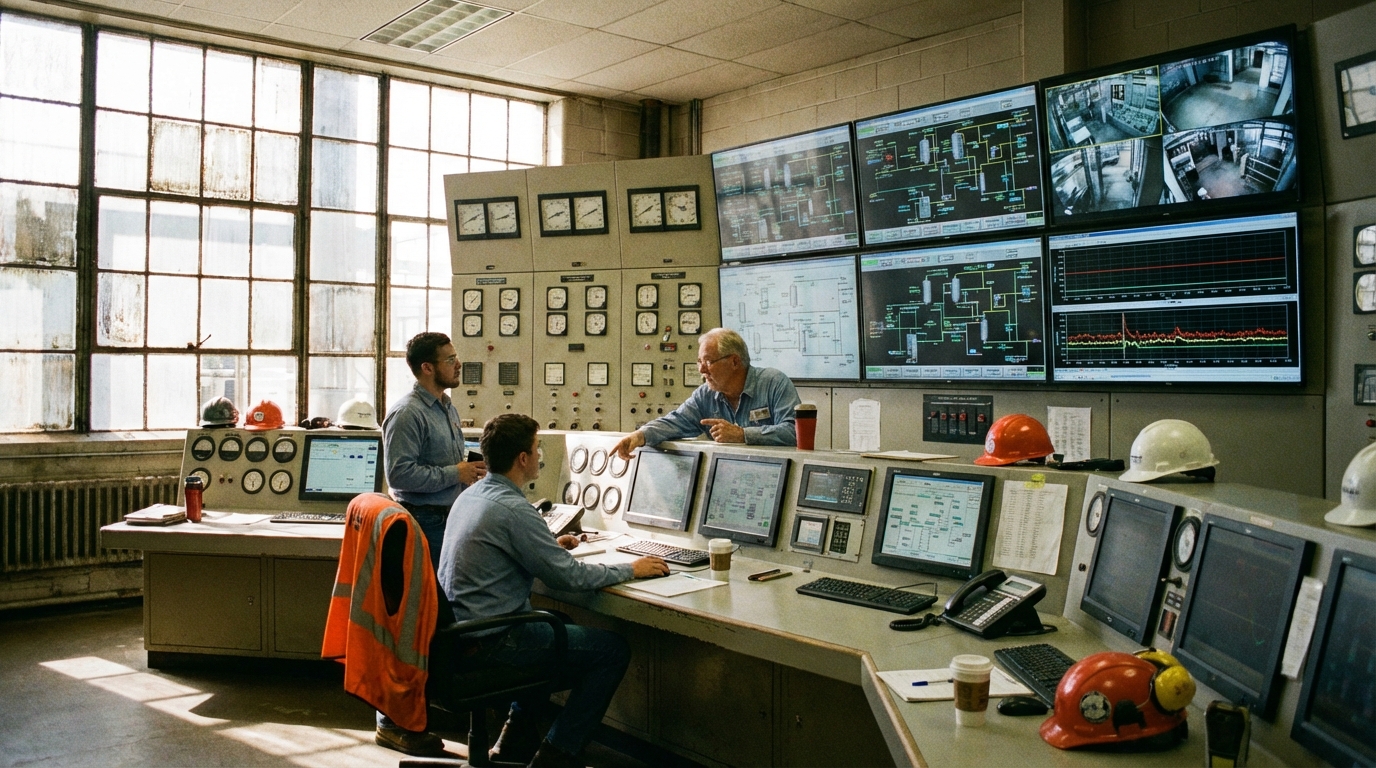
Every operations leader recognizes the moment: standing in a control room surrounded by screens displaying thousands of data points, yet still relying on spreadsheets and institutional memory to make critical decisions. The data streams are there, thousands of measurements captured every second, yet the gap between having data and using it effectively remains a defining constraint for most operations.
This constraint is particularly acute in process industries: refineries, petrochemical complexes, chemical plants, and other continuous operations where raw materials flow through large-scale thermal and chemical transformations. These environments generate enormous volumes of process data, but translating that data into optimized setpoints has historically required significant engineering effort and manual intervention.
Digital transformation initiatives across industries often face implementation constraints, with McKinsey estimating that roughly 70% of large transformations do not fully achieve their objectives. Bridging this gap between available data and actionable intelligence represents both the core constraint and the primary opportunity facing process industries today.
TL;DR: How AI Optimization Enables Process Manufacturing Digital Transformation
AI optimization bridges the gap between available plant data and actionable intelligence by learning from operational patterns and recommending or adjusting setpoints in real time. Unlike traditional APC models that degrade as conditions change, AI-driven approaches adapt continuously. Plants can start in advisory mode, capturing value from day one, then progress toward closed loop optimization as trust builds.
What Makes 2026 Different for Process Industries
The pressures converging on process industries in 2026 differ in both intensity and combination from previous years.
Energy costs and ESG requirements are reshaping operating economics. Industrial energy efficiency is now subject to more stringent regulatory requirements across major economies. Carbon-intensity targets and emissions reporting obligations mean that energy optimization is no longer just a cost play; it directly affects regulatory compliance and license to operate.
Supply chain volatility has become a planning assumption. Feedstock availability, quality variations, and demand shifts require operations that can adapt quickly. Control strategies designed for stable conditions struggle when the operating envelope changes continuously.
The workforce constraint has shifted from abstract concern to operational reality. Experienced operators are retiring faster than organizations can develop replacements. Institutional knowledge accumulated over decades walks out the door, leaving control rooms staffed by teams with less experience navigating complex upset conditions.
These pressures arrive as AI capabilities have matured beyond pilot projects. Deloitte’s 2026 Manufacturing Industry Outlook reports that 80% of manufacturers plan to allocate at least 20% of their improvement budgets to smart manufacturing initiatives, with a focus on automation, analytics, and AI. The technology is no longer experimental. The question is whether organizations can deploy it effectively.
For process industries specifically, this means moving beyond dashboards that display information toward systems that act on it. The distributed control systems (DCS) and advanced process control (APC) solutions that served plants reliably for years were designed for a different operating environment. They excel at maintaining steady-state operations within defined parameters but require significant engineering effort to adapt when objectives multiply and conditions shift continuously.
Why Traditional Automation Reaches Its Limits
Traditional control architectures follow a hierarchical logic. Basic regulatory control handles second-to-second adjustments. APC layers on top to coordinate multiple loops and push operations toward constraints. Optimization engineers periodically review performance and adjust targets based on economic conditions. This structure works, but it contains inherent limitations that become more apparent as operational complexity increases.
Static models decay over time. Conventional APC implementations commonly rely on linear models built during specific operating conditions. As equipment ages, feedstock varies, or process conditions shift, these models drift from reality. Maintaining them requires engineering time and expertise, with APC maintenance representing a continuous requirement to remain effective.
Optimization often happens in silos. In many plants, different units optimize independently, missing opportunities that exist across process boundaries. A decision that improves one unit’s efficiency might create constraints downstream that cost more than the upstream improvement.
Response to disturbances remains reactive. Traditional systems respond to deviations after they occur. By the time a quality excursion is detected, off-spec material has already been produced.
Constraint management stays conservative. Operators understandably build in safety margins when pushing toward constraints. Over time, these margins compound, leaving value uncaptured.
How AI-Powered Process Control Creates New Possibilities
AI optimization approaches plant operations differently than traditional control systems. Rather than relying on first principles models or linear approximations, reinforcement learning algorithms learn directly from operational data, capturing nonlinear relationships, time-varying dynamics, and interactions that resist manual modeling. This data-first approach creates several capabilities that traditional systems cannot match as readily.
Cross-unit coordination. Advanced AI can optimize across unit boundaries, finding global optima that siloed approaches miss. Consider a continuous process plant where upstream reaction conditions affect downstream separation efficiency, which in turn constrains product blending. AI optimization can coordinate setpoints across all three areas simultaneously, capturing value that unit-by-unit optimization leaves on the table.
Predictive constraint management. By learning the relationship between current conditions and future outcomes, AI optimization can anticipate quality excursions, equipment limits, and process upsets before they occur. This enables proactive adjustments rather than reactive responses, reducing off-spec production and avoiding the energy waste of corrective actions.
Economic responsiveness. When energy prices spike, product values shift, or feedstock economics change, AI-powered process control can reoptimize in near real time, capturing value that manual adjustments would miss.
Energy and emissions optimization. As ESG requirements tighten and energy costs remain volatile, AI optimization can identify operating points that reduce specific energy consumption while maintaining throughput. Industry benchmarks suggest that plants implementing AI-driven optimization can achieve energy reductions in the range of 3–7% and yield improvements of 1–3%, depending on baseline conditions and optimization scope. This supports sustainability targets without sacrificing productivity.
Continuous Learning and Operational Impact
Unlike static models that degrade over time, AI optimization can be designed to learn from new operational data and adapt as conditions change. This reduces the amount of manual retuning required compared with static models, provided appropriate monitoring and governance are in place.
This adaptive capability addresses one of the fundamental limitations of traditional APC: model maintenance. Engineering teams often spend considerable effort rebuilding or adjusting linear models that have drifted from reality. AI optimization can reduce this burden by incorporating new patterns more readily, freeing engineering resources for higher-value work.
The practical impact extends beyond efficiency improvements. AI optimization changes how operators interact with their processes. Instead of spending time calculating setpoint adjustments or troubleshooting deviations, operators can focus on exception handling and strategic decisions. The technology handles the continuous computational work while operators retain authority over high-stakes choices. AI does not remove the need for engineering judgment; it changes how judgment is applied.
Building Confidence Through Progressive Deployment
Many organizations can begin capturing measurable improvements early in an advisory deployment, once data quality, integration, and models meet required thresholds. Starting in advisory mode delivers value while building the confidence needed for expanded autonomy.
Advisory mode represents the starting point. AI optimization analyzes plant data and generates optimization recommendations, but operators review and approve every setpoint change. This phase validates model accuracy against real operations, builds operator trust, and captures value while the organization develops familiarity with the technology. Advisory mode is not merely a stepping stone; many organizations find substantial value in enhanced visibility and decision support alone.
During advisory deployment, operators see exactly what the AI recommends and why. They learn where its suggestions align with their own intuition and where it identifies opportunities they might have missed. This transparency transforms skepticism into engagement.
Supervised autonomy follows as confidence builds. AI optimization receives permission to implement certain types of recommendations automatically while operators maintain override authority and receive alerts for changes.
Closed loop optimization represents full deployment, where AI continuously adjusts setpoints in real time while operators monitor performance and intervene when necessary. Even at this stage, the system operates within defined constraints, and operators retain the ability to take manual control instantly.
This progression matters because it addresses the legitimate concerns that operations teams raise about automation. Value accrues at each stage, not just at final deployment.
Preparing the Organization for AI-Enabled Operations
Technology implementation without organizational preparation often presents constraints. Successfully avoiding common implementation obstacles requires deliberate attention to workforce readiness, data foundations, and governance structures.
Workforce development is essential. Operators need enough understanding of how AI optimization works to interpret recommendations appropriately and recognize when model performance degrades. Training programs must address new interaction patterns explicitly, and organizations should create structured ways to capture institutional knowledge before experienced operators retire.
Data readiness improves iteratively. Perfect data is not a prerequisite for starting. Most plants can begin with existing historian and lab data while strengthening data infrastructure in parallel.
Governance and oversight build organizational confidence. Effective implementations establish clear protocols for:
- Model validation cadence and performance monitoring
- Management of change (MOC) procedures for AI system updates
- Cybersecurity and OT security considerations
- Intervention authority and escalation paths
These structures become more important as system autonomy increases, ensuring that AI optimization operates within appropriate boundaries throughout its deployment.
Moving from Understanding to Action
For operations leaders and technology strategists evaluating AI optimization, meaningful progress depends on thorough assessment of current digital capabilities and clear identification of optimization opportunities.
Imubit’s Closed Loop AI Optimization solution learns directly from plant data, identifying optimization opportunities that traditional systems miss, and writes optimal setpoints in real time. The technology uses reinforcement learning (RL) to capture complex, nonlinear process relationships across multiple units simultaneously. Starting in advisory mode and progressing to closed loop operation as confidence builds, the platform provides a clear path from initial assessment to full autonomous optimization while maintaining operator oversight at every stage.
Get a Plant Assessment to quantify potential energy savings, yield improvements, and margin uplift from moving beyond dashboards and traditional APC to AI-driven optimization across your operations.