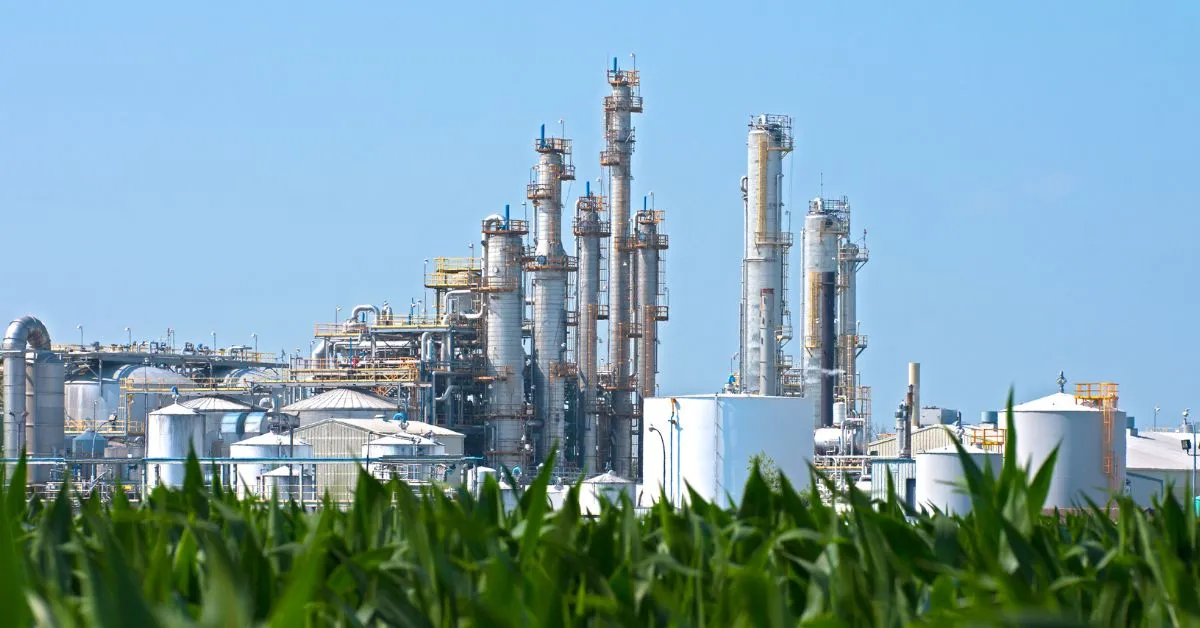
Ethanol producers face intense pressure from variable feedstock quality and high energy costs. This article introduces Closed Loop AI Optimization (AIO), a powerful, data-driven solution that uses industrial AI to continuously learn and autonomously adjust plant operations in real-time. AIO delivers higher yields and cuts energy use in distillation without requiring new hardware, offering a path to greater profit and sustainability for the industry.
Ethanol plants operate in a narrow margin environment where small efficiency differences determine profitability. The U.S. produced a record 16.49 billion gallons of ethanol in 2025, yet rising feedstock costs, volatile energy prices, and tightening carbon intensity requirements continue to squeeze producers.
Most dry mill plants collect thousands of data points every minute across fermentation, distillation, and drying, but traditional process control tools weren't designed to act on that volume of data in real time. The gap between what plants measure and what they can actually optimize represents recoverable margin, and industrial AI is beginning to close it.
Ethanol production follows a well-established process, but the variables that affect yield and energy use shift constantly.
Here's how the process works, where efficiency is lost, and what AI optimization can do about it.
Nearly 90% of U.S. ethanol plants use the dry milling process, a continuous flow operation that converts corn into ethanol, distillers grains, and CO₂ through six primary stages: milling, liquefaction, saccharification, fermentation, distillation, and dehydration.
The process starts by grinding whole corn into flour to expose the starch. That flour is mixed with water, heated, and treated with enzymes that break starch chains into simple glucose sugars. Fermentation is the core conversion step: yeast converts glucose into ethanol and CO₂ over several days, producing a "beer" of roughly 10–15% ethanol by volume.
Temperature, pH, and nutrient availability all influence how completely the yeast converts available sugars.
Distillation separates ethanol from water and solids to approximately 95% purity. Molecular sieves then remove the remaining water to reach fuel-grade purity above 99%. The remaining stillage becomes co-products: distillers grains, corn oil, and captured CO₂. Each contributes to overall plant economics.
Each stage of the process introduces variables that erode yield, inflate energy costs, or create inconsistency between shifts. The constraints aren't mysteries; most plant engineers can point to them. The difficulty is responding to all of them simultaneously, across interconnected process units. When one variable shifts, others follow, and traditional controls aren't built to coordinate the response.
Corn quality shifts seasonally and between suppliers. Starch content, moisture levels, and mycotoxin presence all affect how aggressively yeast ferments. When feedstock quality drops, operators face a choice: push the same fermentation parameters and risk incomplete conversion, or adopt conservative setpoints that reduce throughput rate.
Lab results that measure ethanol concentration and residual sugars typically arrive hours after conditions have already changed. That feedback gap means operators are often adjusting to yesterday's problem while today's has already moved on. And because most traditional controls treat fermentation as a set of independent loops, nothing coordinates temperature, pH, and nutrient dosing as a system.
Thermal energy dominates ethanol plant operating expenses. Steam for starch conversion, distillation, and evaporation accounts for roughly 90% of energy consumed at a typical plant. Natural gas for drying distillers grains adds further cost. Traditional controls maintain fixed setpoints regardless of whether feed alcohol concentration is running higher than normal, ambient conditions have shifted, or utility prices have changed. Every hour those controls hold a static energy profile while conditions drift represents uncaptured savings.
Distillation, evaporation, and drying are thermally coupled, so optimizing one stage without considering the others can simply move the inefficiency somewhere else. A column running at slightly lower reflux might save steam in distillation but push more work onto the evaporators downstream.
Different operators make different judgment calls about the same process conditions. One crew may run fermentation temperatures slightly higher; another may adjust reflux ratios more conservatively. These aren't mistakes; they reflect legitimate differences in experience and risk tolerance. But the variability accumulates into quantifiable yield and energy differences across shifts.
Traditional advanced process control (APC) systems treat each loop independently and miss the interactions between fermentation health, distillation performance, and drying load. A plant can perform well on one shift and leave margin on the table the next, with no systematic way to capture what produced batch-to-batch consistency on the highest-performing runs.
Industrial AI addresses ethanol production constraints differently than traditional controls. Rather than responding to individual variables with fixed rules, AI models learn the complex, nonlinear relationships between hundreds of process variables from a plant's own operating history, not idealized process models, and adjust toward tighter yield and energy targets as conditions change.
Early adopters in industrial processing have reported production increases of 10 to 15%, according to McKinsey.
AI models trained on plant data can identify the combinations of temperature, pH, nutrient dosage, and retention time that produce the highest conversion for a given feedstock quality. Soft sensors built from the same data estimate ethanol concentration and residual sugar levels on a running basis. The hours-long feedback gap between lab samples effectively disappears.
When corn quality shifts, the model adjusts parameters instead of waiting for an operator to notice and react. For plants blending feedstock from multiple sources or receiving shipments with varying moisture content, that speed of response prevents each quality shift from eroding yield.
The result is more consistent fermentation closer to theoretical yield limits, with shorter cycle times that can free capacity without adding vessels.
In distillation, AI balances steam flow, reflux ratios, and column pressure against purity targets to find the optimal setpoint that minimizes fuel consumption while meeting spec. Because the model evaluates hundreds of scenarios in parallel, it can spot opportunities to reduce reboiler duty when feed alcohol runs stronger or when ambient temperatures drop.
Plants can also adjust production around utility price signals. When natural gas costs drop, throughput goes up; when they spike, production scales back.
A shared AI model provides the same optimized recommendations regardless of which crew is operating. Rather than relying on individual operators to recall which parameter combinations produced the best results last week, the model encodes those relationships and enables knowledge transfer across every crew and every handoff.
It identifies what the highest-performing shifts did differently and applies those patterns consistently, whether it's a Tuesday night crew or a Saturday morning handoff. Yield and energy performance tighten across every 24-hour cycle because every shift operates from the same optimized baseline.
Implementing AI optimization in an ethanol plant doesn't require replacing current control infrastructure or committing to full automation from day one. The technology integrates with existing distributed control systems (DCS) and works with existing plant data to build plant-specific models.
Plants don't need perfectly structured data to start; the models learn from operating records and lab data, and their accuracy sharpens as data quality develops.
Most implementations begin in advisory mode. The AI model analyzes real-time conditions and recommends setpoint changes, but operators review and approve each move. This builds trust incrementally. Operators and engineers get a shared, data-grounded view of plant decision-making that makes trade-offs visible across shifts and functions. When senior operators see their own decision logic reflected in the model, something shifts.
The system becomes a tool they trust rather than a black box they tolerate.
No AI model captures every instinct behind a thirty-year veteran's judgment call, but it preserves the observable relationships between process states and the actions that produced good outcomes. As confidence grows, plants can progress toward closed loop control where the AI writes setpoints directly, while operators retain override authority and define safe operating boundaries.
Each stage of the journey produces results, and those results compound as the model learns from more operating data.
For ethanol producers seeking measurable improvements in yield, energy efficiency, and operational consistency, Imubit's Closed Loop AI Optimization solution learns from actual plant operations and writes optimal setpoints to control systems in real time. Plants can start in advisory mode and progress toward closed loop optimization as trust and alignment build across operations, engineering, and planning teams.
Get a Plant Assessment to discover how AI optimization can improve yield and reduce energy costs in ethanol production.
Fermentation efficiency depends on interactions between feedstock quality, yeast health, temperature, pH, and nutrient availability, all of which shift between batches and within a single cycle. Traditional controls address these variables independently, missing the nonlinear relationships between them. AI models trained on a plant's historical data can track these interactions as they develop and adjust parameters to maintain consistent production efficiency even when corn quality changes.
AI optimization layers on top of current distributed control systems and advanced process control infrastructure without requiring equipment replacement. The model reads data from installed sensors and operating records, builds a plant-specific model, and communicates recommended or autonomous setpoint changes through standard plant automation interfaces. Most plants see value without significant capital investment in new instrumentation.
The timeline depends on data quality and scope, but many deployments deliver tangible improvements within months of activation. The model-building phase uses existing manufacturing data to learn from years of operating history. Once deployed in advisory mode, operators can immediately benchmark AI recommendations against current performance. Value accelerates as the plant progresses toward closed loop operation.