The industrial automation market is rapidly adopting AI, expected to reach $378 billion by 2030. Five key AI advances are driving this shift: autonomous control systems, integrated OT/IT data, edge computing for fast analysis, intelligent fault detection, and unified visualization platforms. These technologies work together to deliver higher throughput, reduce costs, and improve reliability in manufacturing, moving beyond fixed logic to adaptive, self-optimizing operations.
The numbers tell a clear story about where plant automation is headed. The global industrial automation market is expected to reach USD 504.38 billion by 2033 and expand at a 10.5 percent compound annual growth rate through 2033. Meanwhile, a recent survey found that a large percentage of surveyed industrial companies are already leveraging AI tools in their operations.
For you, that momentum means AI is no longer an experimental add-on; it's fast becoming the backbone of daily operations, from scheduling to quality control. Fixed, hard-coded logic is giving way to adaptive systems that learn, predict, and self-optimize as conditions shift.
What follows are five AI advances already reshaping front-line operations. Understanding how each technology works and the practical improvements it unlocks will help you prioritize investments that grow profits, boost reliability, and keep your plant ahead of the curve in an increasingly competitive market landscape.
AI-driven plant automation is moving beyond static, rule-based control toward adaptive systems that learn from real plant data and improve continuously.
Here's how each of these technologies works in practice.
For years, front-line operations leaned on traditional advanced process control solutions built around rigid if-then logic. They worked until raw-material quality shifted, demand spiked, or weather threw a curveball.
Today, you can replace those static loops with AI-powered technology that learns from every data point. Instead of following pre-programmed setpoints, a modern autonomous system continuously analyzes historian trends, sensor feeds, and operator feedback to select the most profitable operating conditions in real-time.
The difference is night and day. A rule-based controller is accurate only when conditions match its script. An adaptive AI solution improves every time new data arrives, even in unfamiliar scenarios. This shift translates into tangible business value: companies deploying autonomous systems report up to 30% cost reduction, driven by higher throughput, tighter energy use, and far fewer manual interventions.
Because these adaptive controllers keep units stable under constant variability, they form the foundation for the data integration, edge analytics, and predictive diagnostics explored in the sections that follow.
Modern manufacturing demands more than autonomous control; it requires breaking down the wall between operational technology on front-line operations and enterprise IT.
This convergence creates a single data backbone that feeds both production control and business planning. Unified data streams let you tap real-time sensor feeds alongside work orders, inventories, and energy costs for sharper decisions and faster response.
Every tag, invoice, and maintenance ticket lands in the same data lake, so AI techniques can run cross-domain analytics that predict bottlenecks or optimize run plans on the fly, something traditional silos could never support. This convergence lifts operational efficiency by automating tasks once trapped in isolated systems.
The move isn't risk-free, though. Linking decades-old controllers to corporate clouds expands the cyberattack surface, a threat that increases security vulnerabilities and creates new attack vectors. Technology heterogeneity, proprietary protocols, and organizational splits, OT's bias for availability versus IT's focus on confidentiality and integrity, remain stubborn barriers.
Industry standards like OPC UA and MQTT, combined with secure, segmented networks, help bridge these gaps. The payoff is greater agility: production plans adapt in minutes, not days, and front-line operations gain a real-time view that keeps profit-driving decisions close to the equipment.
While OT/IT integration creates the data foundation, edge computing transforms where and how that data gets processed. Rather than shipping everything to distant cloud servers, edge computing processes data right where it's generated—next to your equipment.
This approach drops response times to single-digit milliseconds, fast enough for robotics, quality checks, and safety systems to react instantly. In high-throughput operations, that speed difference determines whether you catch defects mid-cycle or ship off-spec product.
Your operations stay running even when network connections fail because decisions happen locally before data leaves the facility. Edge platforms filter and compress sensor data, reducing bandwidth costs while still sending key insights to enterprise systems for broader analysis. This local-first approach also strengthens security—keeping sensitive production data on-site reduces breach exposure.
Edge devices routinely run machine learning models that predict bearing failures or detect micro-defects as parts move through production lines. Rather than competing with cloud analytics, distributed processing works alongside it to deliver reliable, immediate decision support across every shift.
Edge computing provides the speed and reliability needed for the next breakthrough: intelligent fault detection. When thousands of sensors stream vibration, temperature, and pressure data every second, machine learning algorithms sift through the noise and identify the one reading that signals trouble ahead.
By learning your plant-specific patterns, these models flag anomalies hours or days before equipment would normally fail, giving you time to intervene on your terms rather than the machine's.
Predictive maintenance forecasts when a pump seal or compressor bearing will cross a failure threshold. Proactive maintenance goes further, automatically retuning set points or recommending process tweaks so the fault never materializes. Together, they create a closed loop of continuous monitoring, early anomaly detection, root-cause diagnostics, and maintenance scheduling that keeps front-line operations steady.
This means fewer emergency callouts, leaner spare-parts inventories, and front-line teams who spend their day interpreting AI insights instead of performing repetitive inspections. The technology augments human expertise rather than replacing it; maintenance engineers still make the final call, but with clearer evidence from platforms that continuously learn from every cycle of operation.
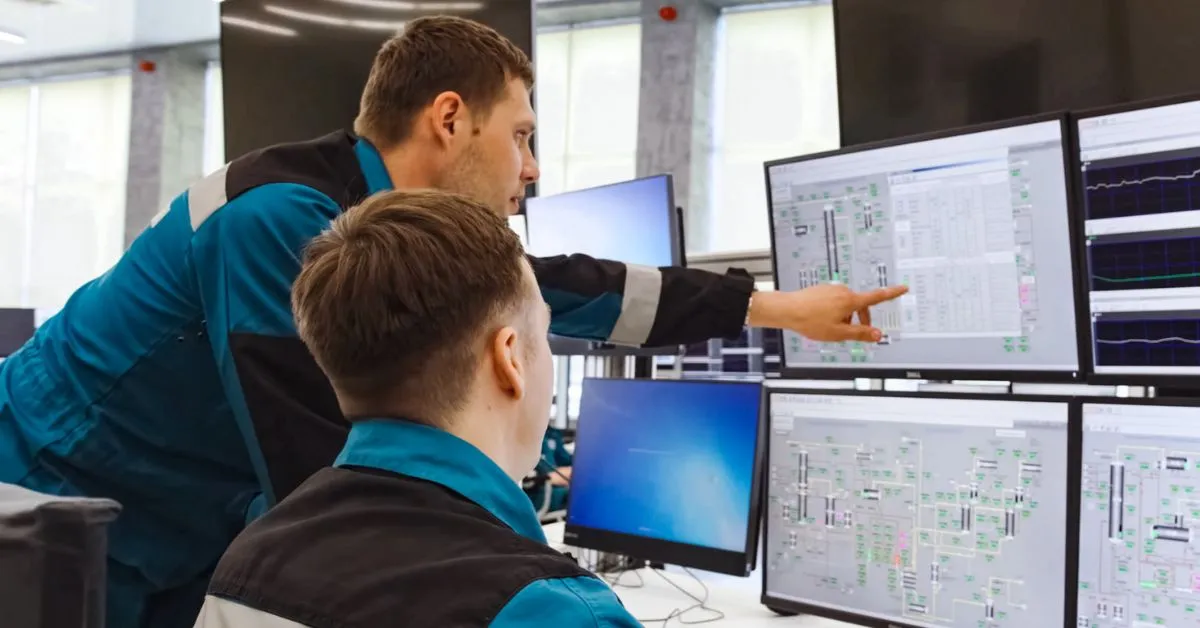
You can't manage what you can't see, which is why unified visualization sits at the heart of modern plant automation. These comprehensive platforms tie together all the technologies we've explored, autonomous control systems, converged OT/IT data, edge analytics, and intelligent diagnostics, into one intuitive command center.
A single dashboard aggregates streaming data from every unit, site, and corporate system, so process industry leaders track production in real time rather than piecing together reports hours later.
Because the platform pulls from operational sensors and ERP databases simultaneously, the same unified information informs engineering, maintenance, and finance decisions. Edge nodes preprocess signals locally, then forward only critical events, maintaining lightning-fast response times while reducing bandwidth requirements.
Role-based views let operators drill into valve temperatures while executives monitor equipment effectiveness from anywhere. Built-in KPI tracking shows how each decision impacts the metrics that drive profitability, while intelligent anomaly detection flags deviations before they escalate, supporting energy and emissions goals alongside throughput targets.
Autonomous process control, OT/IT convergence, edge analytics, AI-powered fault detection, and unified visualization now work together to deliver higher throughput, lower energy use, and steadier quality. The constraints are real: cyber threats, inconsistent data, and a widening skills gap all demand careful planning. But the trajectory is clear, and early adopters are already capturing measurable returns.
For process industry leaders looking to turn these advances into sustained operational results, Imubit's Closed Loop AI Optimization solution offers a practical path forward. The technology learns from actual plant operating data and writes optimized setpoints directly to the distributed control system. Plants can start in advisory mode, capturing value through what-if analysis and cross-shift consistency, then progress toward closed loop optimization as confidence builds.
Get a Plant Assessment to discover how AI optimization can improve throughput, cut energy costs, and strengthen reliability across your operations.
Timelines vary by scope and data readiness, but most plants can begin seeing value within weeks of initial deployment. The process typically starts in advisory mode, where AI models learn from existing plant data and provide optimization recommendations without writing directly to control systems. As confidence builds, teams can progressively expand automation scope. Starting with a single unit and scaling based on results is a common approach that helps manage risk while building AI readiness.
Rule-based systems follow fixed if-then logic programmed for expected operating conditions. When feedstock quality shifts, demand changes, or equipment degrades, those static rules can't adapt. AI-driven automation learns from actual plant operating data and continuously adjusts setpoints to find optimal conditions, even in scenarios the system hasn't encountered before. This adaptability is the core advantage: the system improves with every new data point rather than requiring manual reprogramming.
Yes. Modern AI optimization platforms are designed to integrate with existing distributed control systems, historians, and sensor networks rather than replacing them. The AI layer sits above existing process control infrastructure, reading data from historian systems and writing recommended or optimized setpoints back to the control system. Plants don't need a full infrastructure overhaul to begin capturing value from AI-driven automation.