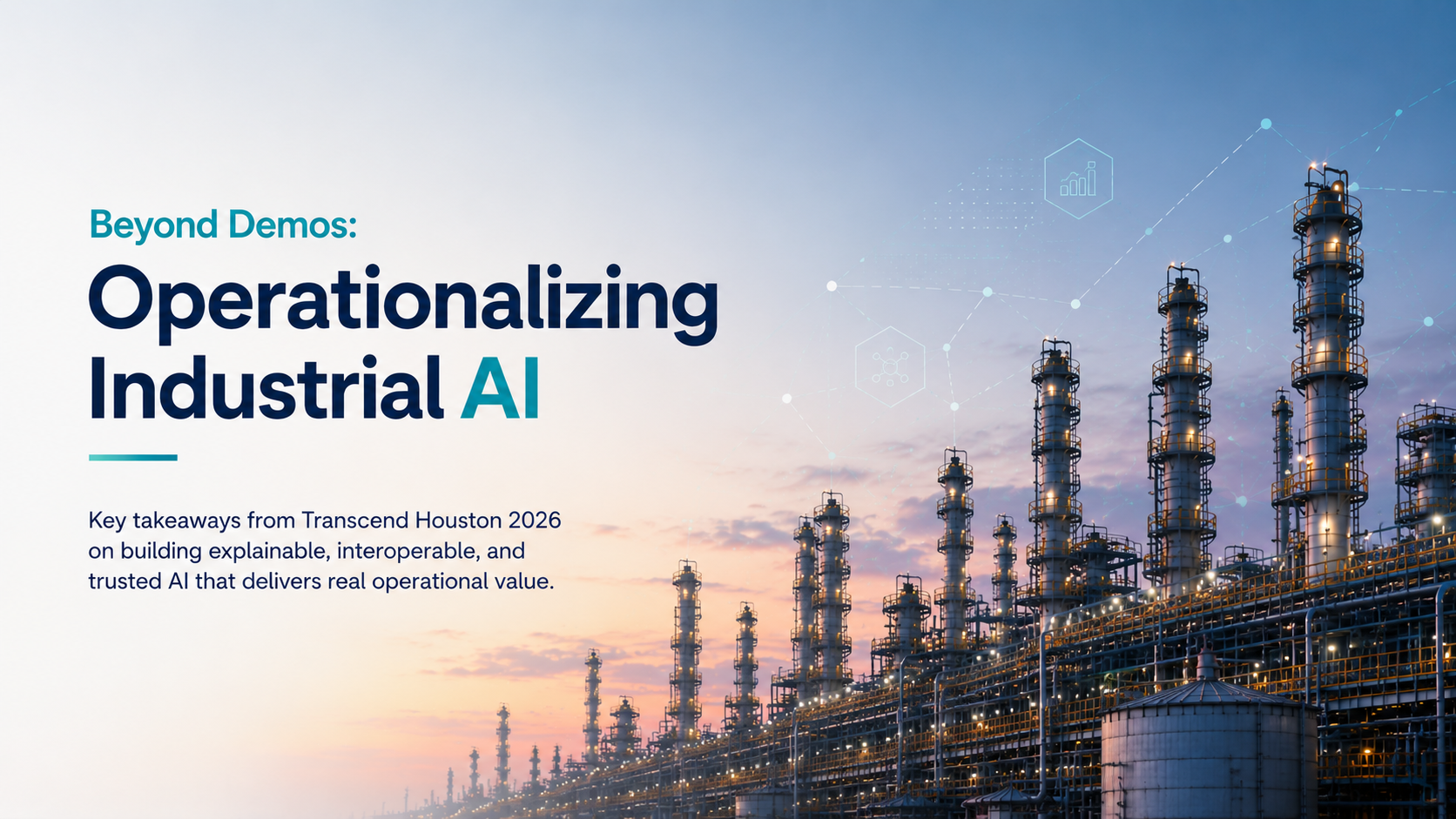
At Transcend Houston 2026, something unusual happened.
Leaders from refining, chemicals, cement, and other process industries arrived with different operating models, different levels of digital maturity, and different approaches to AI adoption. But as conversations unfolded throughout the day, a common pattern emerged with surprising clarity.
The friction points were nearly universal.
Operators struggling with systems that lacked transparency. Engineers fighting fragmented workflows and disconnected tools. Teams working to sustain optimization gains across shifts and organizational boundaries. Experienced personnel retiring while operational complexity continued to increase.
What became increasingly clear throughout the event was that these were not isolated implementation challenges. They were structural operational realities appearing across process industries at the same time.
And once people began talking openly about them, the energy in the room shifted.
During roundtable discussions, attendees repeatedly recognized their own experiences in conversations from entirely different industries.
“I’m in a completely different sector, and we’re dealing with the exact same issue.”
That realization surfaced again and again throughout the day.
Not only on stage, but in hallway conversations, over lunch discussions, and during collaborative working sessions where operators, engineers, and technology leaders compared how they were navigating operational trust, explainability, organizational alignment, and decision-making at scale.
What stood out most was not simply the willingness to discuss these challenges candidly. It was the openness to learn from how others were solving them.
In many cases, the most persuasive voices in the room were not vendors or presenters at all. They were operators and industrial leaders already applying these systems inside their own environments, openly sharing what was working, where friction still existed, and how their organizations were evolving operationally.
Customers were not simply listening to presentations. They were teaching each other.
By the end of an eleven-hour day, the rooms were still full.
Not because industrial AI is still a novelty.
But because the industry is entering a new phase, one where the central challenge is no longer proving that AI can generate value.
The challenge now is operationalizing intelligence across people, workflows, systems, and decisions in environments where trust, continuity, and coordination matter as much as optimization itself.
For years, much of the industry conversation focused on models, interfaces, and individual AI capabilities. But increasingly, leaders are realizing the challenge is not simply building more intelligent tools.
It is coordinating intelligence across operational environments that are already fragmented.
Planning teams, economics teams, operators, engineers, and plant leadership are often directionally aligned toward the same business outcomes. But in practice, they frequently operate through disconnected systems, disconnected workflows, and different interpretations of operational reality.
One team optimizes for throughput.
Another for reliability.
Another for energy efficiency.
Another for economics.
None of those goals are inherently contradictory. But without coordination across systems and disciplines, local optimization can unintentionally create operational friction somewhere else in the plant.
This is where the conversation around industrial AI is beginning to fundamentally shift.
The next phase will not be defined by isolated copilots, standalone dashboards, or every organization building its own disconnected version of an LLM.
Industrial environments will inevitably operate across multiple systems, multiple agents, and multiple sources of operational intelligence. The challenge is no longer simply generating insights. It is coordinating them.
That is the role of Coordinated Operating Strategies.
Not replacing human expertise.
Not centralizing every decision into a single system.
But creating operational environments where people, systems, process knowledge, and AI-driven intelligence remain grounded in the same operational reality and aligned toward the same operational objectives.
At Transcend, that shift became tangible during the Hackathon sessions.
What stood out was not simply the technology itself, but the removal of friction between people and operational understanding.
Instead of navigating hundreds of files, disconnected dashboards, fragmented reports, and manually assembled context, participants were able to interact directly with live operational information through an MCP-first architecture designed around interoperability and accessibility.
The experience changed the nature of the questions people asked.
Not questions about where data lived.
Not questions about which system owned which workflow.
Real operational questions:
What is happening right now?
Why is it happening?
What changed?
What operational context matters?
What actions are available?
For many participants, this became the clearest expression yet of what industrial AI can look like when operational intelligence becomes composable, explainable, and accessible across systems rather than trapped inside them.
That accessibility matters because industrial environments are not lacking data. They are overwhelmed by disconnected context.
Critical operational knowledge still lives across individual shifts, spreadsheets, historians, reports, dashboards, and human experience that is often difficult to preserve or operationalize at scale.
The industry still sees engineers firefighting many of the same operational issues that existed ten years ago, not because the problems themselves are unsolvable, but because the learnings were never captured, connected, or operationalized in ways that could continuously improve future decision-making.
Manufacturing knowledge leakage is real.
And increasingly, industrial organizations are recognizing that the ability to consume, contextualize, and operationalize operational intelligence in real time is not a future aspiration. It is an immediate operational requirement.
This is also why explainbility and deterministic AI continue to matter so deeply in industrial environments. As Colin Masson of ARC Advisory Group recently noted, the future of industrial AI depends on open, interoperable systems that operators and engineers can understand, trust, and operationalize within real production environments.
Trust is not built through abstraction.
It is built operationally.
Operators do not need to understand every mathematical detail behind an optimization system. But they do need to understand why recommendations are being made, what operational conditions influenced them, and how those recommendations connect to the physical realities of the plant around them.
Trust is built through consistency.
Through transparency.
Through reinforcement over time.
Through systems behaving reliably under real operating conditions.
The conversations throughout Transcend reinforced that industrial AI adoption is becoming less about experimentation and more about operational integration.
And increasingly, organizations are realizing they do not need another disconnected AI sandbox.
They need coordination.
Coordination across disciplines.
Coordination across systems.
Coordination across operational context.
Coordination between human expertise and machine intelligence.
Because industrial operations do not happen inside isolated workflows.
They happen across planning teams, economics teams, operators, engineers, historians, control systems, and operational decisions that continuously influence one another in real time.
The organizations moving fastest are beginning to recognize that no single model, no single interface, and no single vendor will own every layer of industrial intelligence.
Industrial environments will inevitably operate through ecosystems of agents, applications, optimization systems, and operational tools.
What matters is whether those systems can work together coherently.
This is why MCP-first architectures matter.
Not as a technology trend.
As an operational necessity.
The excitement throughout the Hackathon sessions was not simply about faster interfaces or more accessible AI. It was about watching operational intelligence become coordinated in ways that felt immediately practical.
Questions that once required navigating hundreds of files, fragmented systems, and disconnected sources of operational context became accessible in real time.
Operational knowledge that previously lived inside individuals, shifts, or siloed systems became actionable across teams.
And perhaps most importantly, people could see themselves inside the workflow instead of outside it.
That shift matters because the next phase of industrial AI will not be won by organizations building isolated tools.
The companies that get this right will own the next decade of process industry performance. The ones still chasing isolated copilots will get there last, if at all.