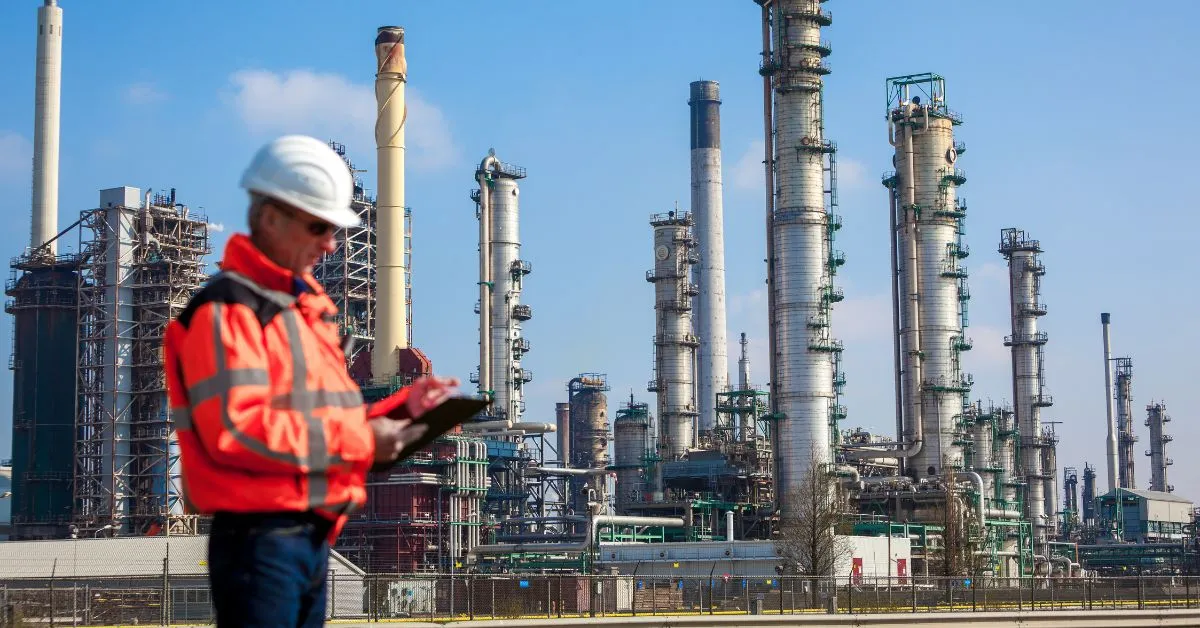
Self-optimizing industrial plants use AI, sensors, and real-time data to autonomously adjust operations, addressing costly issues like unplanned downtime, quality deviations, and resource waste. A four-stage roadmap guides this transformation, beginning with building a data foundation, moving to predictive insights, piloting closed-loop AI optimization (AIO), and finally scaling across the plant. This shift offers significant production gains, improved sustainability, and a more efficient workforce.
Modern industrial plants grapple with a triad of costly inefficiencies: unplanned downtime that can escalate to thousands of dollars per hour, frequent quality deviations that necessitate product rework or rejection, and inefficient resource usage that inflates operating expenses. Advanced AI in industrial processing plants has shown a promising path forward, with McKinsey research indicating that AI implementation has led to a 10-15% rise in production and a 4-5% increase in EBITA in such settings.
Self-optimizing plants mark a transformative step in addressing these inefficiencies by enabling continuous and autonomous optimization of operations. These plants dynamically adjust production processes, significantly reducing downtime, enhancing quality, and improving resource utilization.
To guide plant managers in transitioning towards self-optimization, a structured four-stage roadmap can be followed. This roadmap not only aids in setting up the necessary digital foundation but also focuses on practical implementation strategies, transforming theoretical possibilities into real-world advancements and offering a sustainable operational model that effectively curtails existing industrial inefficiencies.
A self-optimizing plant combines sensor data, historical context, and domain expertise in real-time to fine-tune set points without waiting for an operator’s attention. This environment merges industrial AI, high-fidelity IIoT sensors, and real-time orchestration to autonomously adjust production for higher efficiency, tighter quality, and safer conditions. Unlike conventional automation that follows static logic, these systems keep learning—each run becomes training data for the next, so the plant continually improves its own performance.
The impact shows up directly on your balance sheet. Unplanned outages that once cost tens of thousands (or even far more) per hour get slashed because equipment health is monitored continuously and maintenance is triggered only when it matters. Demand for such condition-based strategies is expected to grow at about 10% annually, underscoring the value process industry leaders already see. Material, energy, and water use drop as the system balances flows against real-time constraints.
Quality improves because AI models spot drift before it pushes product into non-prime territory, while adaptive control keeps energy intensity low, directly supporting sustainability targets. These plants also streamline inventory and supply scheduling by connecting production forecasts to ERP data, turning what used to be rear-view reporting into live course correction.
Decisions that once bounced between departments are executed instantly, giving you faster collaboration, more consistent quality, and a workforce freed to focus on higher-value problem solving rather than constant firefighting. A self-optimizing plant doesn’t just automate—it compounds operational gains every hour it runs.
To embark on transforming into a self-optimizing plant, laying a strong digital and data infrastructure is the critical starting point. You can’t improve what you can’t measure, making data infrastructure foundational to any optimization initiatives.
Integrating essential data sources is the first step. These include process historians and control systems, which record valuable process data over time. Equipment health monitoring is crucial for maintaining asset integrity, while Laboratory Information Management Systems (LIMS) provide quality and compliance data. Enterprise Resource Planning (ERP) and production planning systems offer insight into production scheduling and resource management.
A readiness checklist ensures you have the basic provisions covered for this transformation:
Common pitfalls you might face include struggling with poor sensor calibration or dealing with data silos that limit data visibility. Address these by maintaining calibration schedules and adopting a unified platform to centralize and contextualize data.
With a strong data foundation in place, you can now shift from reactive monitoring to predictive decision-making. Advanced AI models, grounded in your plant’s actual operating behavior, forecast quality swings, energy spikes, or equipment stress before they impact production. Real-time data streams feed into a dynamic process model—like a digital twin—providing a safe environment to evaluate process changes, spot optimization opportunities, and enhance operator training.
Begin with a focused effort: target a high-impact constraint such as an energy-intensive furnace or a quality-critical reactor. Connect live data, set up early-warning alerts, and ensure recommendations are trusted by operators on the floor. As these recommendations are accepted, the model continuously refines itself—without manual tuning.
Track value through tangible outcomes: accuracy of predictions, hours of downtime avoided, non-prime production reduced, and early-warning time gained. Starting with one or two priority constraints helps avoid analysis paralysis, deliver early wins, and build confidence toward full-plant optimization.
AIO solutions bring real-time action to your plant by letting industrial AI models not only predict the best operating targets but also write those targets directly to your control system. Traditional advanced process control still relies on static models and periodic tuning. AIO technology continuously learns from fresh data and adapts to new constraints, closing the loop without waiting for manual intervention. Early pilots in refining and chemicals have shown that such closed-loop approaches can lift yield and cut energy use within months, according to field reports on AI control.
Before you scale AIO across the complex network of units, a focused pilot helps you prove value and harden the workflow. Start by defining the win—pick one unit with a clear business goal like higher throughput, tighter quality, or lower energy intensity, and lock in the KPIs. Next, check your data foundation by confirming historian continuity, sensor accuracy, and cyber-secure connectivity. Any gap will echo through the model.
Once your data is solid, prep and unify it so everything lands in a single platform the model can digest. Clean, time-sync, and contextualize the information streams. Then build the model by combining first-principles understanding with AI techniques.
Wiring into controls comes next—map model outputs to DCS tags, then shadow-run so operators can compare AI recommendations with current settings. Phase the cutover by moving from advisory to partial automation, and finally to full closed-loop mode once performance is verified. Stand up MLOps practices to schedule retraining, monitor drift, and document every change so compliance teams stay comfortable.
Obstacle: Black-box Concerns
Solution: Implement transparent feature importance dashboards and hold daily stand-ups to discuss model logic with your team. Build operator trust gradually by keeping manual override capabilities active and mandating sign-off during the first weeks of autonomous control.
Obstacle: Safety Risks
Solution: Establish hard-coded parameter bounds and interlocks in the control layer to prevent excursions, as advised in chemical-industry studies on closed-loop control.
Obstacle: Model Drift
Solution: Deploy continuous performance alerts that trigger automatic retraining or fallback to previous models, ensuring the loop never goes rogue.
Run the pilot with this discipline and you demonstrate tangible gains—often within a quarter—building the momentum needed for plant-wide optimization.
After a pilot proves autonomous optimization’s profitability, your priority becomes scaling across your entire site and fleet. Create a reusable playbook from your pilot’s data architecture, model workflows, and decision rules. Tailor each deployment to local needs while maintaining core AIO consistency. This “digital thread” enables shared data and expertise without sacrificing plant-specific requirements.
Governance structures determine implementation pace and safety. Choose between centralized (specialists build models for all sites), distributed (local champions own tuning), or the hybrid approach most industry leaders prefer—central standards with local adaptation. Maintain value through quarterly KPI reviews, model retraining when conditions change, and cross-functional optimization sessions.
Automated MLOps systems ensure model versioning and reliability between reviews. People ultimately sustain autonomous plants. Develop upskilling paths for operators, pair experienced engineers with new hires to transfer knowledge, and publicly celebrate successes to cultivate an AI-literate culture where everyone has ownership.
Before technology reaches the control room, mapping the people who can accelerate or stall your journey becomes critical. In a refinery or chemical complex, key stakeholders typically include:
Maintaining implementation momentum:
When every stakeholder sees their own victory in the roadmap, approval cycles shorten and the transition to an autonomous plant moves from concept to reality.
Before scaling your AIO solution, establish clear metrics to prove its value. Finance teams typically evaluate Simple Payback (investment divided by annual savings), Net Present Value (discounted future cash flows), and Internal Rate of Return (percentage return—ideally above cost of capital).
Beyond financials, track sustainability metrics including energy per production unit, CO₂ per tonne, water usage, and waste reduction. These intelligent systems reduce flaring events and excursions, creating improvements critical for sustainability reporting and compliance requirements.
For workforce impacts, measure operator adoption rates, training efficiencies, incident resolution time, and cross-skilling achievements. As engagement increases, employee satisfaction typically follows, providing people-centric metrics that complement your financial and environmental gains.
If you’re ready to translate the vision of an autonomous plant into day-to-day reality, the Imubit Industrial AI Platform provides the shortest path. Its Closed Loop AI Optimization solution uses deep reinforcement learning to learn your plant-specific operations, then drives real-time action directly through existing APC layers—so you capture production gains without expanding capital.
Get a Complimentary Plant AIO Assessment to discover your optimization potential. Our experts will evaluate your current operations, identify high-value optimization opportunities, and provide a customized roadmap to self-optimization.