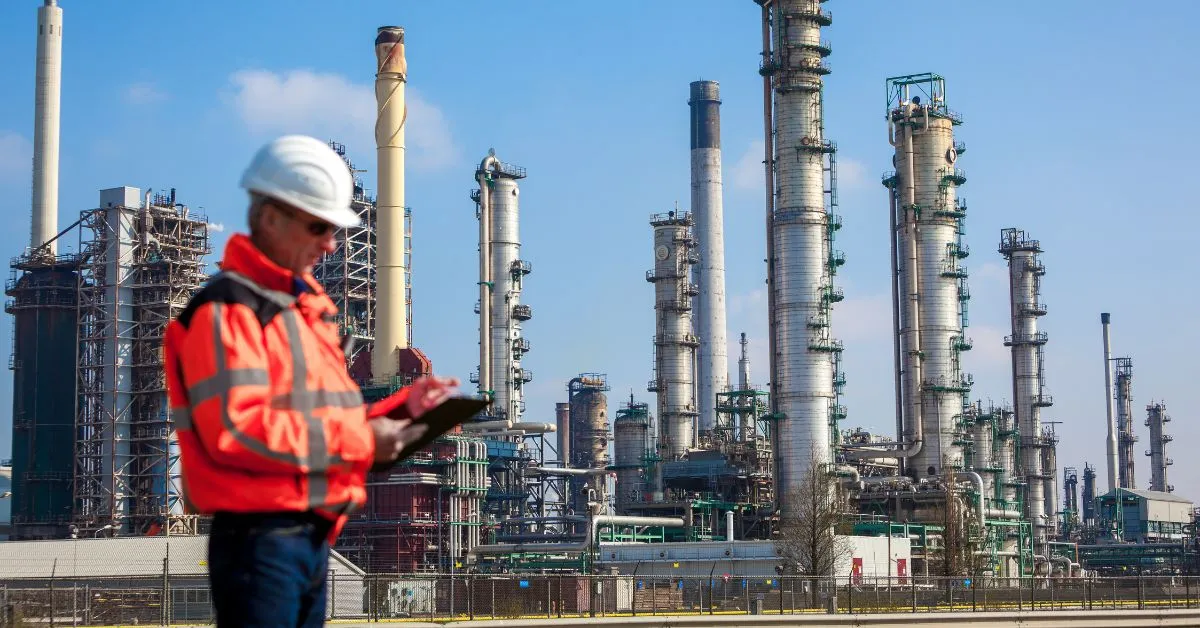
Big West Oil runs a 36,000 barrel-per-day, high-conversion refinery in North Salt Lake City, Utah. To compete with larger, vertically integrated refiners, the team set out to close the gap between plan and plant on its most constrained units, and partnered with Imubit to bring Closed-Loop Physical AI to the decisions that cost the site the most margin. The work is described in "Plantwide AI optimisation and beyond," co-authored by Travis Legrande (Operations Technical Specialist, Big West Oil) and Mitchell McCloud (Imubit) and published in PTQ Q3 2025. The summary below covers what the team did, what changed, and what they learned.
The fluid catalytic cracker (FCC) was the first priority. For years its conversion had been capped by debutanizer throughput, so relieving that bottleneck promised higher conversion, more valuable yields and better unit margin. The broader goal was to coordinate decisions across the whole diesel pool: ULSD flash giveaway, hydroprocessing reactor performance, crude unit molecular management and the trade-offs between distillate hydrotreater feeds as seasonal specifications change.
Leadership also saw modern tools as a way to attract and keep the next generation of engineers and operators, who learn on current technology at university and often find legacy systems when they arrive at a plant.
Learning process models need high-fidelity history. Big West's historian data was compressed in a way that limited what a model could learn, so the team changed how data was stored before any modeling began. The authors' guidance: decompress where possible and use several years of history that span different operating modes, economic cycles and feedstock incentives. If setpoints barely move over a unit's life, a model cannot learn the full range of cause and effect in the process.
Many people saw AI as a black box. Operators can switch any controller off, so the team treated trust as the critical path: transparency, involving everyone affected by the change and training throughout. As the authors put it, "Build trust. Build it early and build it often."
The first model was deliberately simple. On the debutanizer, operators could follow the controller's moves, and tower operation improved within a day or two. That early win created room to push throughput.
Big West planned a sitewide rollout from the start, which required standard IT infrastructure, repeatable development and deployment processes, and governance that fit the site's existing change management.
Each application was built on Imubit's Deep Learning Process Control® (DLPC®) in three layers, moving a decision from engineering judgment to supervised autonomous execution:
The controller runs in closed loop on-premise, writing to the site's existing APC and DCS rather than replacing them, and stays fully isolated from the cloud training environment to meet safety and cybersecurity standards. Operators set the constraints and targets and can take control at any time. A cloud copy lets operators and engineers explore strategies offline.
Console operators, process engineers and leadership helped define each application. At commissioning, operators learned to set constraints and targets and to read the controller's moves, and regular check-ins with operations, engineering and leadership keep the applications aligned with refinery KPIs.
The undersized debutanizer often ran near or beyond flood, which made clean separation of cat gas and olefins difficult and capped FCC conversion. Operators ran it conservatively, and results varied from shift to shift. A closed-loop DLPC® application took over the two main handles, reboiler duty and reflux return temperature, with senior operators validating its predictions along the way.
Result: debutanizer throughput rose 2%, easing the FCC conversion limit. More C5 moved into cat gas, cutting excess olefin production and adding gasoline blending flexibility.
The HDS stripper removes light material from hydrotreated diesel. Because of frequent flooding and measurement variability, the site held a 5 to 10°F buffer above the ULSD flash specification, which cost diesel volume. Engineers and Imubit made reboiler return temperature and overhead temperature the control handles and built a ULSD flash inferential for real-time predictions.
Result: flash variability fell significantly, and operators stepped the target down toward the specification, cutting flash giveaway by about 4 to 5°F.
Training had relied on shadowing experienced operators, and commercial training simulators were expensive and generic. The team built common upsets, including feed rate changes, cooling disruptions and reflux limits, into the DLPC® controllers so operators could practise recovery offline. Friendly competition for the best economic result made sessions engaging, and operators learned that continuous, simultaneous adjustments beat step changes. That practice spread to consoles not yet running closed-loop control, and the training approach has since expanded to other units.
Big West plans to extend closed-loop control to more refining units, coordinating operating strategies across the site as seasonal specifications, opportunity feedstocks and decarbonization goals shift.
Read the full article: "Plantwide AI optimisation and beyond," PTQ Q3 2025, by Travis Legrande (Big West Oil) and Mitchell McCloud (Imubit).